Brazilian · Main Course
Picanha
A whole beef rump cap, its fat scored and left on, grilled over live coals and carved into thin slices against the grain.
Not the same asChurrasco (Churrasco is the wider mixed-grill method that picanha is often cooked within, alongside ribs and sausage; this entry is the single cut, grilled and carved on its own.)
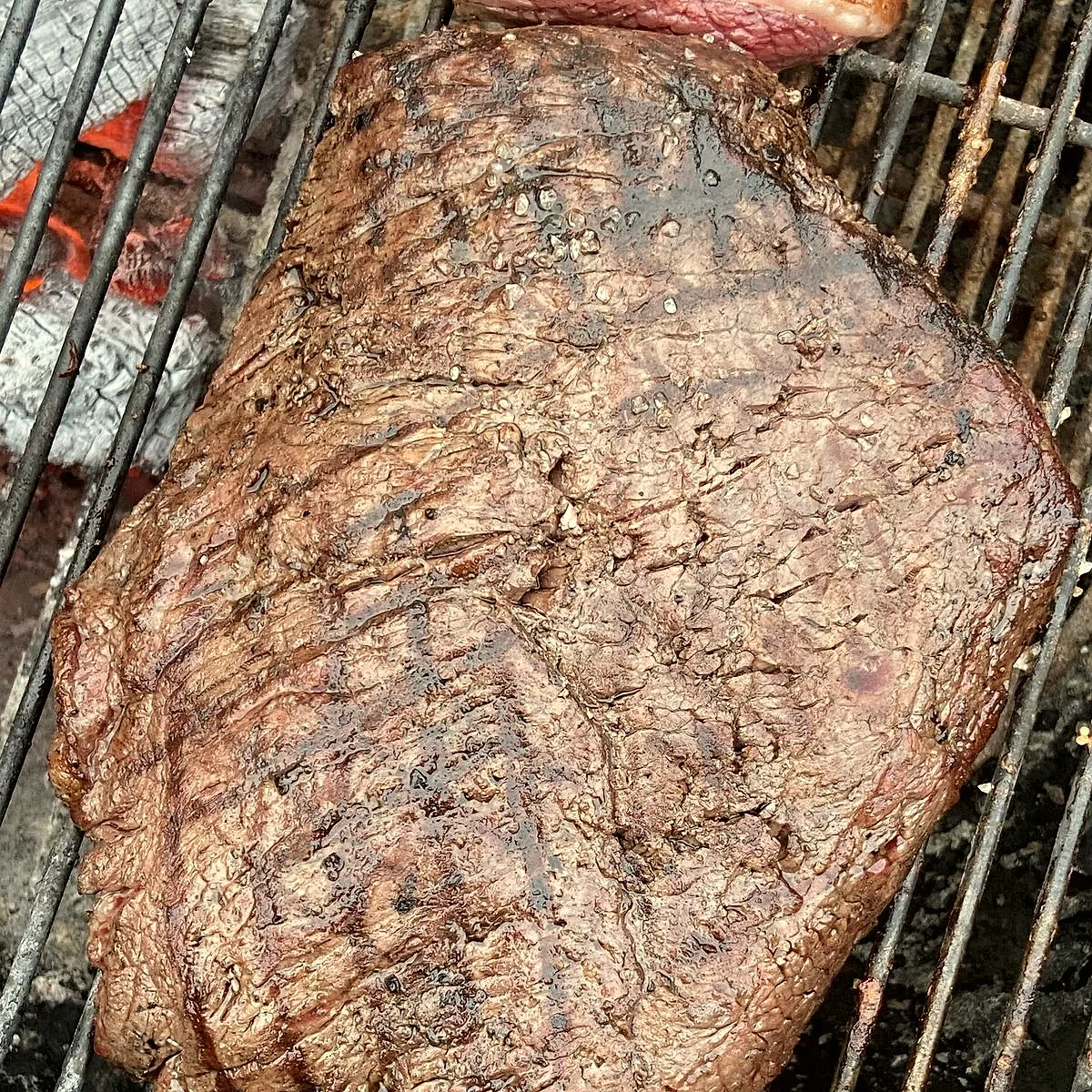

CC BY-SA 4.0. Cropped and colour-adjusted for this site.
Method
Score the fat cap of the 900 g picanha in a shallow crosshatch, without cutting into the meat beneath it, and curve the piece into a loose crescent. Season all over with the 12 g fine sea salt.
Curving the piece into a loose crescent before it goes on the fire, rather than leaving it flat, is what gives every slice cut from it an even edge of fat once it is carved; a flat piece grills unevenly across its width.
Light a wood or charcoal fire and let it burn for 30m, until it has settled into a steady bed of glowing coals.
Set the picanha fat side down over the fire and cook for 15m, until the fat has rendered and turned deeply browned and crisp.
Common pitfallStarting the lean side down instead of the fat renders very little of the fat into the meat and leaves it a pale, unrendered layer rather than the deeply browned crust the cut is known for. The fat side always goes down first.
Turn the picanha and continue grilling for 15m, turning as needed, until it reaches a firm medium throughout.
Move the picanha to a board and rest for 10m.
Slice thinly across the grain and serve at once.
The word "picanha" is usually traced to picana, a pointed pole used across the Iberian Peninsula to drive cattle, applied to the animal's hindquarters, the same part of the animal the cut itself comes from [1][2]. The connection between the tool and the meat is plausible rather than documented, and it is one of at least two competing etymologies in circulation, which is a familiar problem for a word that entered everyday Portuguese long before anyone thought to write down where it came from.
The cut's history as something sold on its own, rather than left attached to the larger rump roast, is easier to pin down and more surprising: it appears to be a mid-twentieth-century São Paulo invention rather than an old gaúcho tradition. Laszlo Wessel, a Hungarian immigrant who opened a butcher shop in the Bixiga neighbourhood of São Paulo in 1957, is credited by his son with being the first butcher to separate picanha from the alcatra, the larger rump cut it comes from, around 1959, reportedly at the request of German immigrant customers who wanted the cut for Tafelspitz, an Austrian boiled beef dish, rather than for grilling at all [2]. Only from that separate cut did picanha go on to become the centrepiece of Brazilian churrascarias.
From there its path outward is clearer. Brazilian steakhouses carried the cut abroad as they expanded internationally from the 1990s onward, and it reached Portugal and other markets largely through Brazilian communities and restaurants rather than through any older shared tradition [1][2]. Because only a small portion of each animal yields a true picanha, its international fame has made it a comparatively scarce and prized cut wherever it travelled, a long way from a butcher's shop in Bixiga separating it out for customers who wanted it boiled, not grilled.
Sources
- Picanha, WikipediaTraces the name to "picana," a cattle-prodding pole used in the Iberian Peninsula, and describes the cut's spread into Portuguese and international steakhouses in the late twentieth century.
- Picanha: do Brasil para o mundo, Revista Problemas BrasileirosInterviews the son of the Hungarian-born butcher Laszlo Wessel, who is credited with first separating picanha from the rest of the rump around 1959.