Chinese · Bread
Mantou
A plain, faintly sweet steamed wheat bun, leavened soft and white, eaten alongside a meal in place of rice.
Also known asChinese steamed bun
Not the same asManti (The Turkish and Central Asian boiled or steamed dumpling of the same root name, which is small, filled with meat, and served under yoghurt and a spiced butter, rather than a plain unfilled bun eaten as bread.)
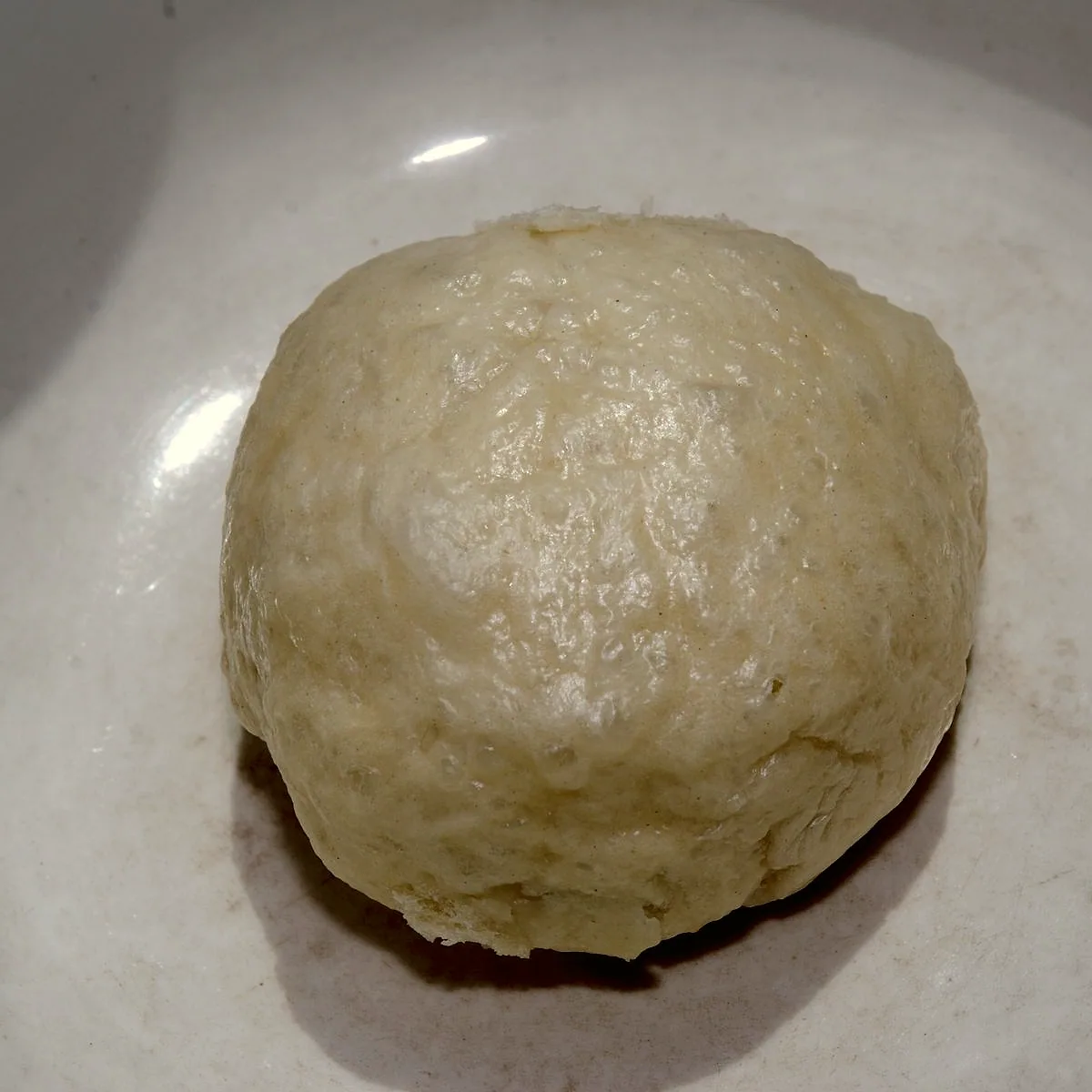

CC BY-SA 4.0. Cropped and colour-adjusted for this site.
Method
Stir the 5 g dried yeast into the 240 ml water and set aside for 10m, until foamy.
Combine the 480 g plain flour, 40 g caster sugar and 5 g baking powder in a large bowl, then pour in the yeast mixture and bring together into a shaggy dough.
Turn the dough out onto the 20 g plain flour and knead for 10m, until smooth, elastic and no longer tacky.
Return the dough to the bowl, cover and leave to prove somewhere warm for 1h, until roughly doubled in size.
Knock the dough back and roll it into a log, then divide it into even pieces and shape each into a smooth, taut bun. Set each on a small square of baking paper.
Cover the shaped buns loosely and leave to prove for a further 20m, until visibly puffed.
Arrange the buns in a steamer basket with space between each to allow for expansion, and steam over gently simmering water for 12m, until risen, glossy and firm to the touch. Turn off the heat and let the steam settle briefly before lifting the lid.
Common pitfallLifting the lid before the steamer has fully cooled lets a rush of cold air hit the buns, and they collapse and wrinkle. Turn off the heat and let the steam settle for a minute before uncovering.
Mantou's early history is harder to pin down than its best-known story suggests. Its popular origin story is set in the Three Kingdoms period, roughly seven centuries before the plain-and-filled split described below, and credits the strategist Zhuge Liang with inventing the bun. Campaigning south of a river that local custom held could only be crossed after sacrificing fifty men, Zhuge Liang is said to have refused the killing and instead had his cooks shape meat-stuffed dough into rough approximations of human heads, offering these to the river spirit in place of real ones, hence mántóu, "barbarian's head" [2]. It is a vivid story and, on the written record, an unverifiable one: it survives as popular legend and folk etymology rather than as a documented event contemporary with Zhuge Liang's own lifetime [1] [2].
What is better attested is the later split between mantou and baozi. By the tenth century, mantou had narrowed to mean a plain, unfilled steamed bun, while the filled version went its own way under the name baozi [2]. That division still holds: mantou today is bread in the most literal sense on a northern Chinese table, torn and dipped or eaten alongside a dish rather than filled with one, while its stuffed relative is a dish in its own right.
Sources
- Mantou, WikipediaFlags the Zhuge Liang story as folk etymology rather than a documented event.
- Take a Bao — The Steamed Buns of China, Great British ChefsCovers the same Three Kingdoms legend and the tenth-century split between plain mantou and filled baozi.