Armenian · Bread
Lavash
A paper-thin wheat dough rolled almost translucent and baked in well under a minute against ferocious, direct heat. Makes one batch of thin sheets; the nutrition panel is for one sheet.
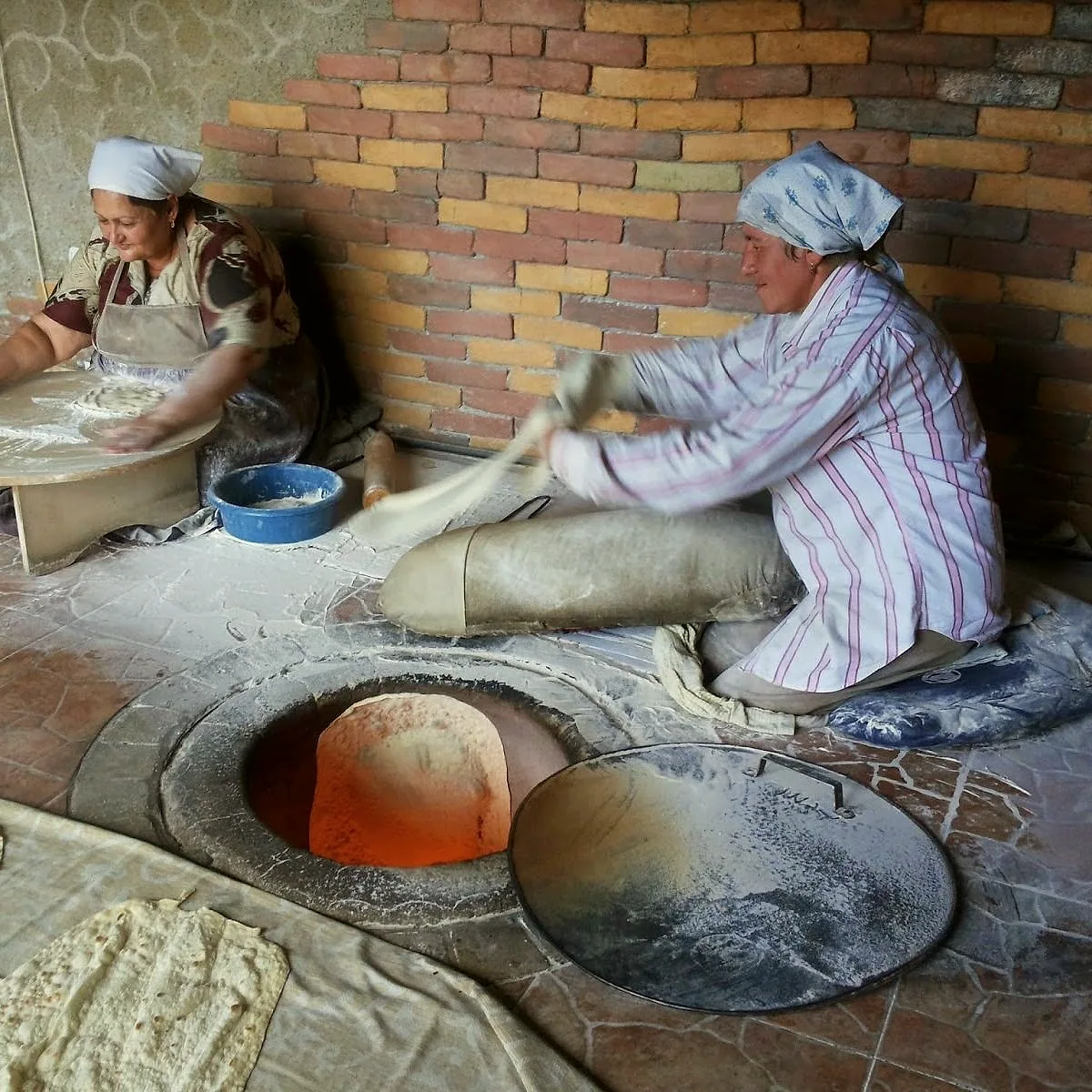

CC BY 4.0. Cropped and colour-adjusted for this site.
Method
Stir the 3 g dried yeast into the warm 240 ml water and leave it for a few minutes until foamy. Combine the 400 g bread flour and 8 g fine sea salt in a large bowl, pour in the yeasted water, and bring it together into a rough dough. This takes 8m.
Turn the dough out and knead for 10m, until smooth, elastic and no longer sticky.
Cover the dough and leave it to prove somewhere warm for 1h, until roughly doubled.
Knock the dough back and divide it into equal pieces, shaping each into a ball. Cover and let them rest for 10m, so the gluten relaxes before rolling.
Heat a baking stone or steel on the floor of the oven to its highest setting. Roll each ball out as thin as possible, close to translucent, and lift it carefully onto the hot stone. Bake until puffed and lightly spotted with brown, then remove immediately. Repeat with the remaining dough, spending 25m in total, and stack the sheets to cool under a cloth.
Rolling the dough close to translucent is what lets it bake through in under a minute: anywhere thicker and the surface blisters and burns against the intense heat before the centre sets.
Common pitfallA domestic oven cannot match a clay tonir's direct wall heat. Baking on a stone or steel preheated as hot as the oven allows, on the floor of the oven rather than a shelf, is the closest substitute.
Lavash is baked directly against the wall of a tonir, a conical clay oven sunk into the ground: a ball of wheat dough is rolled paper-thin, stretched over a cushioned pad, and slapped onto the hot inner wall, where it cooks in well under a minute and is pulled off before it can burn [1]. Made this thin, it keeps for months once dried, and is torn or rehydrated as needed rather than baked fresh for every meal [1].
Exactly whose bread it is depends on who is asked. Armenia, Azerbaijan, Turkey and Iran all lay some claim to it [2][4], and even researchers making the case for Armenian lavash specifically concede that closely similar thin flatbreads exist across the wider region and beyond, distinguishing the Armenian version by details of technique (a deeper tonir, dug to suit a fuel-poor terrain) rather than by any claim to sole invention [3]. None of these claims can be fixed to a single point of origin: thin, clay-oven flatbread of this general kind appears to be an old, broadly shared solution across the region rather than the invention of any one kitchen [2][3].
That contest became public in 2014, when Armenia's nomination of lavash to UNESCO's Intangible Cultural Heritage list, submitted under a title that called it "traditional Armenian bread," drew a formal objection from Azerbaijan, which lobbied UNESCO through multiple channels to have the decision reversed after the fact [2][3]. UNESCO inscribed it that year under the more careful title "an expression of culture in Armenia" rather than "Armenian bread," and its committee explicitly noted that lavash "is shared by communities in the region and beyond," discouraging language like "unique" or "original," and a joint nomination from Azerbaijan, Iran, Kazakhstan, Kyrgyzstan and Turkey covering the wider regional tradition of flatbread-making followed two years later [2][1].
What is not in dispute is the bread's place in Armenian ritual life specifically: it is baked communally, largely by women passing the skill down to younger girls as they help, and a sheet of it is laid across the shoulders of a newly married couple as a wish for fertility and prosperity [1].
Sources
- Lavash, the Preparation, Meaning and Appearance of Traditional Bread as an Expression of Culture in Armenia, UNESCO Intangible Cultural Heritage ListsThe 2014 inscription record describing the preparation, its ritual role at weddings, and the intergenerational transmission of the craft.
- Lavash, WikipediaSets out the competing regional origin claims, the medieval textual record, and the 2014–2016 UNESCO listing dispute.
- UNESCO Recognition of Armenian Lavash, Horizon WeeklyIndependent report on the 2014 inscription and Azerbaijan's objection and attempt to have the decision reversed.
- Turkey, 3 other countries claim lavash as common heritage, Daily SabahTurkish national newspaper report naming Armenia, Azerbaijan, Turkey and Iran as claimants and covering the 2016 joint UNESCO submission.