Ethiopian · Bread
Injera
A large, spongy Ethiopian flatbread of fermented teff flour, cooked on one side only until its surface is covered in tiny open bubbles.
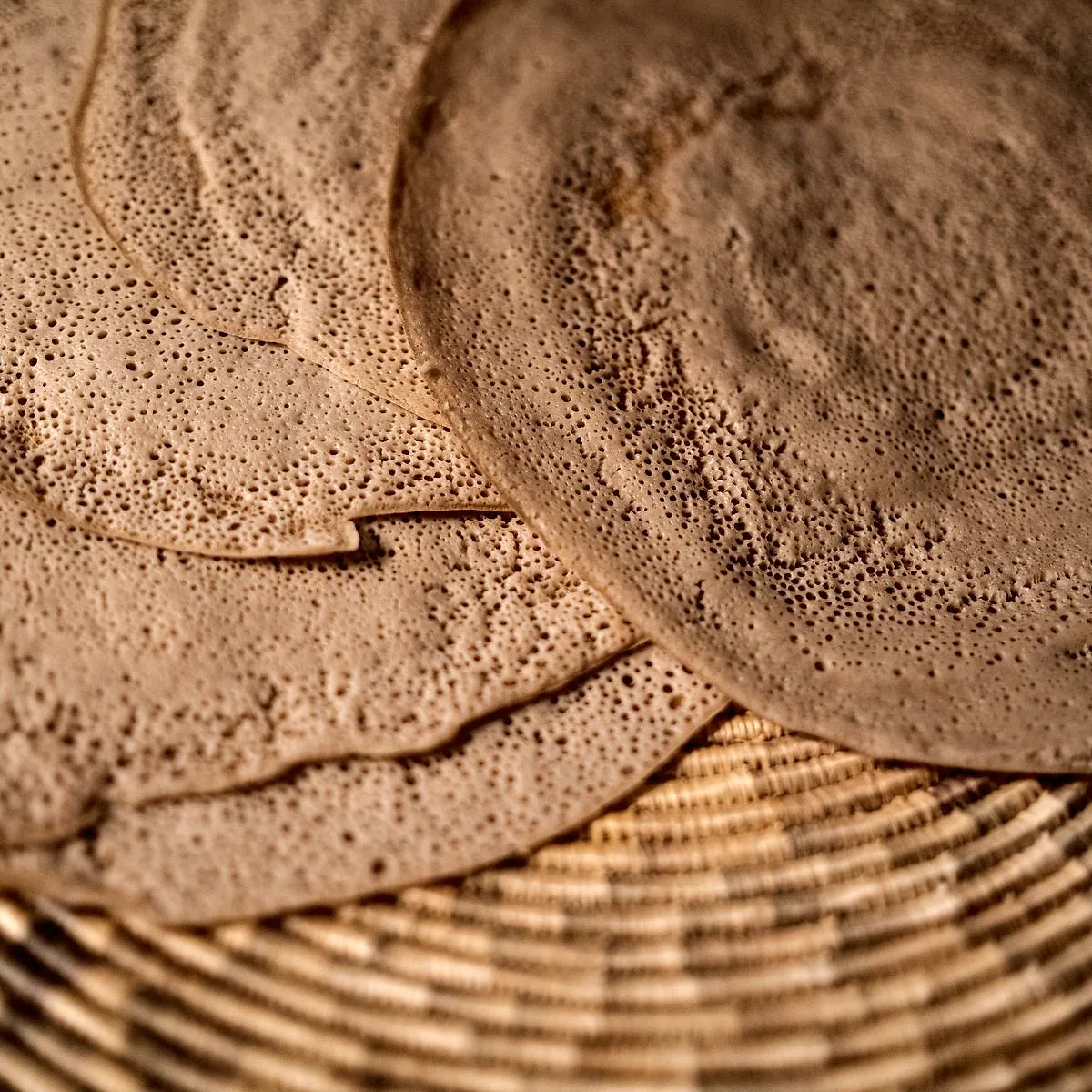

CC BY-SA 2.0. Cropped and colour-adjusted for this site.
Method
Whisk the 500 g teff flour and the 900 ml water together in a large bowl for 10m, until completely smooth and about as thin as double cream.
Cover the bowl loosely and leave it at room temperature to ferment for 72h, stirring once a day. The batter is ready when it smells sharply sour and a layer of clear liquid has separated on top.
The long fermentation is what makes injera injera; teff's own wild yeasts and bacteria need days, not hours, to build the sourness and the gas that riddles the batter with bubbles once it hits the hot griddle.
Pour off the separated liquid, then stir in the 5 g fine sea salt and enough of the 150 ml water to bring the batter back to a thin, pourable consistency, working for 5m.
Heat a large, flat, lightly seasoned griddle over a medium-high heat. Starting from the outside edge, pour the batter in one continuous thin spiral to fill the pan, without smoothing or spreading it further. Cover at once and cook for a share of 20m without turning, until the whole surface is covered in small open bubbles, has dried out, and lifts cleanly from the pan at the edge. Repeat with the remaining batter.
Common pitfallLifting the lid too soon lets steam escape before the surface has finished bubbling, leaving a patchy, half-formed set of eyes. It stays covered until the whole surface has visibly dried and set.
Teff itself is genuinely ancient. It was domesticated in the Ethiopian and Eritrean highlands, with cultivation generally dated to around the fourth millennium BC, making it one of the earliest grains people brought under cultivation anywhere [2]. That gives injera an old ingredient, but not necessarily an old date of its own: teff can be milled into porridge, roasted, or made into any number of things besides a fermented flatbread, and none of that history proves when injera specifically began.
The dish itself is harder to date. It is commonly said to have originated around 100 BC, but the botanists Robert B. Stewart and Asnake Getachew have pointed out that this figure is folklore rather than anything confirmed in the historical record, and that injera more plausibly arose by accident, when a batch of teff flour was left wet for several days and fermented on its own [1]. The oldest physical evidence for anything like the dish is archaeological rather than textual: mitads, the large flat griddles injera is still cooked on, have been found at sites dating back to around 600 AD, alongside evidence that also points to shiro, the chickpea stew commonly eaten with it [1]. That leaves a real gap between teff's deep cultivation history and the first hard evidence of the bread, one this page has no way to close, and states as a gap rather than a settled date.
What the long fermentation does is not really in dispute, whatever its origin story: days of wild fermentation build both the batter's sourness and the gas that gives the cooked bread its distinctive surface of small, even bubbles, known as its "eyes."
Sources
- Injera, WikipediaOn teff's domestication date, the archaeological evidence for mitad griddles, and the Stewart and Getachew assessment that the commonly cited origin date is folklore rather than a verified record.
- Teff History and Origin, Grand Teton Ancient GrainsOn teff's domestication in the Ethiopian and Eritrean highlands and its status as one of the earliest cultivated grains.