American · Side
French Fries
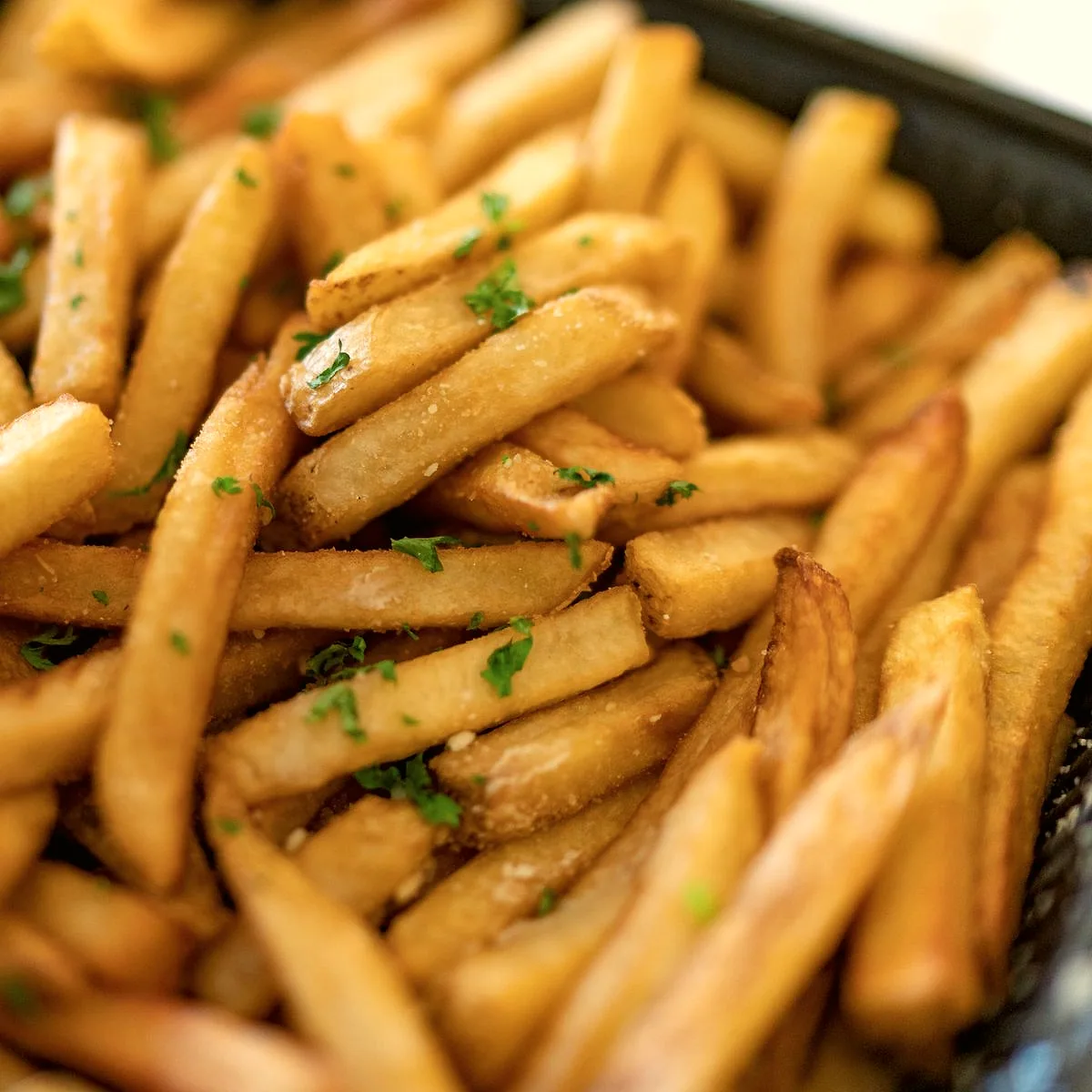
Potato batons double-fried, once to cook through and once to crisp the outside. One serving is one portion.
.jpg)
CC BY-SA 2.0. Cropped and colour-adjusted for this site.
Method
Rinse the cut 800 g potato and soak it in cold water for 30m, which draws out surface starch and helps the fries crisp rather than stick together. Drain and pat completely dry before frying.
Heat the 1.5 L vegetable oil in a deep, heavy pot to 130 °C, allowing 10m for it to come to temperature.
Fry the potato in batches at this lower temperature for 8m, until softened through but still pale, then lift out and drain.
Frying at a low temperature first cooks the potato through without colouring the surface; a single hot fry would brown the outside long before the centre softened.
Spread the par-fried batons out and let them cool and dry for 15m.
Raise the oil to 190 °C, allowing 8m to reach the higher temperature.
Fry the rested batons again, in batches, for 5m, until deep golden and crisp. Drain well and season immediately with the 5 g fine sea salt while still hot.
Common pitfallSkipping the rest between fries leaves the batons too hot and moist inside to crisp properly on the second pass. Letting them cool first is what gives the second fry a shatteringly crisp shell.
The popular Belgian version of this story holds that villagers along the River Meuse were already frying sliced potatoes in the winter of 1680, when the river froze and their usual small fried fish were unavailable. The story does not survive contact with the potato's own history: researchers have pointed out that potatoes were not yet grown in that part of the Meuse valley in 1680, arriving only decades later, around 1735, which would make a potato dish from 1680 there impossible [1].
A rival claim, argued in detail by the Belgian food historian Pierre Leclercq, places the dish instead among the street vendors of Paris's Pont Neuf bridge, who Leclercq traces to the 1780s selling sliced fried potatoes (the "pomme Pont-Neuf") as a portable street food, with deep-frying becoming established there by around 1800 [2]. Leclercq has also revisited the manuscript behind the Belgian story directly: the 1781 document once read as describing potatoes deep-fried "in the shape of small fish" instead describes thin slices pan-fried in a little fat, a different and much older technique that is not the dish in question [2]. Neither claim has the kind of unambiguous documentary evidence that would close the question outright, and the dispute between French and Belgian historians and officials continues without a clear resolution.
The English name adds a separate confusion rather than settling anything. American soldiers stationed in French-speaking Belgium during the First World War are generally credited with the name, assuming the fried potatoes they were served there were French because French was the language they heard [1]. The story is complicated by the fact that "French fried potatoes" already appears in American cookbooks and magazines in the 1890s, before that war, so the wartime soldiers may have popularised a name that already existed rather than coined it outright [1].
Sources
- The Origin of French Fries: Are They French or Belgian?, History CooperativeSets out and interrogates both the Belgian and French claims.
- Les grands mythes de la gastronomie : L'histoire vraie de la pomme de terre frite, University of Liège (ULiège)On food historian Pierre Leclercq's research locating the deep-fried potato's origin among Pont Neuf street vendors in Paris, and his re-reading of the Belgian manuscript once used to date the dish to 1680.