Brazilian · Main Course
Churrasco Brasileiro
Beef ribs, rump cap and sausage, salted plainly and grilled together over an open wood or charcoal fire, gaúcho style.
Not the same asPicanha (One specific cut, grilled whole in a fat-capped crescent and sliced against the grain to serve, rather than the wider mixed-cut, open-fire method churrasco describes.)Asado (The Argentine parrilla tradition, cooked on a grate over a banked fire with its own ordered sequence of achuras and cuts, distinct from the Brazilian gaúcho practice of skewering meat directly over open coals.)
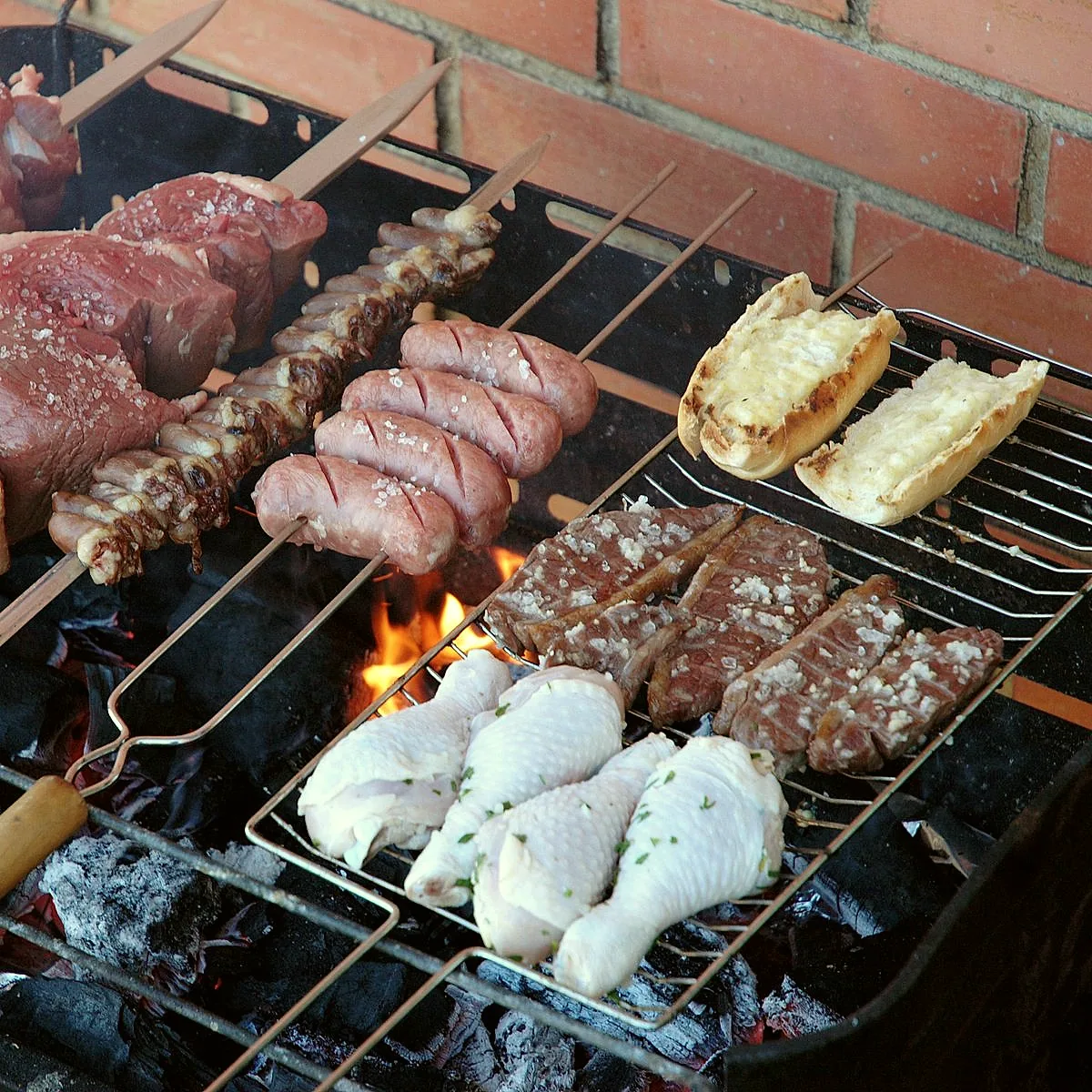

CC BY-SA 2.5. Cropped and colour-adjusted for this site.
Method
Season the 600 g raw beef short rib, 500 g picanha and 300 g linguiça all over with the 15 g fine sea salt. Thread each onto its own skewer, or leave the ribs whole to sit directly on the grate.
Light a wood or charcoal fire and let it burn for 30m, until it has settled into a steady bed of glowing coals rather than open flame.
Set the ribs over the fire, not too close to the coals, and cook for 1h 30m, turning occasionally, until the outside is deeply browned and the meat pulls easily from the bone.
Partway through, set the picanha over the fire fat side down and grill for 25m, turning once the fat has rendered and browned, until the meat is cooked through to a firm medium.
The picanha goes on fat side down first and stays there until the fat has rendered and browned, before it is turned to finish the lean side. Starting lean side down renders none of the fat into the meat and leaves the crust pale.
Add the sausage to the fire and grill for 20m, turning occasionally, until the casing is deeply coloured and it is cooked through.
Move everything to a board and rest for 10m.
Slice the picanha thinly across the grain, cut the ribs apart along the bones and slice the sausage, then serve everything together.
Common pitfallSlicing picanha with the grain, the way a long roast is often carved, leaves it noticeably chewier than the cut needs to be. It is sliced across the grain, against the direction the fibres run.
Churrasco's roots sit in the cattle economy that grew up around Spanish and Portuguese colonisation of what is now Rio Grande do Sul, where descendants of cattle introduced to the region multiplied across the grasslands much as they did on the Argentine side of the Pampas. The gaúchos who worked that land grilled meat over open fire as a practical way to eat on the range, seasoned with little beyond salt, because beef was abundant and there was rarely anything else on hand [1][2].
What is well established is the shared ancestry churrasco holds with Argentine asado: both grew from the same gaúcho fireside cooking practised across the connected grasslands of southern Brazil, Uruguay and Argentina, and the same reference tradition that describes asado explicitly names churrasco as that open-fire practice carried into Brazil under a different name [1][2]. National borders and separate culinary identities pulled the two apart only later, as each country built its own restaurant and household traditions on top of a fireside habit neither one invented alone. Brazil's version distinguishes itself today by cut and format rather than by seasoning alone: picanha, ribs and sausage threaded onto skewers or set whole over the coals, salted plainly and carved as each piece finishes, rather than the parrilla grate and ordered courses of an Argentine asado. The commercial rodízio restaurant, where skewered meats are carried table to table and carved to order, is a twentieth-century restaurant invention built on top of this older, practical fireside habit rather than a continuation of it.
Sources
- Churrascaria, WikipediaStates the shared gaúcho, fireside-roast origin of churrasco across southern Brazil, Argentina and Uruguay.
- Asado, Encyclopedia of Food and Culture (Encyclopedia.com)Reference-work entry describing the shared Río de la Plata gaúcho practice of grilling beef over an open fire, seasoned with salt, and naming churrasco as the same open-fire tradition under its Brazilian name.