
Skip to content
Markey
Theme: System (currently light)
Toyota emblem

Generation

Toyota Land Cruiser (J40)

Toyota Land Cruiser (J40), 1960-1985

Produced
1960–1985
Code
J40
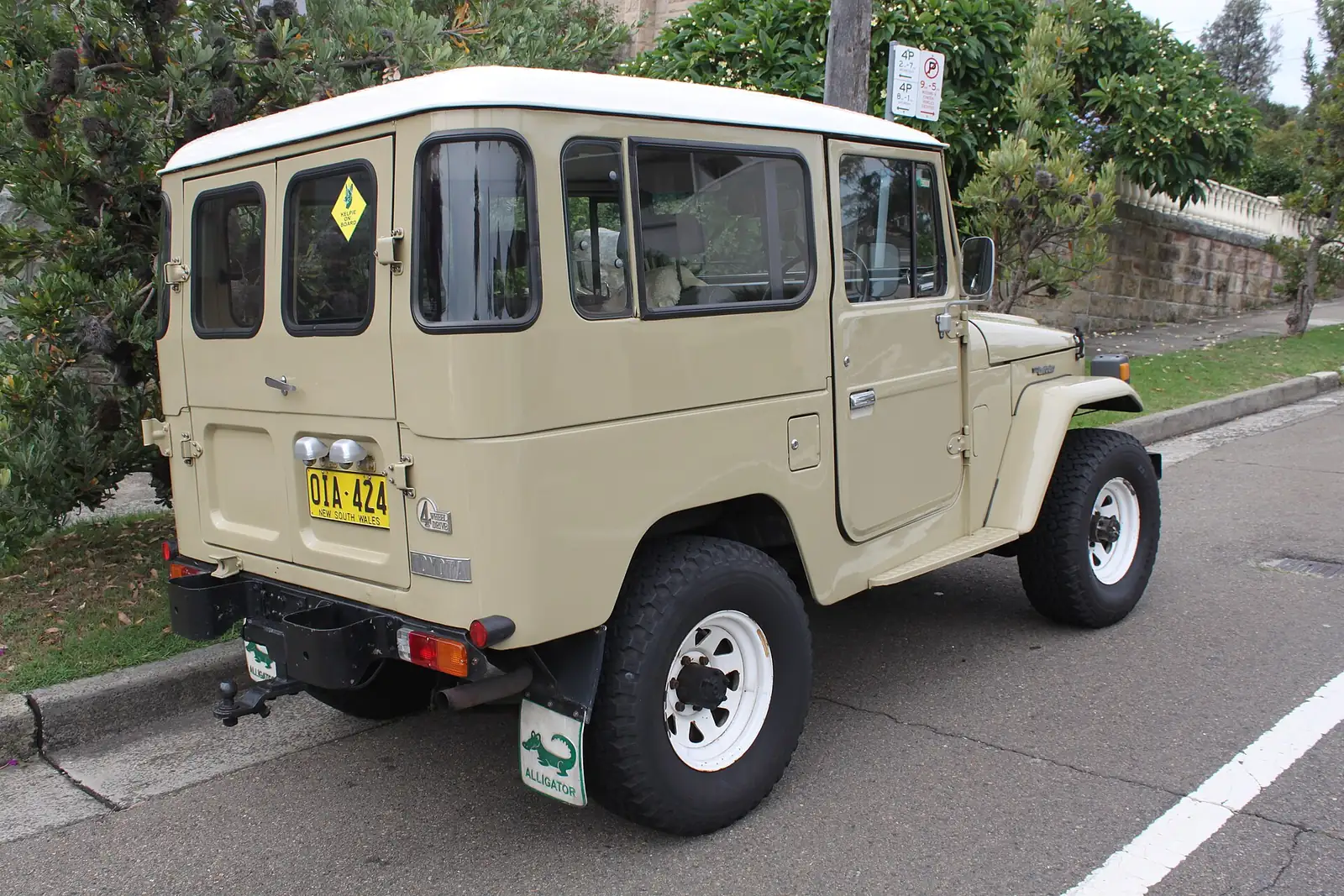
Beige Toyota Land Cruiser FJ40 hardtop photographed from the rear three-quarter angle

Image credit

File
File:1980 Toyota Land Cruiser (FJ40) hardtop (25439621823).jpg
Author (attribution required)
Jeremy from Sydney, Australia
Licence
CC BY 2.0

The J40, launched in 1960 and built for a quarter-century, is the version most people picture when they hear “Land Cruiser”: round headlights, a removable soft or hard top, and a reputation for running long after everything around it has failed.[1] Brazil kept building it, as the Bandeirante with a Mercedes-Benz diesel engine, until 2001, sixteen years after Japan stopped.

The F engine’s exact displacement is recorded as estimated rather than verified: the article calls it simply “3.9 L” without giving a cc figure, and 3,878 cc, this entry’s stated basis, comes from the well-documented Toyota F engine family rather than a number this specific article states.

Overview

Manufacturer
Toyota
Produced
1960–1985
Model code
J40
Segment
E-SUV (Europe) / Full-size SUV (US)
Positioning
Mainstream
Assembly
  • Toyota City, Japan
  • São Bernardo, Brazil
  • Cumaná, Venezuela
  • Jakarta, Indonesia
  • Sarawak, Malaysia

Dimensions

Length
3,841 mm

Published as 151.2 in, converted at 1 in = 25.4 mm.

[1]

Width
1,666 mm

Published as 65.6 in, converted at 1 in = 25.4 mm.

[1]

Height
1,951 mm

Softtop, published as 76.8 in, converted at 1 in = 25.4 mm. The hardtop is 78.8 in / 2,002 mm.

[1]

Wheelbase
2,285 mm

Shortest of four wheelbases offered across the J40 run (2,285/2,430/2,650/2,950 mm) for different body styles; the shortest is recorded here.

[1]

Kerb weight
1,480 kg

Softtop, published as 3,263 lb, converted at 1 lb = 0.45359237 kg. The hardtop is 3,427 lb / 1,554 kg.

[1]

FJ40

Trim · 1960–1975 · F

Power
93 kW

New F engine introduced with the 1960 20-Series-to-40-Series upgrade.

[1]

Torque
Not yet available
Kerb weight
1,480 kg

Softtop figure.

[1]

0–100 km/h
Not yet available
Top speed
Not yet available
Fuel economy
Not yet available
CO₂
Not yet available
Drag coefficient
Not yet available
Frontal area
Not yet available
Displacement
3,878 ccEstimated

The article describes this engine only as "3.9 L"; 3,878 cc is the well-documented displacement of the Toyota F engine, not a figure stated directly in this article.

Boot volume
Not yet available
Seats
4
Engine
inline-6 · F
Drivetrain
Four-wheel drive

Bandeirante

Trim · 1968–1985

Power
58 kW

The Brazilian-built Bandeirante's Mercedes-Benz-sourced diesel engine, from 1968.

[1]

Torque
Not yet available
Kerb weight
1,480 kg

Generation-level softtop figure; no separate Bandeirante-specific weight is published in this article.

[1]

0–100 km/h
Not yet available
Top speed
Not yet available
Fuel economy
Not yet available
CO₂
Not yet available
Drag coefficient
Not yet available
Frontal area
Not yet available
Displacement
Not yet available
Boot volume
Not yet available
Seats
4
Engine
inline-4, Mercedes-Benz-built
Drivetrain
Four-wheel drive

Sources & confidence

Every figure above carries a status. Nothing on this page is estimated without saying so, and nothing missing has been filled in with a guess.

Last verified
2026-09-08
Review status
Compiled from cited sources

Photography on this page is credited on each image. Tap theion a photograph for its author, licence and source.

References

Every sourced figure and every cited claim on this page, numbered. Wikipedia articles record the revision they were read at, because the article will have changed by the time you check it.

  1. [1]

    Toyota Land Cruiser. Wikipedia · revision 1373849935 · read 2026-09-08

    WikipediaCC BY-SA 4.0

    Covers the whole Land Cruiser lineage (J series) in one article, with per-generation infoboxes and history sections.