Skip to content
Markey
Theme: System (currently light)
The Mercedes-Benz three-pointed star, rendered in chrome, inside a circular ring

Generation

Mercedes-Benz S-Class (W126)

Mercedes-Benz S-Class (W126/C126), 1979-1991

Produced
1979–1991
Code
W126
Designer
Bruno Sacco, Werner Breitschwerdt
Dark blue facelifted Mercedes-Benz W126 S-Class saloon on display indoors, photographed from the front three-quarter angle

Image credit

File
File:1987-1991 Mercedes-Benz 300 SEL (V 126) sedan (2010-04-03) 02.jpg
Author
OSX
Licence
Public domain

Released into the public domain by the photographer.

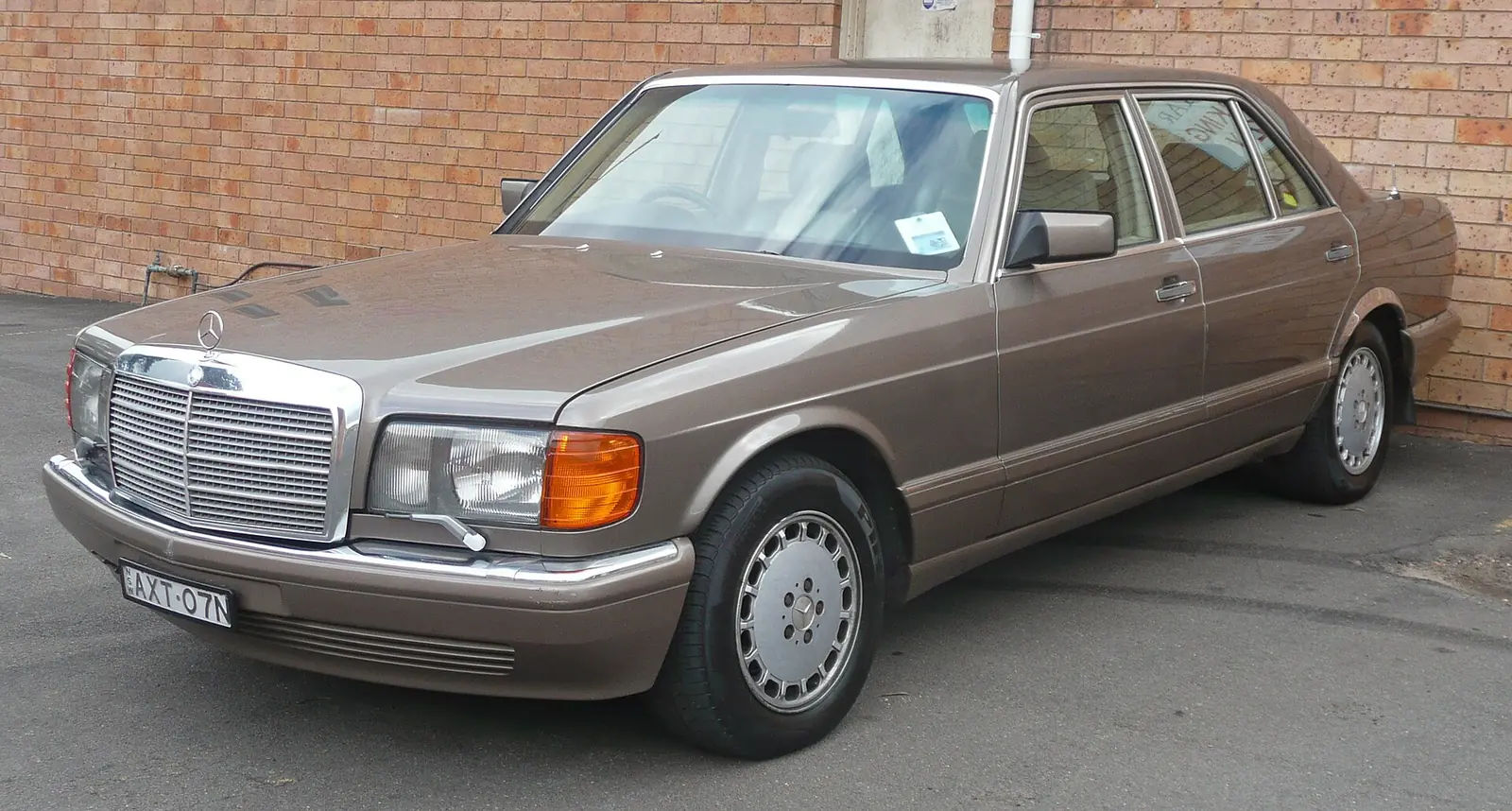
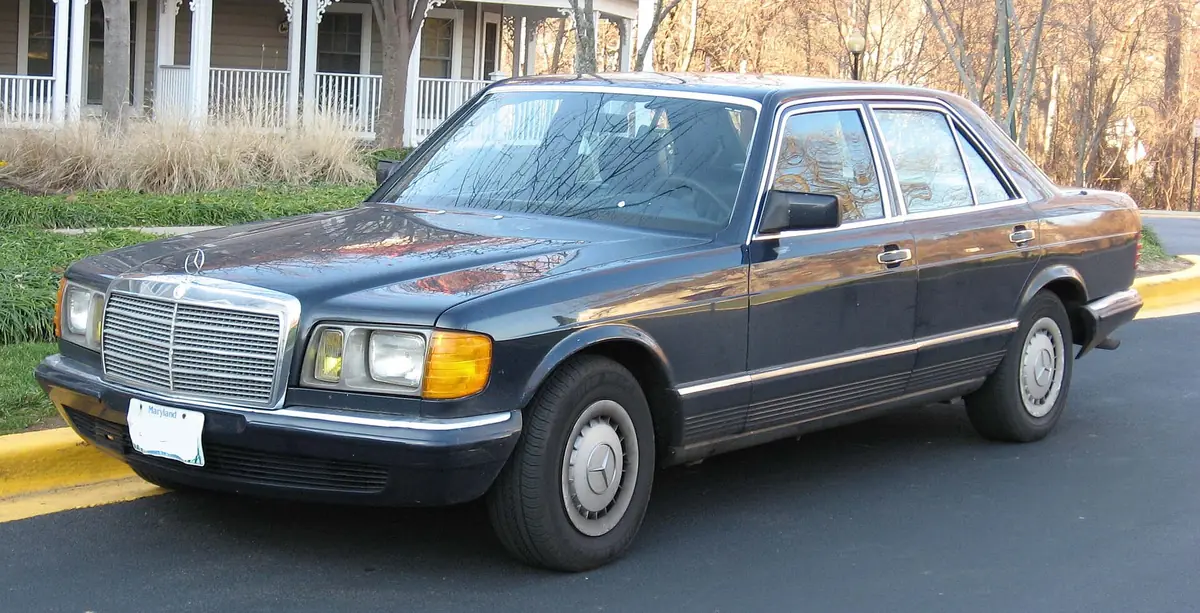
The second S-Class, on sale from December 1979 and, for many buyers of the period, the car that made the badge synonymous with engineering rigour rather than mere size.[1] It ran for nearly twelve years with only one major revision, in 1985-86, and introduced a pillarless coupé body (C126, badged SEC) alongside the saloon for the first time in the S-Class’s history.

The range spanned a 280 SE straight-six to a 5.5-litre V8 in the 560 SEL, and the same 560 SEL badge covers several genuinely different power outputs depending on market and emissions equipment: a European “ECE” car without a catalytic converter made 220 kW, while catalyst-equipped “RÜF” and “CAT” versions sold in the same years made as little as 178 kW. This entry records the non-catalyst European figure and says so, rather than picking whichever number happened to be highest.

A separately published 0-60 mph time for the US-market catalyst car is not converted to a 0-100 km/h figure here; the two describe different speed thresholds, and the entry uses only the figure that was actually measured to 100 km/h.
Overview

Manufacturer
Mercedes-Benz
Produced
1979–1991
Model code
W126
Designer
Bruno Sacco, Werner Breitschwerdt
Segment
F-segment (Europe) / Full-size luxury (US)
Positioning
Luxury
Assembly
  • Sindelfingen, Germany
  • Johor Bahru, Malaysia (OASB)
  • East London, South Africa

Dimensions

Length
4,995 mm

Lowest of the published 4,995-5,020 mm range for the short-wheelbase sedan. The long-wheelbase sedan was 5,135-5,160 mm and the coupé 4,910-4,935 mm.

[1]

Width
1,820 mm

Sedan figure; the coupé was 1,828 mm.

[1]

Height
1,430 mm

Lowest of the published 1,430-1,437 mm range for the short-wheelbase sedan. The long-wheelbase sedan was 1,441 mm and the coupé 1,406 mm.

[1]

Wheelbase
2,935 mm

Short-wheelbase sedan; the long-wheelbase sedan was 3,075 mm and the coupé 2,850 mm.

[1]

Kerb weight
Not yet available

280 SE

Trim · 1979–1985 · M110.989

Power
136 kW

Published directly in kW in the article's technical-data table (First Series, 1979-1985).

[1]

Torque
240 N⋅m

[1]

Kerb weight
1,560 kg

SE curb weight; the SEL was 1,590 kg.

[1]

0–100 km/h
10.0 s

[1]

Top speed
210 km/h

[1]

Fuel economy
15.6 L/100 km

[1]

CO₂
Not yet available
Drag coefficient
Not yet available
Frontal area
Not yet available
Displacement
2,746 cc

[1]

Boot volume
Not yet available
Seats
5
Engine
inline-6, DOHC · M110.989
Drivetrain
Rear-wheel drive

500 SEL

Trim · 1979–1981 · M117.963

Power
177 kW

1979-1981 figure; revised down to 170 kW from September 1981 as part of Mercedes-Benz's 'Energiekonzept' efficiency revisions.

[1]

Torque
402 N⋅m

[1]

Kerb weight
1,650 kg

[1]

0–100 km/h
8.1 s

[1]

Top speed
215 km/h

[1]

Fuel economy
18.5 L/100 km

[1]

CO₂
Not yet available
Drag coefficient
Not yet available
Frontal area
Not yet available
Displacement
4,973 cc

[1]

Boot volume
Not yet available
Seats
5
Engine
V8, SOHC · M117.963
Drivetrain
Rear-wheel drive

300 SD

Trim · 1979–1982 · OM617.951

Power
89 kW

Published directly in kW; revised to 92 kW from October 1982.

[1]

Torque
250 N⋅m

[1]

Kerb weight
1,620 kg

[1]

0–100 km/h
15.2 s

[1]

Top speed
175 km/h

[1]

Fuel economy
12.4 L/100 km

[1]

CO₂
Not yet available
Drag coefficient
Not yet available
Frontal area
Not yet available
Displacement
2,998 cc

US, Canada and Japan only. Won Motor Trend's 1981 Import Car of the Year award.

[1]

Boot volume
Not yet available
Seats
5
Engine
inline-5, turbocharged · OM617.951
Drivetrain
Rear-wheel drive

560 SEL

Trim · 1985–1986 · M117 (5.5)

Power
220 kW

Published directly in kW for the non-catalyst 'ECE' European-market car, September 1985-August 1986. Catalyst-equipped 'RUF' and 'CAT' versions sold in the same period made between 178 kW and 205 kW.

[1]

Torque
455 N⋅m

ECE non-catalyst figure, matching the power output note.

[1]

Kerb weight
1,830 kg

[1]

0–100 km/h
6.9 s

ECE non-catalyst figure. A separately published 7.0-second figure for the US-market catalyst car is a 0-60 mph time, not 0-100 km/h, and is not used here.

[1]

Top speed
250 km/h

[1]

Fuel economy
Not yet available
CO₂
Not yet available
Drag coefficient
Not yet available
Frontal area
Not yet available
Displacement
5,547 cc

The largest engine offered in the W126, and the most powerful; later catalyst-equipped ('RUF' and 'CAT') versions of the same car made less power, down to 178 kW for the US-market catalyst car.

[1]

Boot volume
Not yet available
Seats
5
Engine
V8, SOHC · M117 (5.5)
Drivetrain
Rear-wheel drive

Sources & confidence

Every figure above carries a status. Nothing on this page is estimated without saying so, and nothing missing has been filled in with a guess.

Last verified
2026-09-08
Review status
Compiled from cited sources

Photography on this page is credited on each image. Tap theion a photograph for its author, licence and source.

References

Every sourced figure and every cited claim on this page, numbered. Wikipedia articles record the revision they were read at, because the article will have changed by the time you check it.

  1. [1]

    Mercedes-Benz W126. Wikipedia · revision 1368404512 · read 2026-09-08

    WikipediaCC BY-SA 4.0