
Skip to content
Markey
Theme: System (currently light)
Ford blue oval logotype

Generation

Ford Mustang (first generation)

Ford Mustang (first generation), 1964-1973

Produced
1964–1973
Code
Mustang I
Designer
Gale Halderman
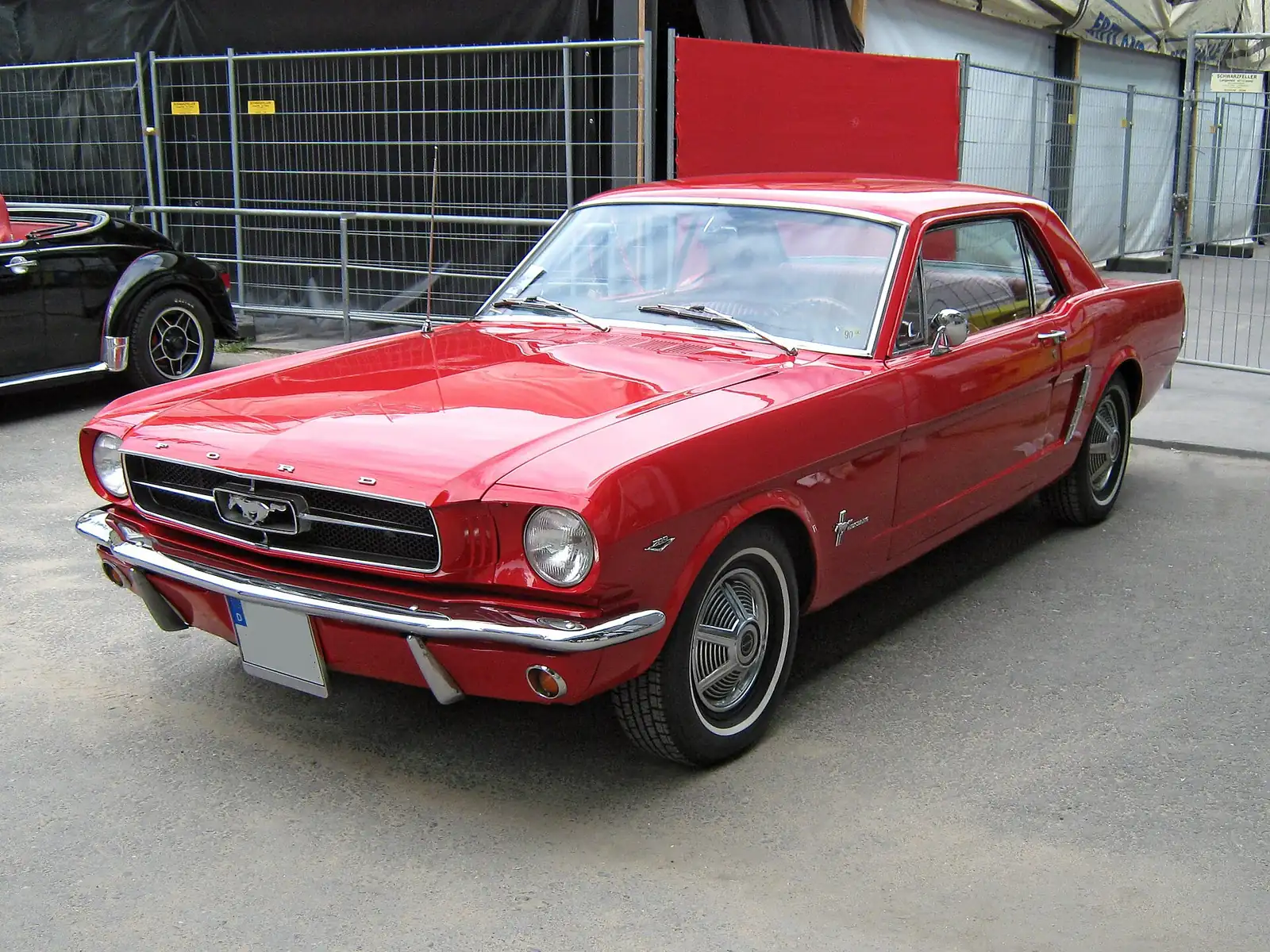
Red 1965 Ford Mustang two-door hardtop photographed from the front three-quarter angle

Image credit

File
File:1965 Ford Mustang 2D Hardtop Front.jpg
Author (attribution required)
Kroelleboelle

Powertrain

The original Mustang, built from the parts bin of the humble Ford Falcon but given its own body, its own name, and a launch at the 1964 World’s Fair that made it the fastest-selling new model in Ford’s history.[1]

Wikipedia’s article treats the whole 1964-1973 run as one generation, even though the car changed size substantially at facelifts in 1967, 1969 and 1971: the “1971” big-block Mustang shares almost nothing dimensionally with the original. This entry records only the dimensions and trims of the original 1964½/1965 launch car rather than blur nine years of growth into one average figure.

Overview

Manufacturer
Ford
Produced
1964–1973
Model code
Mustang I
Designer
Gale Halderman
Segment
S-segment (Europe) / Sports car (US)
Positioning
Mainstream
Assembly
  • Dearborn, Michigan, United States (Ford River Rouge Complex)
  • Milpitas, California, United States (San Jose Assembly Plant)
  • Edison, New Jersey, United States (Edison Assembly)

Dimensions

Length
4,613 mm

1965-66 model years. The car grew substantially at the 1967, 1969 and 1971 facelifts, all folded into Wikipedia's single 'first generation' article; this figure describes only the original 1964½/1965 launch car.

[1]

Width
1,732 mm

1965-66 model years.

[1]

Height
1,301 mm

1965-66 model years.

[1]

Wheelbase
2,743 mm

108 in, unchanged through the whole 1964-1973 run despite the car's growth in every other dimension.

[1]

Kerb weight
1,109 kg

Base 1965-66 six-cylinder hardtop, published as 2,445 lb, converted at 0.45359237 kg/lb.

[1]

170 (U-code six)

Trim · 1964–1965 · U

Power
78 kW

Published as 105 bhp (SAE gross, period practice) at 4,400 rpm, converted at 1 hp = 0.745699872 kW.

[1]

Torque
212 N⋅m

Published as 156 lb-ft at 2,400 rpm, converted at 1 lb-ft = 1.355818 Nm.

[1]

Kerb weight
Not yet available
0–100 km/h
Not yet available
Top speed
Not yet available
Fuel economy
Not yet available
CO₂
Not yet available
Drag coefficient
Not yet available
Frontal area
Not yet available
Displacement
2,786 cc

Published as 170 cu in, converted at 16.3871 cc/cu in.

[1]

Boot volume
Not yet available
Seats
4
Engine
inline-6 · U
Drivetrain
Rear-wheel drive

289 HiPo (K-code)

Trim · 1964–1966 · K

Power
202 kW

Published as 271 bhp (SAE gross) at 6,000 rpm, converted at 1 hp = 0.745699872 kW.

[1]

Torque
423 N⋅m

Published as 312 lb-ft at 3,400 rpm, converted at 1 lb-ft = 1.355818 Nm.

[1]

Kerb weight
Not yet available
0–100 km/h
Not yet available
Top speed
Not yet available
Fuel economy
Not yet available
CO₂
Not yet available
Drag coefficient
Not yet available
Frontal area
Not yet available
Displacement
4,736 cc

Published as 289 cu in, converted at 16.3871 cc/cu in.

[1]

Boot volume
Not yet available
Seats
4
Engine
V8 · K
Drivetrain
Rear-wheel drive

Sources & confidence

Every figure above carries a status. Nothing on this page is estimated without saying so, and nothing missing has been filled in with a guess.

Last verified
2026-09-03
Review status
Compiled from cited sources

Photography on this page is credited on each image. Tap theion a photograph for its author, licence and source.

References

Every sourced figure and every cited claim on this page, numbered. Wikipedia articles record the revision they were read at, because the article will have changed by the time you check it.

  1. [1]

    Ford Mustang (first generation). Wikipedia · revision 1359146397 · read 2026-09-03

    WikipediaCC BY-SA 4.0

    Covers 1964-1973, which Wikipedia treats as one generation with several major facelifts; other sources split this span into two or three generations.