
Skip to content
Markey
Theme: System (currently light)
Ford blue oval logotype

Generation

Ford Focus (second generation, Europe)

Ford Focus (C307), 2004-2010

Produced
2004–2010
Code
C307
Designer
Murat Güler
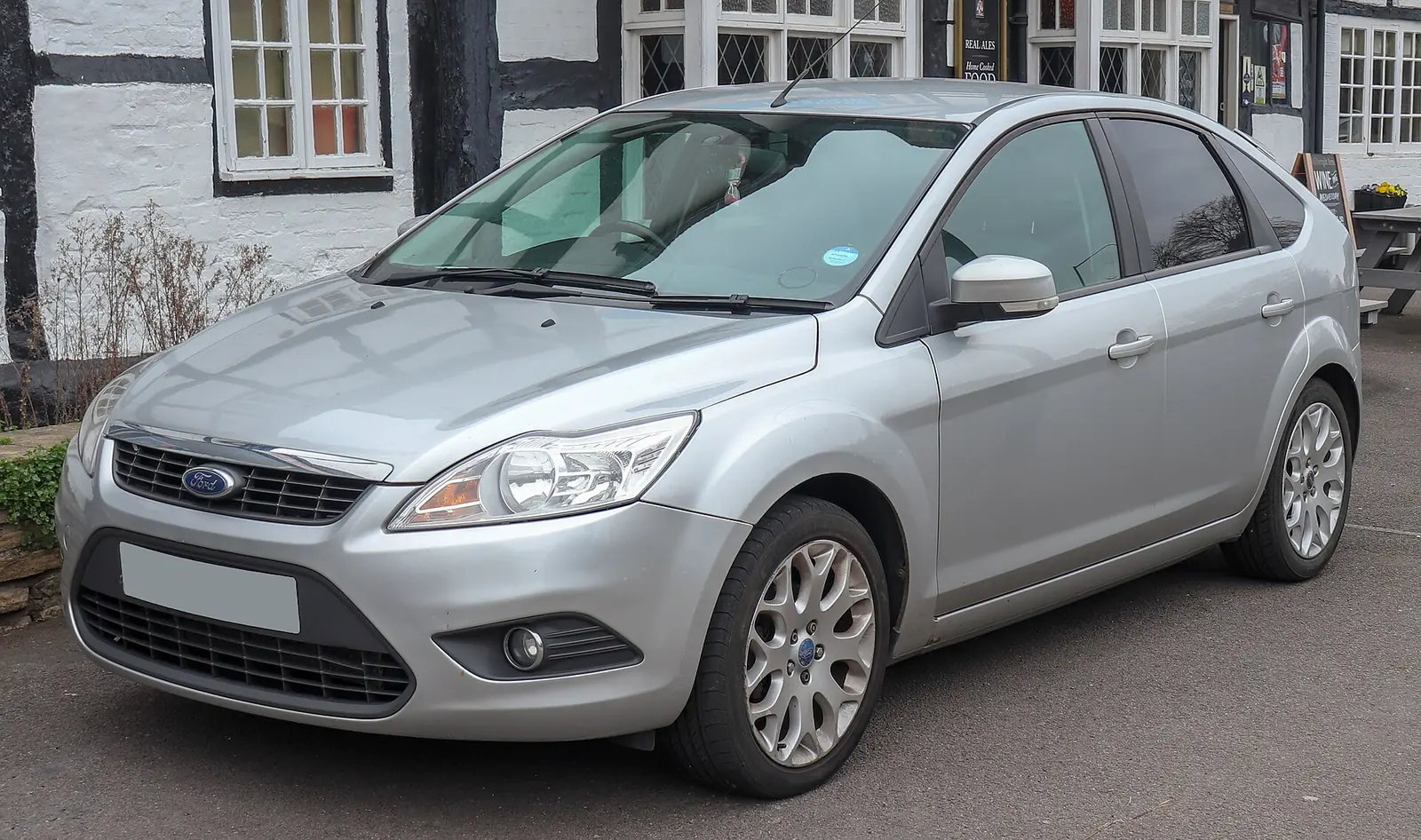
Silver facelifted second-generation Ford Focus hatchback photographed from the front three-quarter angle outside a pub

Image credit

File
File:2008 Ford Focus Zetec TD 109 1.6 Front.jpg
Author (attribution required)
Vauxford

The second Focus, launched at the 2004 Paris Motor Show, kept its predecessor’s suspension architecture largely unchanged but grew in every dimension: 25 mm more wheelbase, and increases in length, width and height that Ford said improved ride at some cost to the sharper handling enthusiasts associated with the Mk1.[1] A two-door coupé-cabriolet with a retractable hardtop, built by Pininfarina in Turin, joined the range in 2007.

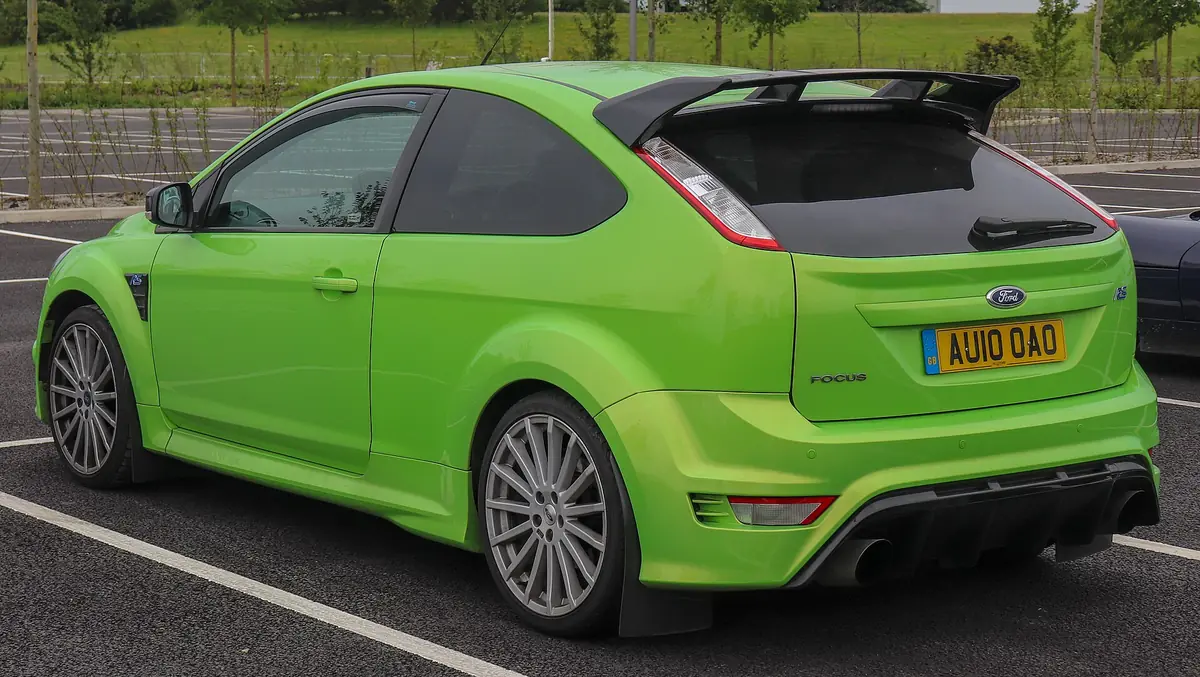
Three trims are recorded here: the 1.6 Duratec petrol, the 2.0 TDCi diesel, and the RS of 2009, Ford’s first Focus RS with the previous generation’s inline-four dropped for a turbocharged, Volvo-derived straight-five shared with the Focus ST, driving the front wheels through a new “RevoKnuckle” suspension designed to fight torque steer. As with the first generation, two engine displacements here (the 1.6 petrol and 2.0 diesel) are recorded as estimated, since the source states only the rounded litre figure for each rather than an exact cubic-centimetre value.
Overview

Manufacturer
Ford
Produced
2004–2010
Model code
C307
Designer
Murat Güler
Segment
C-segment (Europe) / Compact (US)
Positioning
Mainstream
Assembly
  • Saarlouis, Germany
  • Valencia, Spain
  • Vsevolozhsk, Russia (Ford Sollers)
  • Turin, Italy (Pininfarina, coupé-cabriolet)
  • Chungli, Taiwan
  • General Pacheco, Argentina
  • Santa Rosa, Philippines
  • Pretoria, South Africa (Samcor)
  • Chongqing, China (Changan Ford Mazda)

Dimensions

Length
4,340 mm

2004-2007 hatchback figure. The saloon was 4,480 mm, the estate 4,470 mm, the ST 4,360 mm and the coupé cabriolet 4,510 mm; post-2007 facelift figures differ by a few millimetres in each body style.

[1]

Width
1,840 mm

2004-2007 saloon/hatchback/estate figure; the coupé cabriolet was 1,835 mm.

[1]

Height
1,500 mm

2004-2007 hatchback/estate figure. The saloon was 1,495 mm and the coupé cabriolet 1,448 mm; the ST was 1,537 mm.

[1]

Wheelbase
2,640 mm

[1]

Kerb weight
1,229 kg

Lowest of a published 1,229-1,630 kg range across the whole range; not attributed to one specific trim, so recorded at generation level only.

[1]

1.6 Duratec

Trim · 2004–2010

Power
74 kW

Published as 100 PS, converted at 1 PS = 0.73549875 kW.

[1]

Torque
150 N⋅m

[1]

Kerb weight
Not yet available
0–100 km/h
11.9 s

With the 5-speed manual; the 4-speed automatic version was slower, at 13.6 s.

[1]

Top speed
180 km/h

With the manual gearbox; the automatic was 172 km/h.

[1]

Fuel economy
6.7 L/100 km

Combined-cycle figure with the manual gearbox.

[1]

CO₂
Not yet available
Drag coefficient
Not yet available
Frontal area
Not yet available
Displacement
1,596 ccEstimated

The article states only '1.6-L' for this engine's displacement. 1,596 cc is the Duratec/Sigma family's commonly documented exact displacement, not a figure this article itself states, so it is marked estimated rather than verified.

Source

Boot volume
Not yet available
Seats
5
Engine
inline-4
Drivetrain
Front-wheel drive

2.0 TDCi

Trim · 2004–2010 · G6DA/G6DB

Power
100 kW

Published as 136 PS, converted at 1 PS = 0.73549875 kW.

[1]

Torque
340 N⋅m

[1]

Kerb weight
Not yet available
0–100 km/h
9.3 s

With the manual gearbox; the automatic was 9.6 s.

[1]

Top speed
203 km/h

With the manual gearbox; the automatic was 200 km/h.

[1]

Fuel economy
5.5 L/100 km

Combined-cycle figure with the manual gearbox.

[1]

CO₂
Not yet available
Drag coefficient
Not yet available
Frontal area
Not yet available
Displacement
1,997 ccEstimated

The article states only '2.0-L' for this engine's displacement. 1,997 cc is the DW10 Duratorq's commonly documented exact displacement, not a figure this article itself states, so it is marked estimated rather than verified.

Source

Boot volume
Not yet available
Seats
5
Engine
inline-4, turbocharged · G6DA/G6DB
Drivetrain
Front-wheel drive

RS

Trim · 2009–2010

Power
224 kW

Published as 305 PS at 6,500 rpm, converted at 1 PS = 0.73549875 kW.

[1]

Torque
440 N⋅m

At 2,250-4,500 rpm.

[1]

Kerb weight
Not yet available
0–100 km/h
5.9 s

[1]

Top speed
263 km/h

[1]

Fuel economy
Not yet available
CO₂
Not yet available
Drag coefficient
Not yet available
Frontal area
Not yet available
Displacement
2,522 cc

A modified Volvo-derived straight-five, shared with the Focus ST, using a Quaife automatic torque-biasing limited-slip differential and Ford's RevoKnuckle front suspension to control torque steer through the front wheels.

[1]

Boot volume
Not yet available
Seats
4
Engine
inline-5, turbocharged
Drivetrain
Front-wheel drive

Sources & confidence

Every figure above carries a status. Nothing on this page is estimated without saying so, and nothing missing has been filled in with a guess.

Last verified
2026-09-08
Review status
Compiled from cited sources

Photography on this page is credited on each image. Tap theion a photograph for its author, licence and source.

References

Every sourced figure and every cited claim on this page, numbered. Wikipedia articles record the revision they were read at, because the article will have changed by the time you check it.

  1. [1]

    Ford Focus (second generation, Europe). Wikipedia · revision 1370551475 · read 2026-09-08

    WikipediaCC BY-SA 4.0