Skip to content
Markey
Theme: System (currently light)
BMW roundel

Generation

BMW 5 Series (E12)

BMW 5 Series (E12), 1972-1981

Produced
1972–1981
Code
E12
Designer
Paul Bracq, Marcello Gandini
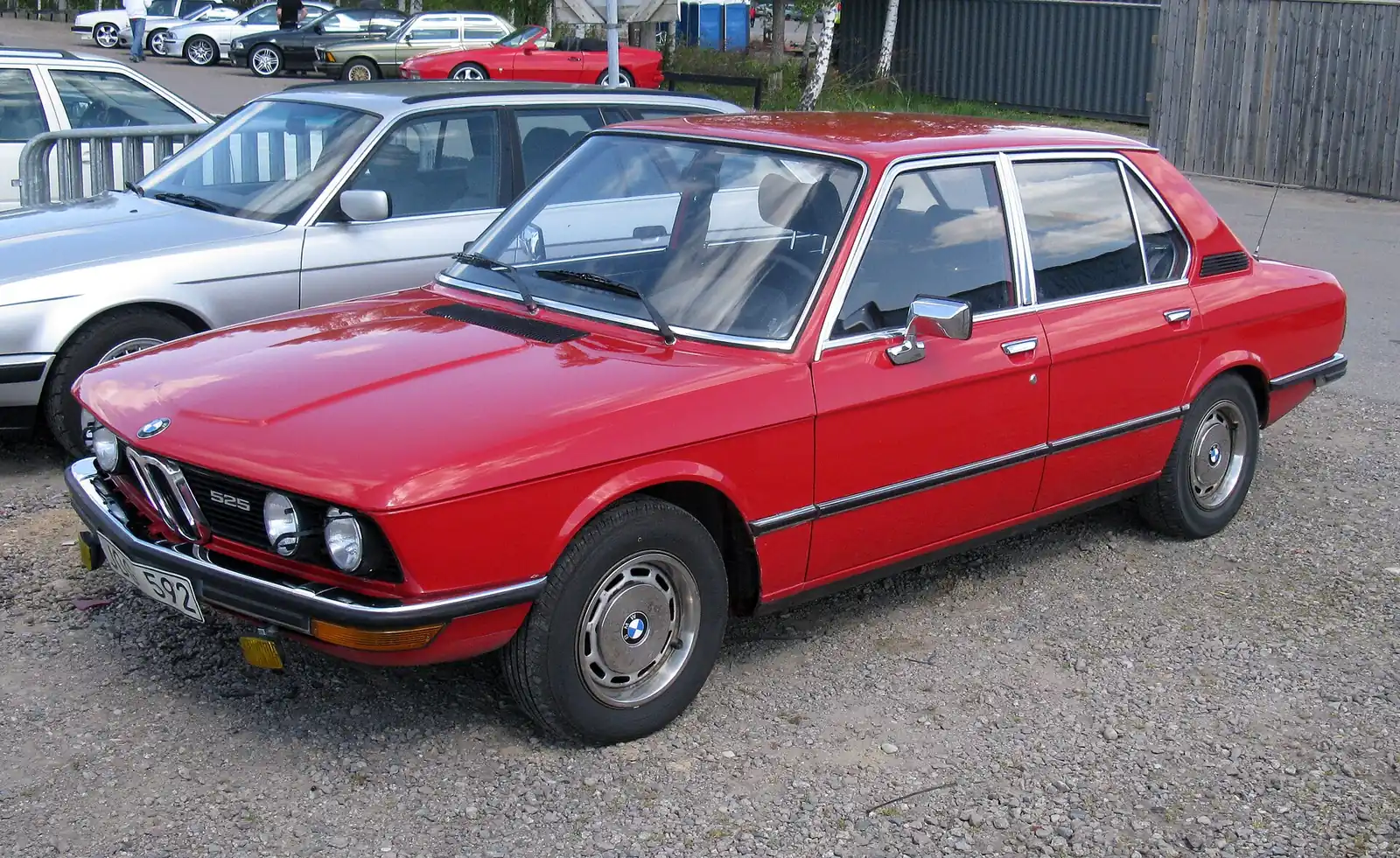
Red BMW E12 525 saloon photographed from the front three-quarter angle in a gravel car park

Image credit

File
File:BMW 525 (3538948081).jpg
Author (attribution required)
nakhon100
Licence
CC BY 2.0

Body style

Powertrain

The car that started the 5 Series name, styled by Paul Bracq with Marcello Gandini of Bertone as co-designer, and the first BMW built with computer- assisted crumple-zone design.[1] It replaced the “New Class” saloons in 1972 with a body that kept their basic dimensions but looked far less boxy, and, at launch, offered only a carried-over four-cylinder engine, with the range’s straight-sixes following over the next few years.

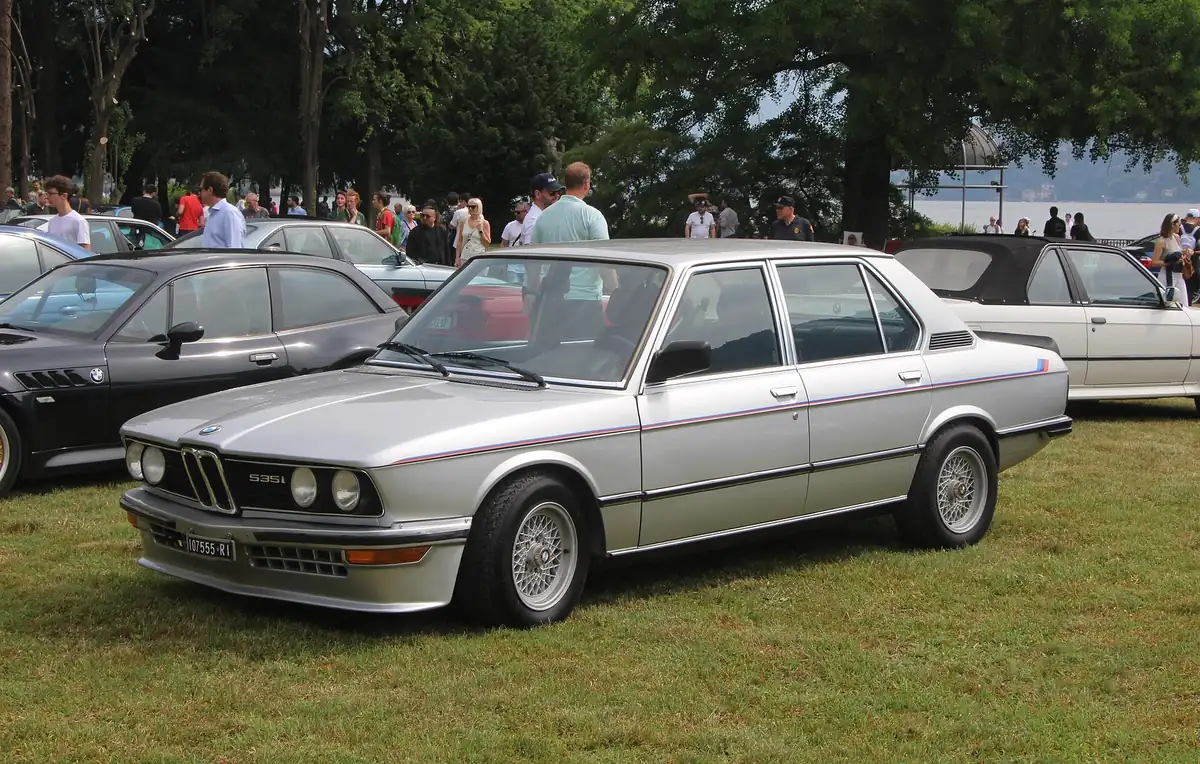
Three trims are recorded here: the 520, the entry four-cylinder that launched the range; the 528, the mid-range straight-six; and the M535i of 1980, the first M-badged 5 Series and the car BMW itself credits as the M5’s forerunner, though the M5 name did not yet exist. Several exact engine displacements in this entry (the 520’s 2.0-litre four, the 528’s 2.8-litre six, the M535i’s 3.5-litre six) are recorded as estimated: the article states only the rounded litre figure for each engine, so the widely documented exact cubic-centimetre displacement is marked as an estimate rather than presented as a sourced fact.
Overview

Manufacturer
BMW
Produced
1972–1981
Model code
E12
Designer
Paul Bracq, Marcello Gandini
Segment
E-segment (Europe) / Full-size (US)
Positioning
Premium
Assembly
  • Dingolfing, West Germany
  • Munich, West Germany
  • Rosslyn, South Africa (BMW SA)
  • Jakarta, Indonesia (Gaya Motor)
  • Bangkok, Thailand (Yontrakit Group)

Dimensions

Length
4,620 mm

[1]

Width
1,690 mm

[1]

Height
1,425 mm

[1]

Wheelbase
2,636 mm

[1]

Kerb weight
1,235 kg

Lowest of a published 1,235-1,565 kg range covering the whole E12 run; not attributed to one specific trim in the infobox, so recorded at generation level only.

[1]

520

Trim · 1972–1977 · M17

Power
85 kW

Published as 115 PS at 5,800 rpm, converted at 1 PS = 0.73549875 kW. Power and torque throughout this table are manufacturer claims measured to the German DIN 70020 standard.

[1]

Torque
165 N⋅m

At 3,700 rpm.

[1]

Kerb weight
Not yet available
0–100 km/h
Not yet available
Top speed
Not yet available
Fuel economy
Not yet available
CO₂
Not yet available
Drag coefficient
Not yet available
Frontal area
Not yet available
Displacement
1,990 ccEstimated

The article states only '2.0 L' for this engine, carried over from the BMW New Class saloons. 1,990 cc is the M10-family engine's commonly documented exact displacement, not a figure this article itself states, so it is marked estimated rather than verified.

Source

Boot volume
Not yet available
Seats
5
Engine
inline-4 · M17
Drivetrain
Rear-wheel drive

528

Trim · 1975–1976 · M30B28

Power
121 kW

Published as 165 PS at 5,800 rpm (pre-facelift), converted at 1 PS = 0.73549875 kW. Rose to 170 PS (125.03 kW) after the 1976 facelift's carburettor change.

[1]

Torque
234 N⋅m

At 4,000 rpm.

[1]

Kerb weight
Not yet available
0–100 km/h
Not yet available
Top speed
Not yet available
Fuel economy
Not yet available
CO₂
Not yet available
Drag coefficient
Not yet available
Frontal area
Not yet available
Displacement
2,788 ccEstimated

The article states only '2.8 L' for this engine. 2,788 cc is the M30B28's commonly documented exact displacement, not a figure this article itself states, so it is marked estimated rather than verified.

Source

Boot volume
Not yet available
Seats
5
Engine
inline-6 · M30B28
Drivetrain
Rear-wheel drive

M535i

Trim · 1980–1981 · M90

Power
160 kW

Published as 218 PS at 5,200 rpm, converted at 1 PS = 0.73549875 kW; the article also states this engine's output directly as 160 kW elsewhere in the text, matching this figure to within rounding.

[1]

Torque
310 N⋅m

At 4,000 rpm.

[1]

Kerb weight
Not yet available
0–100 km/h
Not yet available
Top speed
Not yet available
Fuel economy
Not yet available
CO₂
Not yet available
Drag coefficient
Not yet available
Frontal area
Not yet available
Displacement
3,453 ccEstimated

The article states only '3.5 L' for this engine. 3,453 cc is the M90/M30B35's commonly documented exact displacement, not a figure this article itself states, so it is marked estimated rather than verified. The M535i was the first M-badged 5 Series and is considered the M5's spiritual predecessor, though BMW Motorsport did not yet call it an M5. 1,650 were built, including 240 CKD kits for South Africa.

Source

Boot volume
Not yet available
Seats
5
Engine
inline-6 · M90
Drivetrain
Rear-wheel drive

Sources & confidence

Every figure above carries a status. Nothing on this page is estimated without saying so, and nothing missing has been filled in with a guess.

Last verified
2026-09-08
Review status
Compiled from cited sources

Photography on this page is credited on each image. Tap theion a photograph for its author, licence and source.

References

Every sourced figure and every cited claim on this page, numbered. Wikipedia articles record the revision they were read at, because the article will have changed by the time you check it.

  1. [1]

    BMW 5 Series (E12). Wikipedia · revision 1373768878 · read 2026-09-08

    WikipediaCC BY-SA 4.0