
Sherry
Sherry is a sherry of Spain carried here in 2 forms from 15% ABV to 18% ABV, used in 2 drinks on this site.
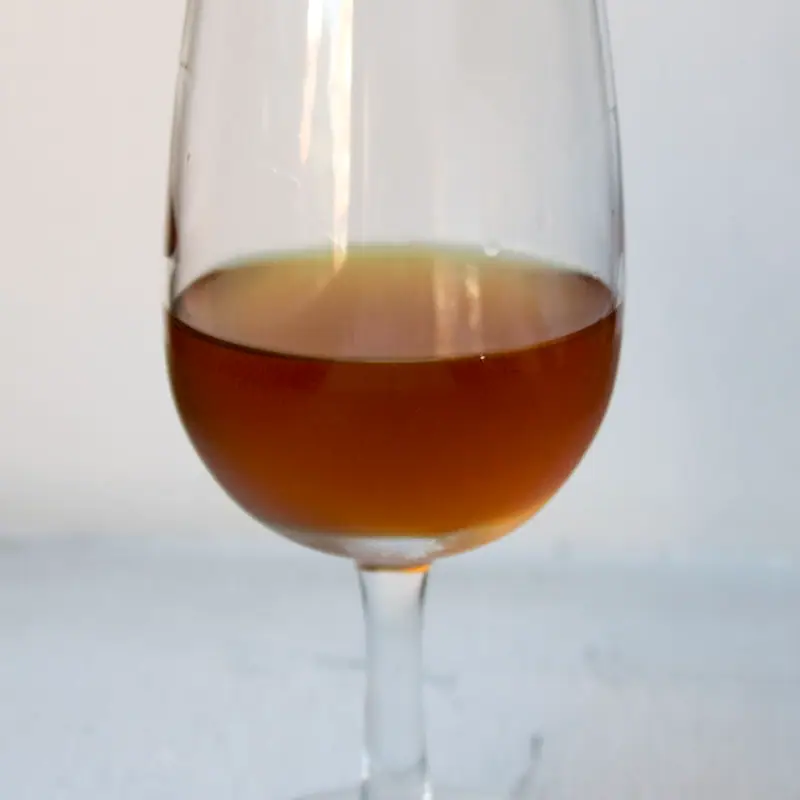

CC BY-SA 3.0 · Cropped, white-balanced, graded and re-encoded to WebP by eXir.
A copita glass of amber amontillado sherry
Composition · Fino
Sherry is routinely fined with isinglass or gelatine, and a producer rarely states whether a given bottle was.
Producer-adjacent published figures · sherrynotes.com/fino. Fino is the driest, palest sherry style and the one a Sherry Cobbler is built on. FoodData Central carries no sherry record. ABV is taken from the 15-18% range specialist sources state for the style, at the low end where fino typically sits; sugar and energy are taken from a retail nutrition aggregator's figures for a fino bottling, which land close to what 15% alcohol alone would produce (about 83 kcal/100 ml from ethanol) and are treated as a reasonable cross-check rather than a precise measurement. Density has no measured liquid source. The fortified-wine class is referenced to sweet vermouth, whose sugar is what lifts it above water; fino carries almost none, so it takes the dry-wine class instead, which is the nearer description of a bone-dry wine at this strength.
Composition · Cream
Sherry is routinely fined with isinglass or gelatine, and a producer rarely states whether a given bottle was.
Producer-adjacent published figures · harveys-bristol-cream. Harveys Bristol Cream, the reference bottle for the style, is retailer-published at 17.5% ABV and about 130-135 g of sugar per litre; the mid-point, 13 g per 100 ml, is used here. FoodData Central carries no sherry record of any style. Energy is estimated from the alcohol and sugar together (about 123 kcal/100 ml from the ethanol plus roughly 52 kcal/100 ml from the sugar, rounded down slightly for the overlap between the two published figures) rather than taken from a lab panel. No measured density is published; the site's own fortified-wine class (1.03 g/ml, referenced to a sweet vermouth near 16% ABV) is used as the nearest estimate, since a sweetened, fortified wine at a similar proof sits closer to that class than to the drier fino figure above.