
Yuanyang
Hong Kong milk tea lengthened with brewed coffee, three parts coffee to seven of tea.
CC BY 2.5 · Cropped, white-balanced, graded and re-encoded to WebP by eXir.
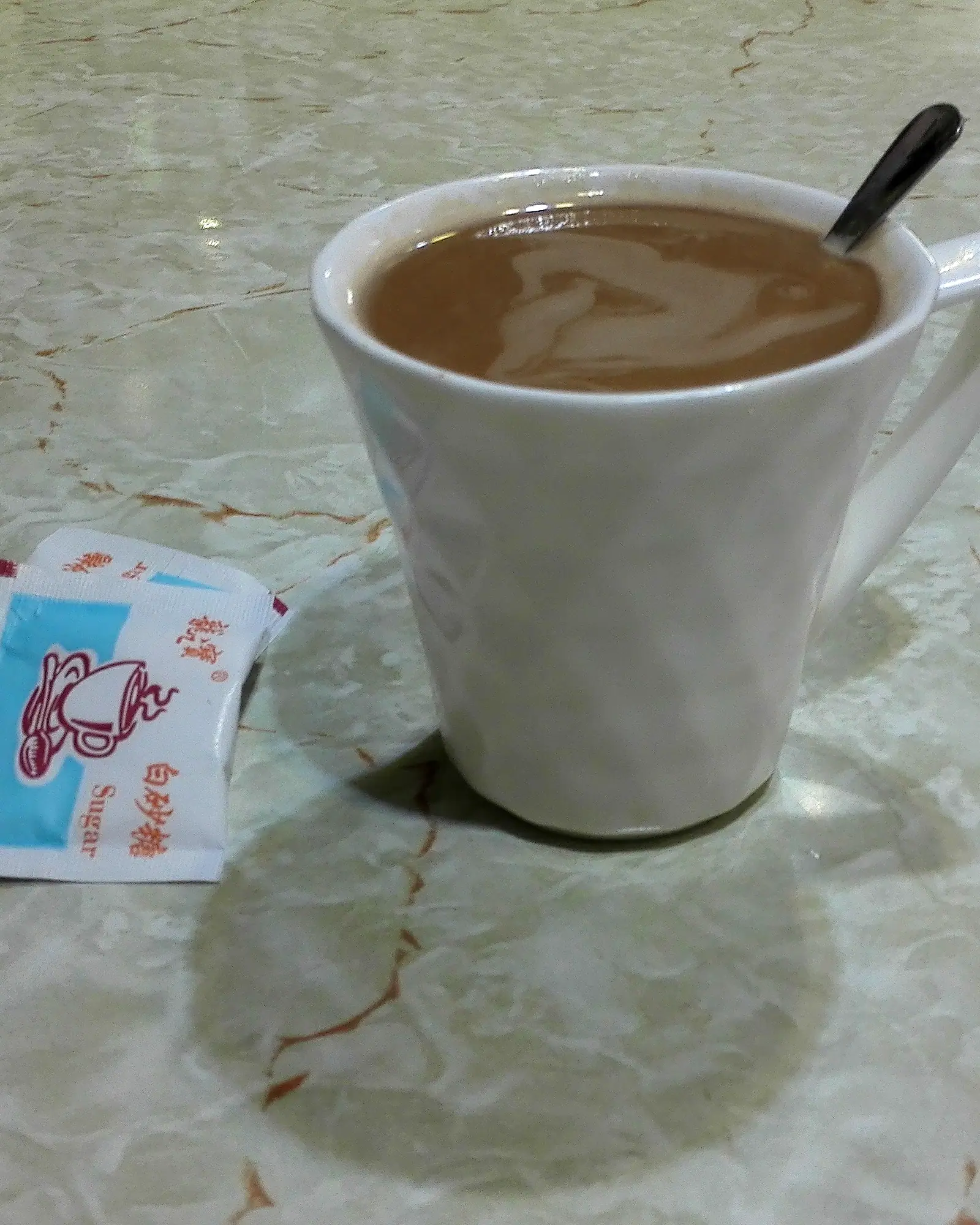
A white mug of milky tea-coffee yuanyang with a spoon resting inside, on a marble table
Serving
Drink spec, per drink
Every figure above is per drink and does not move with the count, which is what makes the two service modes comparable. Sugar per litre, strength and standard drinks stay in the units their own authorities publish, because they are figures for comparing rather than for pouring.
Diet and allergen labels are computed from the ingredients listed on this page and nothing else. They cannot account for cross-contamination or for the particular product you buy, and they are not medical or safety guidance.
Ingredients


Glass
Vessel
321 ml of liquid, served without ice, inside the 350 ml the glass holds. The build fails if a recipe ever exceeds its stated vessel.
A batch needs a vessel that closes and fits a fridge shelf.
Method
4 steps · 8mPour the 170 ml water at 100 °C over the 8 g black tea and leave to steep for 5m.
Strain the tea through a fine cloth sock back and forth between two vessels for 30s, then stir in the 25 ml evaporated milk and the 10 g granulated sugar.
While the tea is pulled, brew the 14 g coffee with the 120 ml water at 95 °C over 3m.
Pour the milk tea into the mug, then add the coffee on top and stir once to marble the two together.
The tea is poured first and the coffee added after, rather than the other way round, so the heavier milk tea sits underneath and the two marble together as they meet instead of the coffee sinking through a settled layer of milk.
Common pitfallBrewing the coffee weak to match the tea's volume rather than to its own strength leaves a cup where the milk tea simply dilutes the coffee; the ratio is meant to be three parts coffee to seven of tea by volume, not a splash of coffee added to a mug of tea.
Keeping and make-ahead
Both halves are brewed and pulled to order and combined at the last moment; either one held and reheated separately changes the drink.
About
Hong Kong milk tea and coffee combined in one cup, named after a duck whose paired male and female look nothing alike.
The drink takes its name from the mandarin duck, a species in which the male and female look strikingly unlike each other but which mates for life and is long used in Chinese culture as a symbol of a devoted pair 1. Coffee and milk tea are an equally unlike pairing, and the name reads as much as a joke about the two ingredients as it does a compliment.
It belongs to the dai pai dong and cha chaan teng tradition (the open-air stalls and fast, informal cafés that grew up around Hong Kong's working population) rather than to any tea house or coffee shop of the kind that serve the drink's two components separately 2. Lan Fong Yuen, a long-running cha chaan teng, claims to have invented it in 1952, though that specific claim is not independently verified, unlike the same restaurant's better-documented claim to "silk-stocking" milk tea, its close relative 1. What is agreed is simpler and less dependent on any one shop: combining leftover coffee and tea was a practical way to stretch two drinks that manual labourers wanted and pure tea, at the time, was priced out of reach for 2.
Hong Kong's Leisure and Cultural Services Department, in describing the drink for its own heritage documentation, states the standard mixture as three parts coffee to seven parts Hong Kong–style milk tea 1. This is the ratio this page follows, rather than an equal split of the two. The milk tea itself, pulled hard through a cloth filter and finished with evaporated rather than fresh milk, is unchanged from how it is served on its own; coffee is added to it, not the other way round.
- 1Yuenyeungen.wikipedia.org
- 2Coffee or tea? Order a yuen yeungscmp.com