
Yerba Mate
Dried yerba leaf steeped in its own gourd and sipped through a metal straw, topped up rather than poured fresh each round.

CC BY-SA 4.0 · Cropped, white-balanced, graded and re-encoded to WebP by eXir.
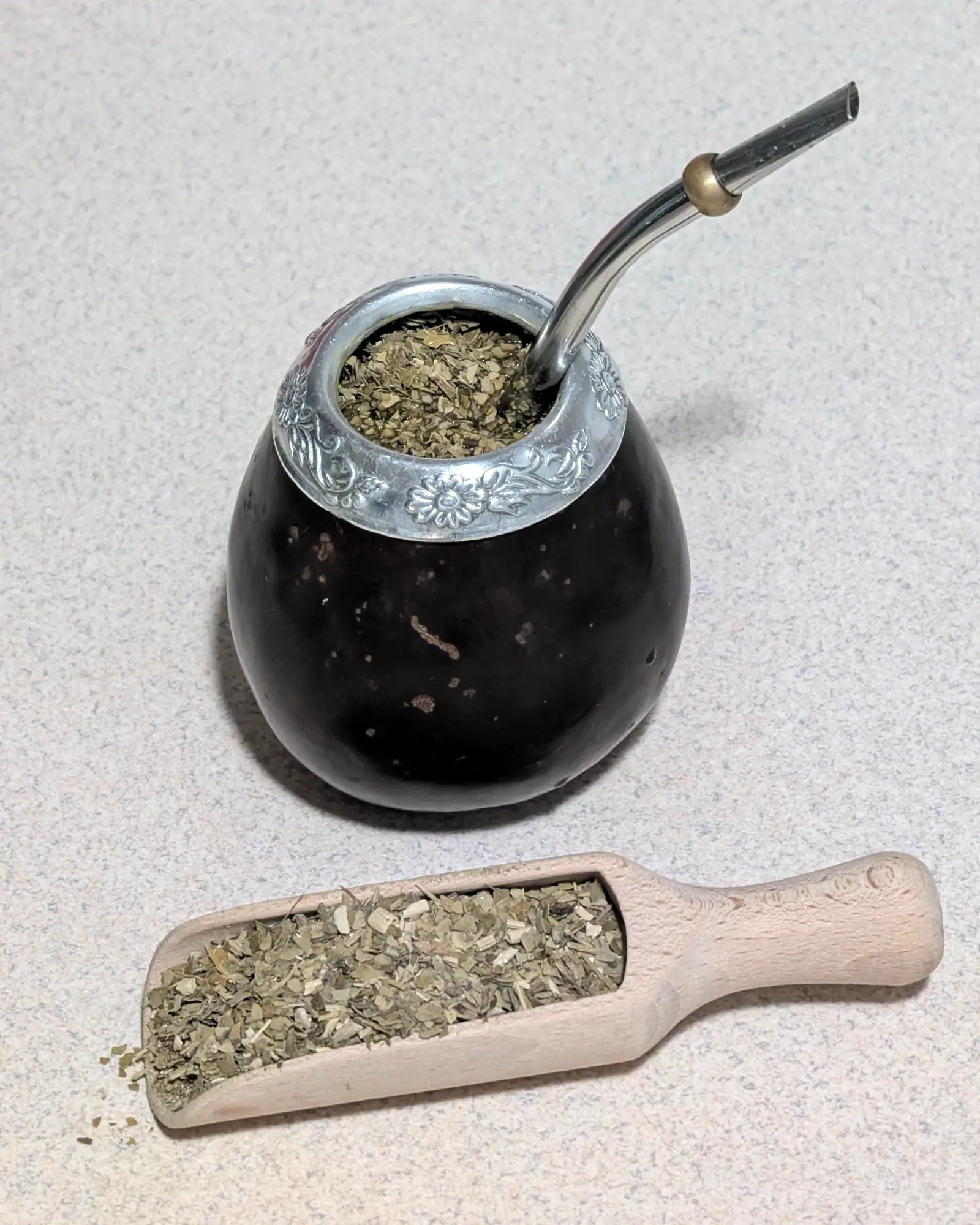
A traditional calabash gourd filled with yerba mate leaf and a metal bombilla straw, beside a small scoop of loose yerba
Serving
Drink spec, per drink
Every figure above is per drink and does not move with the count, which is what makes the two service modes comparable. Sugar per litre, strength and standard drinks stay in the units their own authorities publish, because they are figures for comparing rather than for pouring.
Diet and allergen labels are computed from the ingredients listed on this page and nothing else. They cannot account for cross-contamination or for the particular product you buy, and they are not medical or safety guidance.
Extraction
No extraction yield is shown. It needs a measured dissolved-solids figure from the finished cup, nothing on a bag of coffee supplies one, and estimating it from the method would be inventing the single number the calculation exists to establish.
Ingredients
 12 g yerba mate
 70 ml water
- 12 g yerba mate
- 70 ml water
Glass
Vessel
60 ml of liquid, served without ice, inside the 350 ml the glass holds. The build fails if a recipe ever exceeds its stated vessel.
A batch needs a vessel that closes and fits a fridge shelf.
Method
3 steps · 1m 45sFill the gourd about two-thirds full with the 12 g yerba mate, cover the mouth and shake once, then tip the gourd so the leaf banks to one side. Set the bombilla into the empty side, against the wall of the gourd rather than straight down into the leaf.
The gourd is filled most of the way with dry leaf and tilted so the leaf banks to one side before any water goes in; the bombilla's strainer tip then sits in the empty side, in the water rather than packed against the leaf, which is what keeps it from clogging.
Pour the 70 ml water, just off the boil, slowly into the empty side and let it soak into the leaf for 1m before the first sip.
Drink the full gourd through the bombilla without stirring, then refill with fresh hot water for the next round.
Common pitfallWater at a full boil scorches the leaf and turns the mate bitter within the first couple of refills; it is heated close to boiling point and then let off the heat slightly before it goes in.
Keeping and make-ahead
The same leaf is topped up with fresh hot water through a whole sitting rather than brewed once as a fixed batch.
About
Dried yerba leaf steeped in a shared gourd and drunk through a metal straw, developed by the Guaraní and later spread commercially by Jesuit missions that had first tried to suppress it.
The Guaraní, spread across what is now Paraguay, northeastern Argentina, southern Brazil and Uruguay, drank mate in pre-Columbian times, toasting and drying the leaf of Ilex paraguariensis and steeping it in a gourd sipped through a cane straw. That is the same basic vessel and technique still used today 1 2. Spanish colonisers recorded the practice from the fifteenth century onward, and it spread through the wider Southern Cone over the following two centuries 1.
The plant's path to cultivation was not straightforward. Spanish authorities banned the drink at first, suspicious of an indigenous practice they did not control, before Jesuit missionaries reversed that position once they saw how widely it was valued 2. From the mid-seventeenth century, Jesuit missions went further and domesticated the plant outright, establishing plantations within their reducciones in the Argentine province of Misiones. This was a shift from wild harvesting to organised agriculture that outlasted the Jesuits' own expulsion from the region in the 1770s 1.
The gourd and metal straw, called the bombilla, are not incidental tableware but the mechanism the drink depends on: the straw acts as both sipping tube and filter, holding back the loose leaf while letting the liquid through 1. Drinking is built around sharing a single gourd rather than individual servings; one person, the cebador, refills and passes it round a circle, and the etiquette runs in reverse of what a Western table would expect: a drinker who says thank you is understood to be declining another turn, not offering thanks for the one just finished 1. What had been a rural custom moved into cities across the twentieth century, helped in the 1960s by the introduction, in Uruguay, of the insulated flask that let the hot water travel with the drinker rather than staying by the kettle 2.
- 1Mate (drink)en.wikipedia.org
- 2The History and Origins of Yerba Mateyerbacrew.com