
Water Kefir
Sugar water fermented two days with live grains and a few raisins into a tangy, faintly fizzy drink.

CC BY-SA 3.0 · Cropped, white-balanced, graded and re-encoded to WebP by eXir.
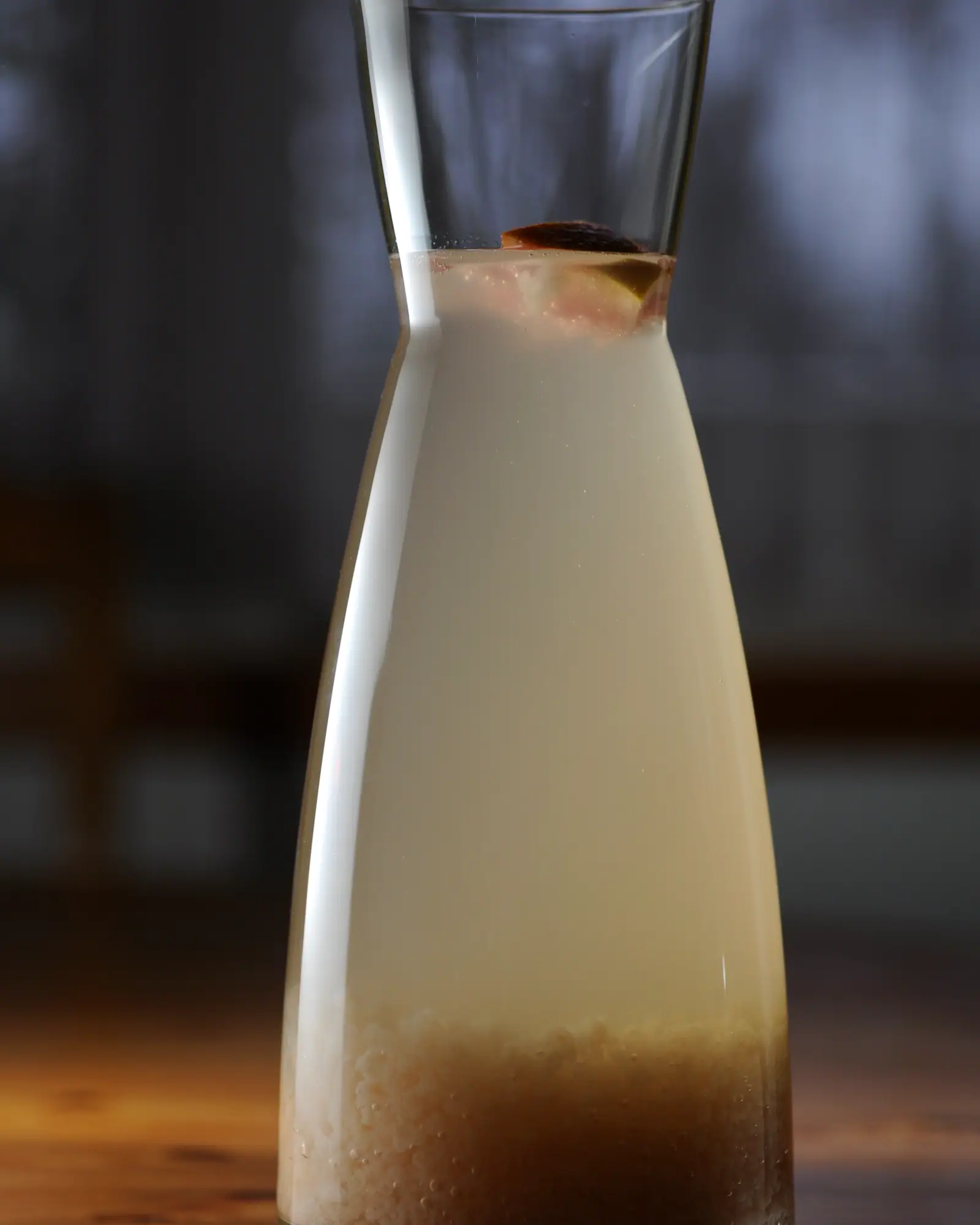
A carafe of pale, faintly cloudy fermented water kefir with a raisin floating near the surface
Serving
Drink spec, per drink
Every figure above is per drink and does not move with the count, which is what makes the two service modes comparable. Sugar per litre, strength and standard drinks stay in the units their own authorities publish, because they are figures for comparing rather than for pouring.
Diet and allergen labels are computed from the ingredients listed on this page and nothing else. They cannot account for cross-contamination or for the particular product you buy, and they are not medical or safety guidance.
Ingredients
 80 g granulated sugar
 1 000 ml water
 30 g water kefir grains
 10 g raisins
- 80 g granulated sugar
- 1 000 ml water
- 30 g water kefir grains
- 10 g raisins
Glass
Vessel
263 ml of liquid, served without ice, inside the 350 ml the glass holds. The build fails if a recipe ever exceeds its stated vessel.
A batch needs a vessel that closes and fits a fridge shelf.
Method
4 steps · 2dStir the 80 g granulated sugar into the 1 000 ml water until fully dissolved, then let it cool completely to room temperature.
Add the 30 g water kefir grains and the 10 g raisins to the cooled sugar water in a clean jar.
Cover loosely and leave at room temperature for 2d, away from direct light, until the liquid tastes tangy rather than sweet.
Strain out the grains and raisins, reserving the grains for the next batch, and refrigerate the kefir before serving.
Water kefir grains are a different culture from milk kefir grains, built to work in sugar water rather than milk, and the two are not interchangeable even though the names and the jar-on-the-counter method look alike.
Common pitfallStirring the grains into water still warm from dissolving the sugar weakens or kills them outright; the water needs to be fully back to room temperature first.
SafetyThe jar is covered loosely rather than sealed, since the ferment produces real carbon dioxide as it works. A batch that smells sharply of solvent, or shows pink, orange or fuzzy growth rather than clear, faintly cloudy liquid, has gone wrong and should be discarded rather than tasted.
Keeping and make-ahead
Batched ahead, this keeps sealed and cold. The water line the engine adds is the dilution figure from the spec panel, not a rule of thumb.
About
A sugar-water ferment kept going by passing live grains from batch to batch, most credibly traced to a Mexican cactus at the end of the nineteenth century, though even that origin has a competing story.
Where the culture itself comes from is genuinely unsettled. One early theory, put forward by the microbiologist Martinus Beijerinck in 1889, held that the grains descended from the "ginger beer plant" supposedly carried home by British soldiers returning from the Crimean War of the 1850s. The mycologist Harry Marshall Ward rejected that account in 1892 as unsubstantiated, writing that the culture's real origin was a mystery 1. The best-documented early sighting of what is now called water kefir instead comes from Mexico: in 1899 the researcher Lutz reported grains, which he called tibi, growing on the pads of an Opuntia cactus and capable of being revived in sugar water, a finding that gives the culture its still-current Mexican name, tibicos 1.
The drink has carried a scatter of other names in the years since, among them Japanese water crystals, California bees and the ginger beer plant Ward was arguing against, reflecting how widely and informally the culture travelled once it left any one place, passed jar to jar between households rather than sold or documented commercially 12.
It is easy to confuse with milk kefir because both are jar ferments kept going by straining out and reusing a live culture, and both carry the word "kefir." They are not the same organism, though: water kefir's grains are built around a different community of yeast and bacteria suited to sugar water rather than milk, and swapping one culture into the other's liquid does not reliably work. In Mexico, tibicos are also used as the starter for tepache, fermenting sweetened pineapple rather than plain sugar water, which is a second, quite different drink built on the same culture.
- 1Tibicosen.wikipedia.org
- 2The Origin Of Water Kefirculturesforhealth.com