
Turkish Coffee
Extra-fine grounds cooked with sugar and water in an open copper pot until it foams.
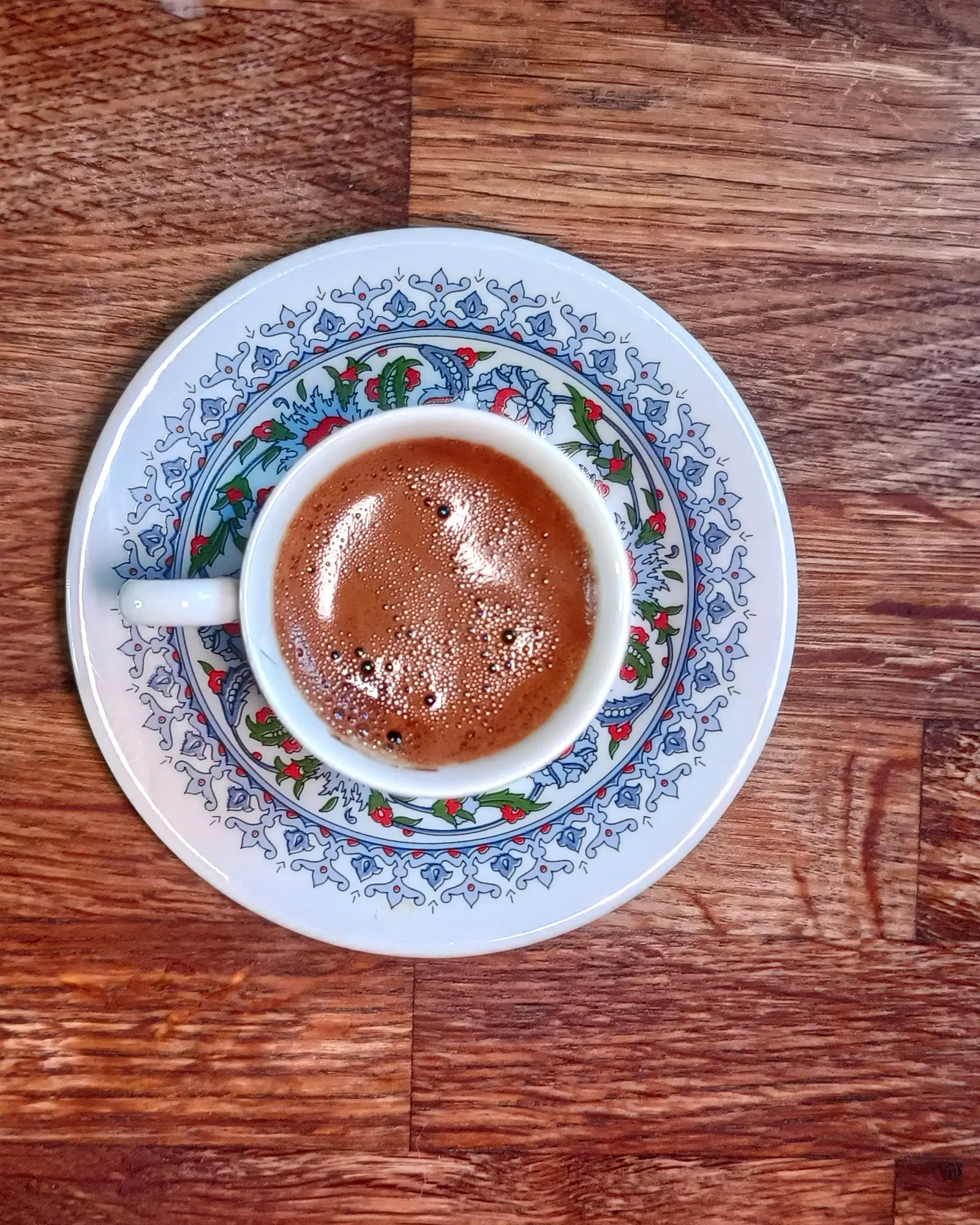

CC BY-SA 4.0 · Cropped, white-balanced, graded and re-encoded to WebP by eXir.
A small cup of Turkish coffee with a thick reddish-brown foam, on a patterned saucer, seen from above
Serving
Drink spec, per drink
Every figure above is per drink and does not move with the count, which is what makes the two service modes comparable. Sugar per litre, strength and standard drinks stay in the units their own authorities publish, because they are figures for comparing rather than for pouring.
Diet and allergen labels are computed from the ingredients listed on this page and nothing else. They cannot account for cross-contamination or for the particular product you buy, and they are not medical or safety guidance.
Extraction
This brew works out at 116.7 g of coffee per litre of water, against the 49.5 to 60.5 g/L the standard allows, so it is stronger than it. The comparison is made in grams per litre and not on the ratio, because a ratio is the reciprocal of a strength and a symmetric band on one is an asymmetric band on the other. Source: Golden Cup Standard, Specialty Coffee Association.
No extraction yield is shown. It needs a measured dissolved-solids figure from the finished cup, nothing on a bag of coffee supplies one, and estimating it from the method would be inventing the single number the calculation exists to establish.
Ingredients
 7 g coffee
 60 ml water
 5 g granulated sugar
- 7 g coffee
- 60 ml water
- 5 g granulated sugar
Glass
Vessel
58 ml of liquid, served without ice, inside the 80 ml the glass holds. The build fails if a recipe ever exceeds its stated vessel.
A batch needs a vessel that closes and fits a fridge shelf.
Method
4 steps · 6mGrind the 7 g coffee to an extra-fine, almost powdery texture.
Combine the grounds with the 60 ml water and 5 g granulated sugar in the cezve and stir to wet the grounds evenly.
Set the pot over low heat. As the surface begins to foam, lift it off the heat just before it boils over, then return it, repeating over 4m until the foam is thick and stable.
The pot is pulled off the heat and returned to it several times rather than left to boil through in one go, which builds a stable foam in stages instead of breaking it the moment a hard boil sets in.
Spoon the foam into the cup first, then pour the rest over it and let the grounds settle for 1m before drinking.
Common pitfallA grind any coarser than the flour-fine standard the cezve needs never fully suspends in the water, so it sinks early, cooks against the bottom of the pot and scorches instead of settling gently once poured.
Keeping and make-ahead
Cooked one small pot at a time; the foam that is the point of the method collapses within moments of the pot leaving the heat.
About
Extra-fine grounds cooked unfiltered with water and sugar in a small open pot, a method old enough in Istanbul to have built the city's first coffeehouses and recent enough in UNESCO's eyes to be listed as heritage.
Coffee reached Istanbul under the Ottomans, and a legal document already mentions a dedicated coffee chamber in the household of the admiral Barbaros Hayreddin Pasha by 1539 1. The city's first coffeehouses followed within about fifteen years, opened by two merchants from Aleppo and Damascus, and their number is said to have passed six hundred not long after 1. The method served in them is the one still used: coffee ground close to a powder, cooked directly in water in a small handled pot, with nothing filtered out before it reaches the cup.
UNESCO inscribed Turkish coffee culture and tradition on its Representative List of the Intangible Cultural Heritage of Humanity in 2013, and its own description of the method matches the traditional one closely: finely ground beans brewed slowly with water and sugar in the pot until a foam forms on top 2. The listing is explicit that the designation covers more than the recipe: it names the drink's role in hospitality, in engagement ceremonies, and in a tradition of reading the settled grounds after the cup is finished, alongside the brewing itself 2.
The same cezve method, under different national names, is shared across a region that once sat inside or beside the Ottoman world; it is served as Greek coffee in Greece and by comparable names elsewhere in the Balkans and the Levant, with the pot and the technique effectively unchanged 1. What distinguishes the method from every other coffee on this site is that nothing about it is filtered or pressurised: the grounds are cooked directly into the water they are served in, and the foam raised in stages during that cooking, not the crema of a pressurised shot, is the mark of a cup made correctly.
- 1Turkish coffeeen.wikipedia.org
- 2Turkish coffee culture and traditionich.unesco.org