
Turkish Çay
Strong black tea brewed in a small pot set over boiling water, let down with hot water to the drinker's own strength.
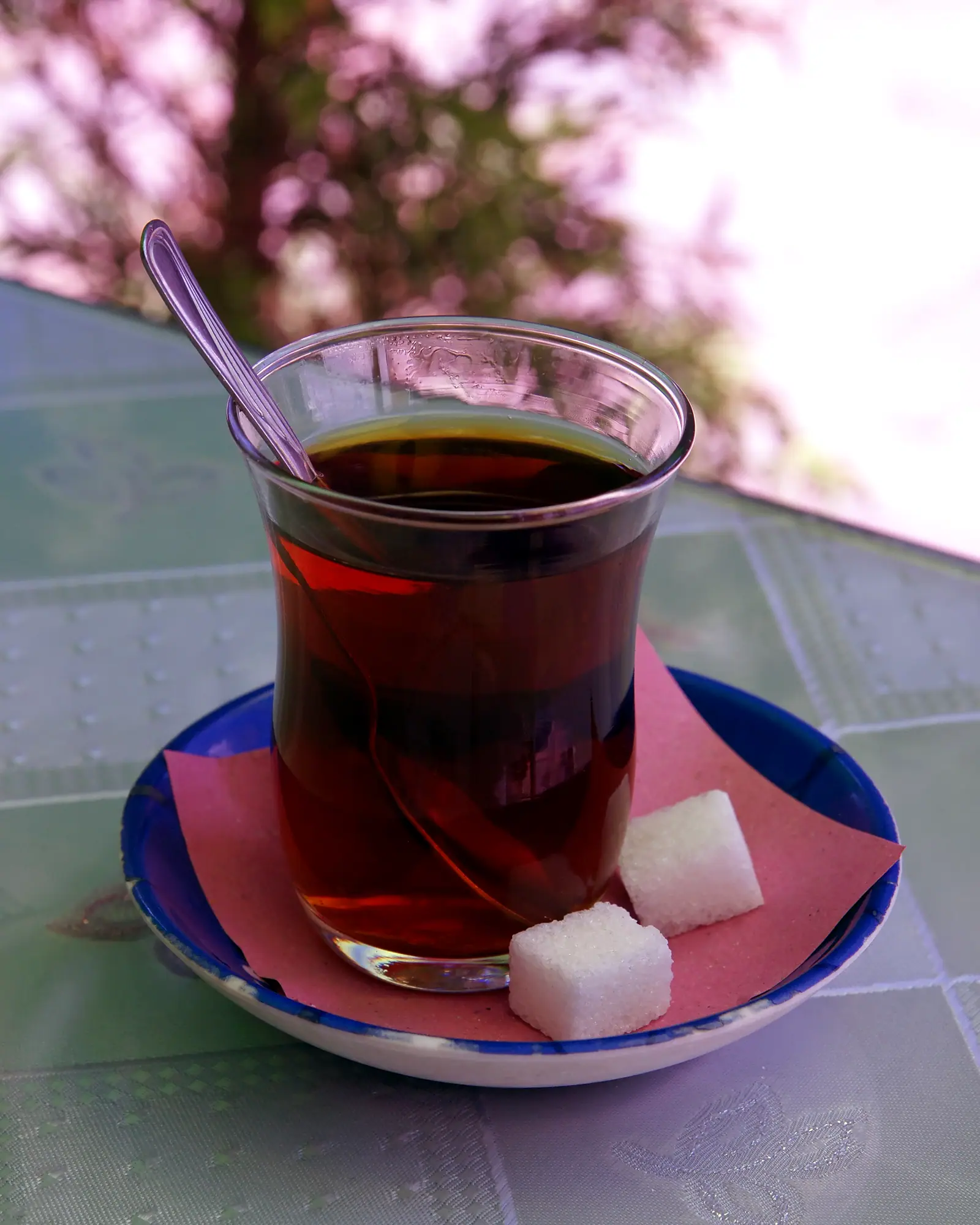

CC BY 3.0 · Cropped, white-balanced, graded and re-encoded to WebP by eXir.
A tulip-shaped glass of Turkish tea on a saucer with sugar cubes and a spoon
Serving
Drink spec, per drink
Every figure above is per drink and does not move with the count, which is what makes the two service modes comparable. Sugar per litre, strength and standard drinks stay in the units their own authorities publish, because they are figures for comparing rather than for pouring.
Diet and allergen labels are computed from the ingredients listed on this page and nothing else. They cannot account for cross-contamination or for the particular product you buy, and they are not medical or safety guidance.
Extraction
No extraction yield is shown. It needs a measured dissolved-solids figure from the finished cup, nothing on a bag of coffee supplies one, and estimating it from the method would be inventing the single number the calculation exists to establish.
Ingredients
 120 ml water
 6 g black tea
- 120 ml water
- 6 g black tea
Glass
Vessel
110 ml of liquid, served without ice, inside the 150 ml the glass holds. The build fails if a recipe ever exceeds its stated vessel.
A batch needs a vessel that closes and fits a fridge shelf.
Method
4 steps · 15mBring the 120 ml water to a boil in the lower kettle.
Add the 6 g black tea to the smaller pot set on top, ladle in a little of the boiling water, and steep for 10m over the simmering kettle below.
Pour a small amount of the concentrate into a tulip glass.
Top up with hot water from the lower kettle to the strength wanted.
The small pot brews one fixed, strong concentrate; the strength each drinker actually gets is set afterwards, glass by glass, with hot water from the larger kettle underneath rather than by changing how the tea itself is brewed.
Common pitfallJudging the dose against a Western teapot's ratio makes the small pot look absurdly strong. It is meant to be: the concentrate is never drunk undiluted, and the whole point of the second pot is that the strength gets fixed at the glass, not in the brew.
Keeping and make-ahead
Batched ahead, this keeps sealed and cold. The water line the engine adds is the dilution figure from the spec panel, not a rule of thumb.
About
A strong tea concentrate brewed over a boiling kettle and let down with hot water at the glass, grown into Turkey's everyday drink only after coffee became scarce.
Coffee, not tea, was the drink historically associated with Turkey, and tea only became the everyday choice once coffee grew scarce and expensive in the disrupted trade of the First World War 1. Tea had already been trialled experimentally in Rize province, on the Black Sea coast, from 1912, but it took decades for cultivation there to produce a meaningful crop; sizable harvests are only recorded from around 1945, with the first local processing factory opening in 1947 2. Mustafa Kemal Atatürk's government backed the region's tea industry through the 1930s as part of a wider push toward domestic agricultural self-sufficiency, and Rize's climate (heavy rainfall and fertile soil between the Pontic Mountains and the Black Sea) turned out to suit tea particularly well 2 1.
The double kettle brewing method predates Turkey's own tea industry. The çaydanlık, a smaller pot stacked on a larger one, is generally traced to the Russian army in the early nineteenth century and was adopted into Turkish tea culture well before Rize was producing tea of its own 1. The lower kettle keeps a supply of plain boiling water going; the upper pot holds a small volume of tea brewed deliberately stronger than anyone would drink it undiluted. Heat from below rather than direct contact with a flame keeps the leaf from scorching, and the two-pot design lets a host serve guests at different strengths from the same brew, simply by varying how much hot water goes in at the glass 1.
- 1Why Turkish Tea is Brewed in a Stacked Kettle?sakiproducts.com
- 2Rize teaen.wikipedia.org