
Douhua Soy Milk
Soaked soybeans ground, boiled and strained into fresh soy milk, served warm and lightly sweetened.

CC BY-SA 4.0 · Cropped, white-balanced, graded and re-encoded to WebP by eXir.
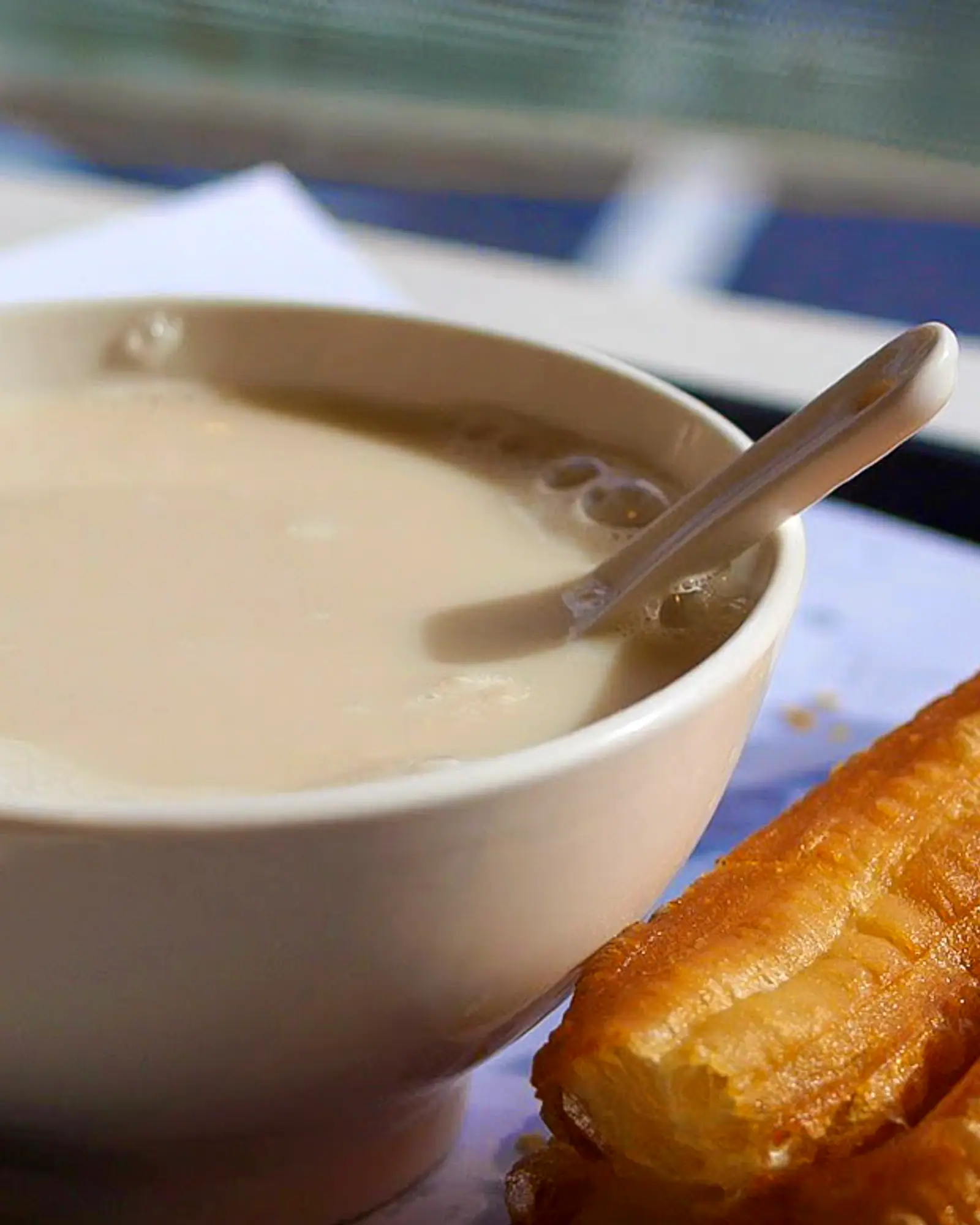
A bowl of warm plain soy milk (doujiang) with a spoon, served alongside a fried dough stick
Serving
Drink spec, per drink
Every figure above is per drink and does not move with the count, which is what makes the two service modes comparable. Sugar per litre, strength and standard drinks stay in the units their own authorities publish, because they are figures for comparing rather than for pouring.
Diet and allergen labels are computed from the ingredients listed on this page and nothing else. They cannot account for cross-contamination or for the particular product you buy, and they are not medical or safety guidance.
Ingredients
 150 g dried soybeans
 1 600 ml water
 90 g granulated sugar
- 150 g dried soybeans
- 1 600 ml water
- 90 g granulated sugar
Glass
Vessel
331 ml of liquid, served without ice, inside the 350 ml the glass holds. The build fails if a recipe ever exceeds its stated vessel.
A batch needs a vessel that closes and fits a fridge shelf.
Method
4 steps · 8h 15mSoak the 150 g dried soybeans in the 600 ml water for 8h, until fully softened and swollen.
Drain the beans and blend them with the 1 000 ml water until smooth.
Strain the mixture through muslin, pressing hard to get all the milk through and leave the spent pulp behind.
Bring the strained milk to a full boil, watching closely as it rises, then lower the heat and simmer for 10m, stirring the 90 g granulated sugar through before serving warm.
Fresh soy milk has to be brought to a full boil and held there briefly rather than just warmed, since raw soybeans carry compounds that upset digestion and only heat breaks them down.
Common pitfallSoy milk foams up and boils over far faster than dairy milk does, so it wants a wide pot, a watchful eye, and a lowered flame the moment it starts to rise rather than the moment it is already spilling.
Keeping and make-ahead
Batched ahead, this keeps sealed and cold. The water line the engine adds is the dilution figure from the spec panel, not a rule of thumb.
About
Fresh soy milk, documented in China since at least the first century AD and long popularly credited to a Han-dynasty prince on a legend historians do not actually support.
The earliest known reference to soy milk in China appears around 82 AD, in Wang Chong's Lun Heng, in a passing remark that makers of soymilk feared thunder would spoil their product 1. A popular story credits its invention, along with tofu itself, to Liu An, a Han-dynasty prince, in the second century BC, but the earliest version of that legend only appears in print in the late 1500s, and even that original source attributes tofu alone to Liu An, with soy milk added to his supposed accomplishments by later writers with no historical basis given for the claim 1. It is a useful case of how a food origin story can be both widely repeated and, on the documentary record, unsupported.
What the historical sources agree on is a split that has lasted into the present: soy milk was drunk two distinct ways early on, sweetened as a morning drink and unsweetened in a savoury, soup-like preparation alongside fried dough, though exactly when and where that split developed is not recorded 1. Today's doujiang, sold hot from bowls at breakfast stalls rather than bottled the way dounai, its shelf-stable packaged cousin, is, keeps that same basic choice between sweet and savoury alive 2. It is also the base liquid for douhua, the soft-set tofu pudding sold at the same stalls: the same soy milk, left liquid and drunk, or curdled and eaten with a spoon.
- 1History of Soymilk and Dairy-like Soymilk Productssoyinfocenter.com
- 2Doujiangen.wikipedia.org