
Sazerac
Rye, sugar and Peychaud's bitters, stirred and poured into an absinthe-rinsed glass.

CC BY-SA 3.0 · Cropped, white-balanced, graded and re-encoded to WebP by eXir.
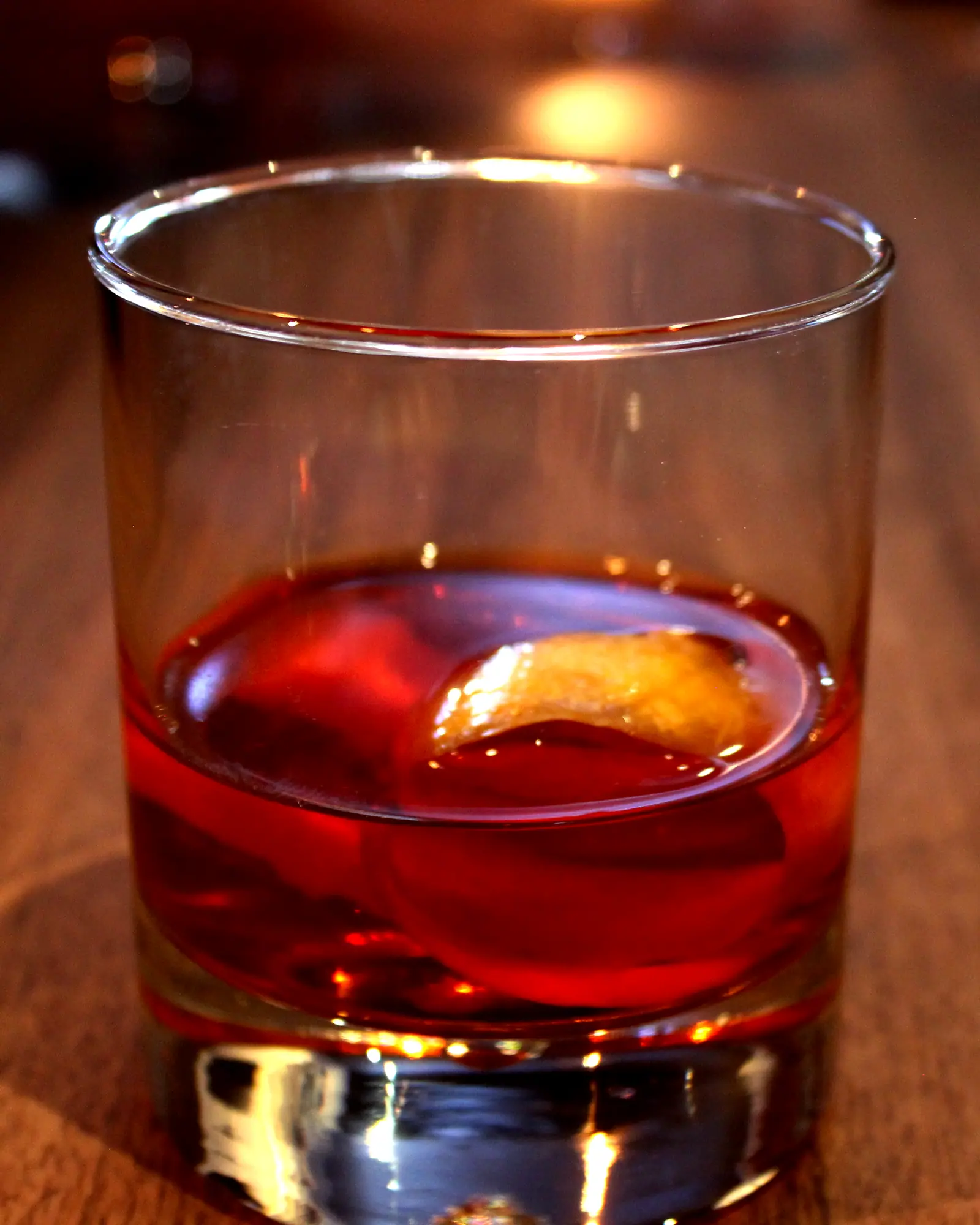
A Sazerac served up in a rocks glass with no ice, deep amber-red, with a lemon peel resting on the surface
Serving
Drink spec, per drink
Every figure above is per drink and does not move with the count, which is what makes the two service modes comparable. Sugar per litre, strength and standard drinks stay in the units their own authorities publish, because they are figures for comparing rather than for pouring. Dilution is modelled rather than measured, as a fraction of the poured volume before any ice; dotted figures descend from that estimate.
Diet and allergen labels are computed from the ingredients listed on this page and nothing else. They cannot account for cross-contamination or for the particular product you buy, and they are not medical or safety guidance.
Ingredients
 6 dashes absinthe (5 ml)
 7.5 ml simple syrup
 3 dashes Peychaud's Bitters (2.7 ml)Proprietary
 60 ml rye whiskey
 1 lemon (58 g)
- 6 dashes absinthe (5 ml)
- 7.5 ml simple syrup
- 3 dashes Peychaud's Bitters (2.7 ml)Proprietary
- 60 ml rye whiskey
- 1 lemon (58 g)
- ~32 ml water
Glass
Vessel
103 ml of liquid, served without ice, inside the 300 ml the glass holds. The build fails if a recipe ever exceeds its stated vessel.
A batch needs a vessel that closes and fits a fridge shelf.
Method
5 steps · 1m 50sChill a rocks glass. Pour the 6 dashes absinthe (5 ml) into it, tilt and swirl so the spirit coats the inside completely, then tip it out over the sink.
The absinthe never joins the other ingredients in the mixing glass. It is poured straight into the chilled serving glass, swirled to coat the inside and tipped out, so the drink carries only its aroma rather than its full alcohol. Adding the rinsed measure whole would push real strength into a drink this small; rinsing keeps the anise on the nose without the arithmetic it would otherwise carry.
Combine the 7.5 ml simple syrup, the 3 dashes Peychaud's Bitters (2.7 ml) and the 60 ml rye whiskey in a mixing glass filled with cubed ice.
Stir for 25s, until the outside of the glass is frosted.
Strain into the rinsed glass, which holds no ice of its own.
Cut a 4 cm swathe of lemon peel, hold it skin-outwards over the surface and squeeze so the oil lands on the drink, then discard the peel rather than dropping it in.
Common pitfallStraining onto ice or into an unchilled glass loses the point of the absinthe rinse entirely: the coating warms and thins before the drink ever reaches the glass, and what should read as a top note reads as nothing at all.
Keeping and make-ahead
Batched ahead, this keeps sealed and cold. The water line the engine adds is the dilution figure from the spec panel, not a rule of thumb.
About
A New Orleans apothecary's bitters, a brand of imported cognac and a whiskey substitution forced by a vine disease, assembled over decades into the drink Louisiana later declared its official cocktail.
The name comes from a brand of cognac, Sazerac-de-Forge et Fils, imported into New Orleans around 1850 by the merchant Sewell T. Taylor 1. Aaron Bird, who ran the Merchants Exchange Coffee House on Exchange Alley, began serving a cocktail built on that cognac, and the bitters said to have gone into it from the start were made by the local apothecary Antoine Amédée Peychaud, who is credited with formulating them in 1834 2.
The drink's own history is not settled beyond that point. The most-repeated account traces its assembly to Bird's bar rather than to Peychaud personally, and the historian David Wondrich has argued the popular version of events compresses a longer, messier commercial history, including the possibility that an early form was sold bottled by the Sazerac company itself rather than mixed to order 1. Both readings agree on the two changes that turned the drink into the one served today. Around 1870, when Thomas H. Handy took over what by then was called the Sazerac Coffee House, cognac gave way to American rye whiskey after phylloxera devastated the French vineyards that supplied it 2. An absinthe rinse was added to the glass at some point in the same period, and when absinthe was banned in the United States in 1912 the Sazerac company introduced its own substitute, Herbsaint, which stood in for it for decades afterward 2.
On June 23, 2008, the Louisiana Legislature named the Sazerac the state's official cocktail of the city of New Orleans 2, a designation with a firm date even where the drink's earlier decades are disputed.
The rinse rather than a poured measure of absinthe is the detail that survives every retelling. It is what lets a spirit strong enough to flavour the whole glass appear only as a scent on the nose, and it is also the reason the drink is stirred separately from the glass it is served in rather than built inside it the way its plainer, older relatives are.
- 1Sazerac (New Orleans style)diffordsguide.com
- 2Sazeracen.wikipedia.org