
Rooibos
Fermented rooibos leaf steeped like black tea, with no caffeine in it at all.
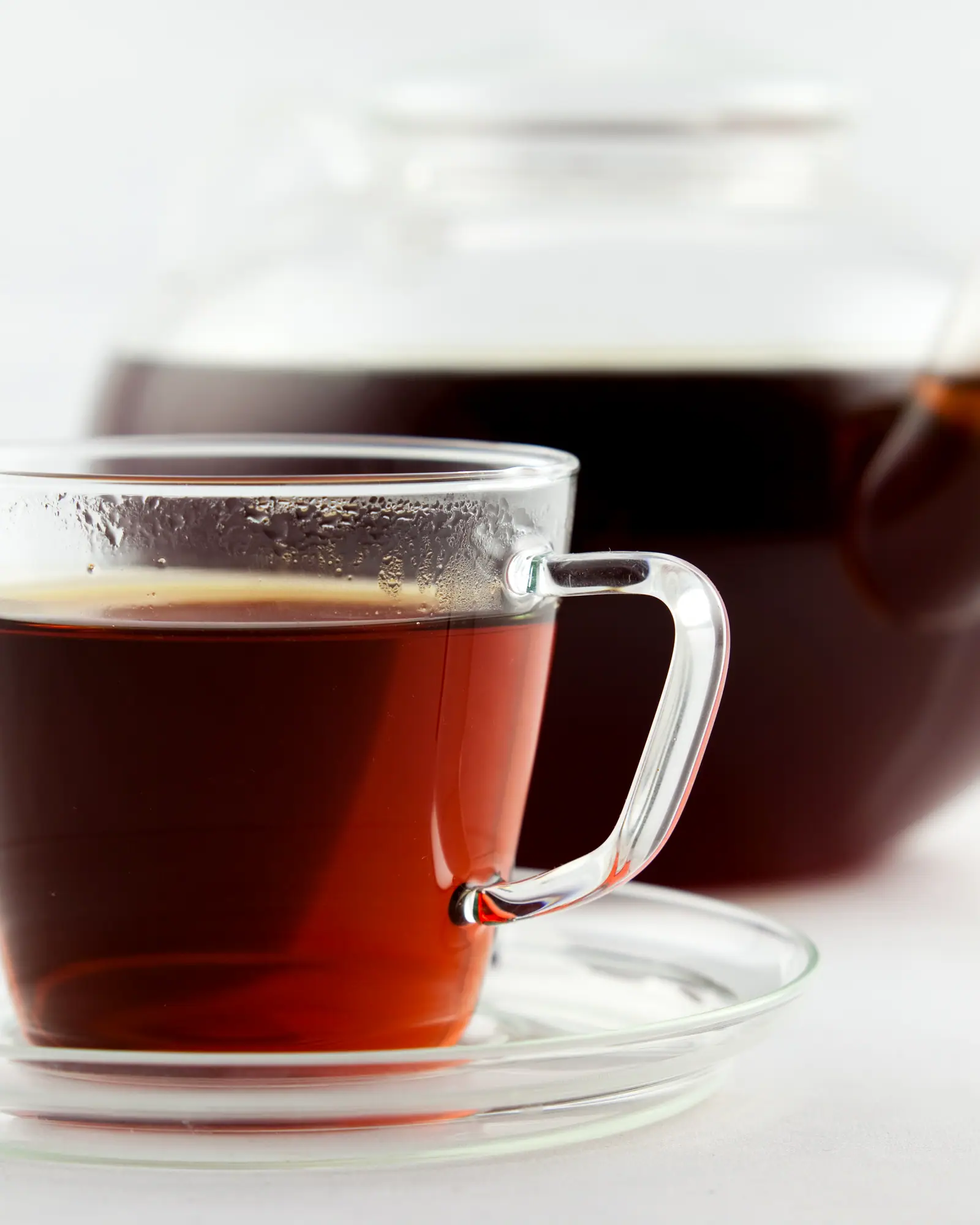

CC BY-SA 3.0 · Cropped, white-balanced, graded and re-encoded to WebP by eXir.
A glass cup of freshly brewed rooibos tea, deep amber-red, with a glass teapot behind it
Serving
Drink spec, per drink
Every figure above is per drink and does not move with the count, which is what makes the two service modes comparable. Sugar per litre, strength and standard drinks stay in the units their own authorities publish, because they are figures for comparing rather than for pouring.
Diet and allergen labels are computed from the ingredients listed on this page and nothing else. They cannot account for cross-contamination or for the particular product you buy, and they are not medical or safety guidance.
Extraction
No extraction yield is shown. It needs a measured dissolved-solids figure from the finished cup, nothing on a bag of coffee supplies one, and estimating it from the method would be inventing the single number the calculation exists to establish.
Ingredients
 240 ml water
 3 g rooibos
- 240 ml water
- 3 g rooibos
Glass
Vessel
220 ml of liquid, served without ice, inside the 350 ml the glass holds. The build fails if a recipe ever exceeds its stated vessel.
A batch needs a vessel that closes and fits a fridge shelf.
Method
2 steps · 5mPour the 240 ml water at 100 °C over the 3 g rooibos and steep for 5m.
Rooibos has no tannin problem the way a true tea leaf does, so it can steep well past the point that would turn black tea bitter without the cup souring; the stated time is for strength rather than a limit not to cross.
Strain into a mug, leaving the spent leaf behind.
Common pitfallRooibos steeped too briefly, on the assumption it behaves like a delicate green tea, comes out thin and grassy rather than the deep amber cup the leaf is capable of.
Keeping and make-ahead
Batched ahead, this keeps sealed and cold. The water line the engine adds is the dilution figure from the spec panel, not a rule of thumb.
About
Fermented leaf from a Cederberg shrub, steeped like black tea but naturally free of caffeine, turned into an industry by a Russian immigrant who could not at first get the plant to grow to order.
Rooibos, Aspalathus linearis, grows wild only in South Africa's Cederberg region, and the Khoisan people who lived there are understood to have known the plant early on, though the historical record does not clearly establish that they brewed it as tea or used it medicinally the way it is used today 1. The first written account is European: the naturalist Carl Thunberg documented the wild plant in the Cederberg mountains in 1772, noting its taste and aroma, after which settlers took to it as a cheaper local alternative to imported black tea 1.
The industry now built around it is comparatively recent. Benjamin Ginsberg, a Russian immigrant who had been trading on foot and by mule cart through the Cederberg valleys, learned of rooibos from local harvesters and began buying and reselling it around 1903, opening a shop in Clanwilliam the following decade and building the trade into a real business 2. In 1904 he worked out the fermentation, or "sweating," process still used to turn the green leaf a deep red-brown, and he marketed the finished tea under the brand Eleven O'Clock, still the oldest surviving packaged rooibos label 2 1.
Growth outpaced supply through the 1920s because nobody could reliably germinate the plant from seed. The problem was solved by Pieter le Fras Nortier, a doctor and Ginsberg's business partner, who found in the 1930s that scarifying the tough seed coat by grinding it and sowing the seed in acidic, sandy soil made cultivation possible, turning rooibos from a wild harvest into a farmed crop 1.
- 1The History of Rooibos Teaklipopmekaar.co.za
- 2Benjamin Ginsberg (businessman)en.wikipedia.org