
Arabic Qahwa
Lightly roasted coffee simmered with cardamom and a thread of saffron, poured without sugar.
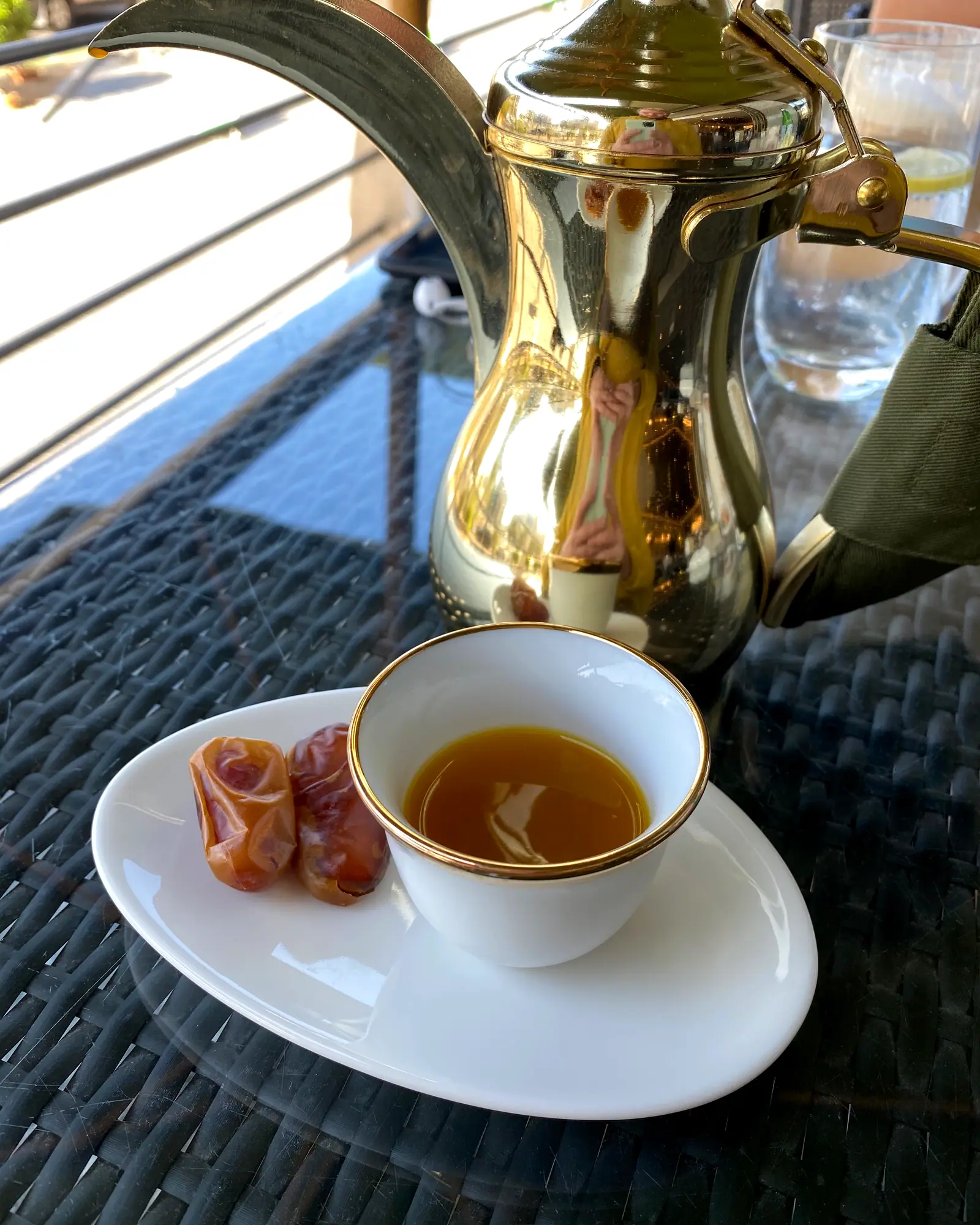

CC BY-SA 4.0 · Cropped, white-balanced, graded and re-encoded to WebP by eXir.
A small white cup of golden-brown qahwa on a saucer with dates, beside a brass dallah coffee pot
Serving
Drink spec, per drink
Every figure above is per drink and does not move with the count, which is what makes the two service modes comparable. Sugar per litre, strength and standard drinks stay in the units their own authorities publish, because they are figures for comparing rather than for pouring.
Diet and allergen labels are computed from the ingredients listed on this page and nothing else. They cannot account for cross-contamination or for the particular product you buy, and they are not medical or safety guidance.
Extraction
This brew works out at 66.7 g of coffee per litre of water, against the 49.5 to 60.5 g/L the standard allows, so it is stronger than it. The comparison is made in grams per litre and not on the ratio, because a ratio is the reciprocal of a strength and a symmetric band on one is an asymmetric band on the other. Source: Golden Cup Standard, Specialty Coffee Association.
No extraction yield is shown. It needs a measured dissolved-solids figure from the finished cup, nothing on a bag of coffee supplies one, and estimating it from the method would be inventing the single number the calculation exists to establish.
Ingredients
 8 g coffee
 120 ml water
 1.5 g crushed cardamom pods
 0.1 g saffron threads
- 8 g coffee
- 120 ml water
- 1.5 g crushed cardamom pods
- 0.1 g saffron threads
Glass
Vessel
40 ml of liquid, served without ice, inside the 80 ml the glass holds. The build fails if a recipe ever exceeds its stated vessel.
A batch needs a vessel that closes and fits a fridge shelf.
Method
4 steps · 8mGrind the 8 g coffee coarse and lightly roasted.
Combine the grounds with the 120 ml water in the dallah and simmer at 95 °C for 5m.
Take the pot off the heat, stir in the 1.5 g crushed cardamom pods and 0.1 g saffron threads, and leave to infuse for 2m.
The pot is taken off the heat before the cardamom and saffron go in and left to sit rather than simmered further, because boiling the spices rather than steeping them off the heat cooks off the aromatics the drink is built around.
Strain into small cups, filling each only a third full.
Common pitfallSugar has no place in the pot. Qahwa is served unsweetened by convention, alongside dates rather than with sugar stirred through it, and adding any changes the drink into something else.
Keeping and make-ahead
Simmered to order in a dallah; the pot is traditionally kept warm and poured over a sitting rather than made ahead and reheated.
About
Pale, unsweetened coffee simmered with cardamom and saffron and poured in small measures, a fixture of Gulf hospitality inscribed as intangible heritage in 2015.
Coffee moved through Yemeni ports as one of the region's major traded goods long before it settled into the ceremony now associated with it, and gahwa grew from what began as a simple gesture of welcome toward travellers into a formal ritual of diplomacy and daily hospitality across the Gulf 1. Cardamom is the constant in the recipe, with cloves, saffron and occasionally rosewater used alongside it depending on the household 2. The style is a lighter roast and a shorter simmer than Turkish coffee, poured pale and without sugar.
The vessel is as much a part of the tradition as the brew. The dallah, the long-spouted pot with a domed lid used to simmer and serve it, takes its name from an Arabic root meaning to pamper, and regional forms vary by craftsmanship, with the Iraqi al-Baghdadiya dallah considered among the oldest and finest still made 2. In the United Arab Emirates the pot's standing was formalised outright: it has appeared on the national one-dirham coin since 1973 1.
Declining a cup when it is offered carries real weight. The pour itself is small and repeated rather than a single full serving, and refusing it, or failing to offer it to a guest, is read as a breach of hospitality rather than a simple preference 1. That social role, alongside the brewing method itself, is what UNESCO recognised in 2015 when Arabic coffee culture was added to its Representative List of the Intangible Cultural Heritage of Humanity 2.
- 1Gahwa in the Gulf: Meaning behind the traditional coffee ceremonythenationalnews.com
- 2Energising berries, Arabian dallah and the origins of gahwagulfnews.com