
Pour-Over Coffee
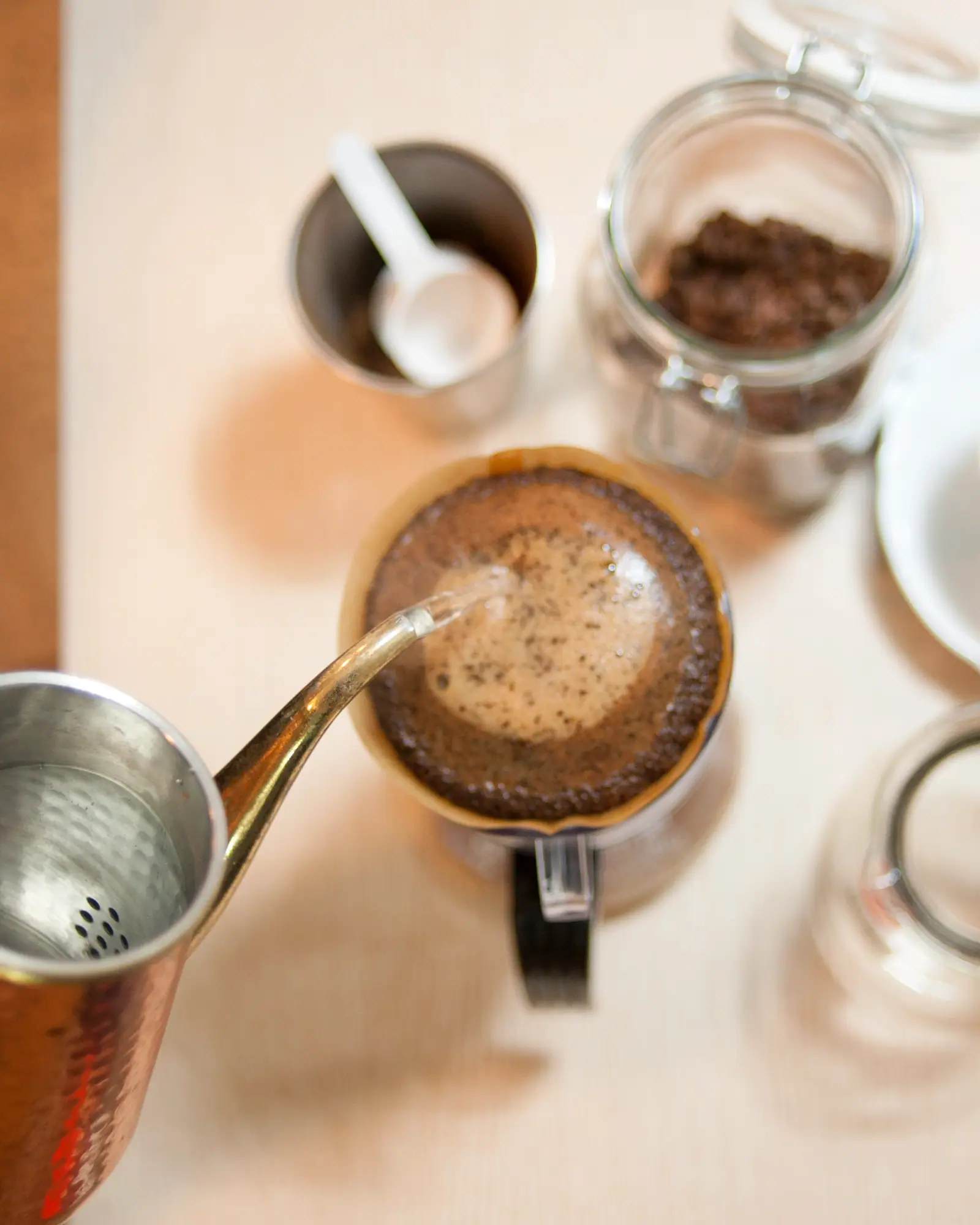
Ground coffee, a paper filter and a kettle. The bed deepens as the cone narrows.
The same brew in a flat-bottomed dripper, where the bed stays the same depth throughout.
_coffee.jpg)
CC0 · Cropped, white-balanced, graded and re-encoded to WebP by eXir.
Water poured from a gooseneck kettle onto a bed of coffee grounds in a cone dripper set over a mug, seen from above
Serving
Drink spec, per drink
Every figure above is per drink and does not move with the count, which is what makes the two service modes comparable. Sugar per litre, strength and standard drinks stay in the units their own authorities publish, because they are figures for comparing rather than for pouring.
Diet and allergen labels are computed from the ingredients listed on this page and nothing else. They cannot account for cross-contamination or for the particular product you buy, and they are not medical or safety guidance.
Extraction
This brew works out at 61.1 g of coffee per litre of water, against the 49.5 to 60.5 g/L the standard allows, so it is stronger than it. The comparison is made in grams per litre and not on the ratio, because a ratio is the reciprocal of a strength and a symmetric band on one is an asymmetric band on the other. Source: Golden Cup Standard, Specialty Coffee Association.
No extraction yield is shown. It needs a measured dissolved-solids figure from the finished cup, nothing on a bag of coffee supplies one, and estimating it from the method would be inventing the single number the calculation exists to establish.
Ingredients
 22 g coffee
 360 ml water
- 22 g coffee
- 360 ml water
Glass
Vessel
320 ml of liquid, served without ice, inside the 350 ml the glass holds. The build fails if a recipe ever exceeds its stated vessel.
A batch needs a vessel that closes and fits a fridge shelf.
Drink spec, per drink
Every figure above is per drink and does not move with the count, which is what makes the two service modes comparable. Sugar per litre, strength and standard drinks stay in the units their own authorities publish, because they are figures for comparing rather than for pouring.
Diet and allergen labels are computed from the ingredients listed on this page and nothing else. They cannot account for cross-contamination or for the particular product you buy, and they are not medical or safety guidance.
Extraction
This brew works out at 62.9 g of coffee per litre of water, against the 49.5 to 60.5 g/L the standard allows, so it is stronger than it. The comparison is made in grams per litre and not on the ratio, because a ratio is the reciprocal of a strength and a symmetric band on one is an asymmetric band on the other. Source: Golden Cup Standard, Specialty Coffee Association.
No extraction yield is shown. It needs a measured dissolved-solids figure from the finished cup, nothing on a bag of coffee supplies one, and estimating it from the method would be inventing the single number the calculation exists to establish.
Ingredients
- 22 g coffee
- 350 ml water
- 22 g coffee
- 350 ml water
Glass
Vessel
310 ml of liquid, served without ice, inside the 350 ml the glass holds. The build fails if a recipe ever exceeds its stated vessel.
A batch needs a vessel that closes and fits a fridge shelf.
Method
4 steps · 4m 15sGrind the 22 g coffee to a medium-fine texture, a little coarser than table salt.
Set the paper filter in the cone and rinse it through with hot water, then discard what collects underneath. This washes the paper and warms the vessel; an unrinsed filter tastes of itself.
Pour the 50 ml water at 94 °C over the grounds, wetting all of them, and leave it for 30s. The bed will swell and foam.
Fresh coffee carries dissolved carbon dioxide from roasting, and it comes out as gas the moment it meets hot water. Gas in the bed pushes water away from the grounds, so wetting the dose and waiting is what lets the rest of the brew extract evenly instead of channelling around a foaming crust.
Add the 310 ml water over 2m 30s, pouring in a slow spiral and keeping the bed level. The drawdown should finish shortly after the last of the water goes in.
Common pitfallPouring hard enough to dig a crater in the bed sends water down the sides of the filter rather than through the grounds. The cup then tastes thin and sour and the usual response is to grind finer, which makes it worse.
Keeping and make-ahead
Coffee is brewed to order. A batch held warm keeps oxidising and is a different and worse drink within twenty minutes.
Method
4 steps · 4m 45sGrind the 22 g coffee a shade coarser than you would for a cone. A flat bed drains more slowly at the same grind, and the extra contact is already in the recipe.
Set the wave filter in the dripper, open its pleats and rinse it through with hot water. Discard what collects underneath.
Pour the 50 ml water at 93 °C over the grounds and leave it for 40s.
Add the 300 ml water over 2m 50s in three even additions, pouring into the middle and letting the level fall between them.
A flat bottom holds the grounds at one depth across the whole bed, so water passes through the same amount of coffee wherever it enters. A cone piles the grounds deeper in the middle, which is why it rewards a careful pour and this shape forgives a careless one.
Keeping and make-ahead
Brewed to order, like the cone.
About
Filtered coffee poured by hand, a method invented to solve a domestic annoyance in 1908 and rebuilt twice since as an instrument of precision.
Paper-filtered coffee begins with a specific registration. Melitta Bentz filed her design with the Imperial Patent Office in Berlin on 20 June 1908, and it was granted on 8 July as a utility model described as a coffee filter with a domed underside, a recessed bottom and inclined flow holes 1. The problem it solved was grounds in the cup and bitterness from over-extraction, and the solution was paper, which removes both by removing the grounds from the liquid the moment brewing stops.
The method was redesigned as a scientific instrument rather than a kitchen convenience by Peter Schlumbohm, whose Chemex dates from 1941 2. Its filter is markedly thicker than a drip filter, which holds back most of the oils and produces a cup usually described as clean 2. This is a deliberate trade of body for clarity, and the first time the paper itself was treated as a variable worth choosing.
The current specialty form is more recent still. Hario's V60 dates from 2004 and is named for its shape: a cone at a sixty-degree angle, with spiral ribs added so that water runs down the sides rather than being held against them by the paper 3. Between the three of them the equipment has changed far less than the intent has. Bentz was removing a nuisance; the modern cone exists to make every variable adjustable.
Two things distinguish this from every other drink documented here. The first is that it scales by ratio rather than by count: doubling the cup means doubling the dose and the water together, while the temperature, the grind and the contact time stay exactly where they are. The second is that most of what is weighed out never arrives. About a fifth of the dose dissolves; the rest stays in the filter, along with a tenth of the water, which is why the cup is smaller than the kettle suggests and why the figures here are stated against what reaches it.
- 1Melitta Bentz's coffee filtersdpma.de
- 2Chemex Coffeemakeren.wikipedia.org
- 3Birth of the Hario V60hario.co.uk