
Pisco Sour
Pisco, lime and syrup, rounded by egg white and finished with a few drops of bitters.
Pisco, lime and syrup alone, drier and more spirit-forward than the Peruvian.
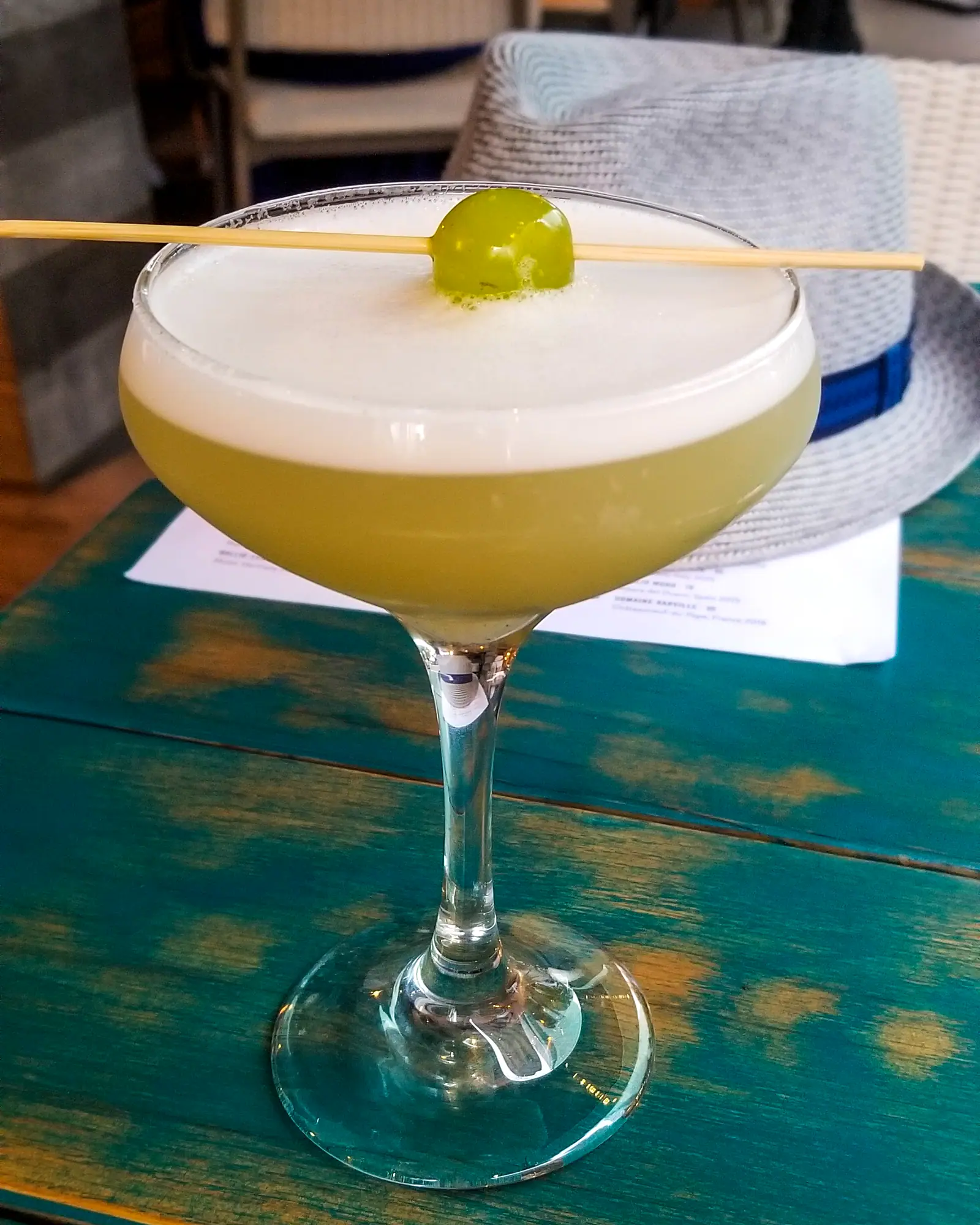

CC BY 2.0 · Cropped, white-balanced, graded and re-encoded to WebP by eXir.
A frothy pale yellow Pisco Sour served up in a coupe, garnished with a grape on a pick
Serving
Drink spec, per drink
Every figure above is per drink and does not move with the count, which is what makes the two service modes comparable. Sugar per litre, strength and standard drinks stay in the units their own authorities publish, because they are figures for comparing rather than for pouring. Dilution is modelled rather than measured, as a fraction of the poured volume before any ice; dotted figures descend from that estimate.
The producer's own product page states the bitters are 100% vegan and gluten-free.
Diet and allergen labels are computed from the ingredients listed on this page and nothing else. They cannot account for cross-contamination or for the particular product you buy, and they are not medical or safety guidance.
Ingredients
 23 ml fresh lime juice
 53 ml pisco
 15 ml simple syrup
 ½ white egg white (15 ml)
 1 dash Angostura Aromatic Bitters (0.9 ml)Proprietary
- 23 ml fresh lime juice
- 53 ml pisco
- 15 ml simple syrup
- ½ white egg white (15 ml)
- 1 dash Angostura Aromatic Bitters (0.9 ml)Proprietary
- ~58 ml water
Glass
Vessel
164 ml of liquid, served without ice, inside the 180 ml the glass holds. The build fails if a recipe ever exceeds its stated vessel.
A batch needs a vessel that closes and fits a fridge shelf.
Drink spec, per drink
Every figure above is per drink and does not move with the count, which is what makes the two service modes comparable. Sugar per litre, strength and standard drinks stay in the units their own authorities publish, because they are figures for comparing rather than for pouring. Dilution is modelled rather than measured, as a fraction of the poured volume before any ice; dotted figures descend from that estimate.
Diet and allergen labels are computed from the ingredients listed on this page and nothing else. They cannot account for cross-contamination or for the particular product you buy, and they are not medical or safety guidance.
Ingredients
- 23 ml fresh lime juice
- 68 ml piscoInterchangeable by volume, but rum brings a sweetness pisco does not have, so the drier, more citrus-forward balance this tab is built around softens considerably.flavour: significant change · strength: no change · sweetness: minor change
- 23 ml simple syrup
- 23 ml fresh lime juice
- 68 ml pisco
- 23 ml simple syrup
- ~56 ml water
Glass
Vessel
169 ml of liquid, served without ice, inside the 180 ml the glass holds. The build fails if a recipe ever exceeds its stated vessel.
A batch needs a vessel that closes and fits a fridge shelf.
Method
6 steps · 2m 9sSqueeze the 23 ml fresh lime juice and strain out the pips and pulp.
Combine the 53 ml pisco, the 23 ml fresh lime juice, the 15 ml simple syrup and the ½ white egg white (15 ml) in a shaker, with no ice yet.
Shake hard for 20s with no ice, so the egg white has room to whip into a stable foam before any water is added to it.
Shaken once without ice before the ice ever goes in. Cold, diluted liquid resists whipping into a foam; the dry shake builds the emulsion while the drink is still warm and full strength, and the second shake only has to chill and finish what the first one started.
Add cubed ice and shake again for 14s to chill the drink and finish the emulsion.
Fine strain into a chilled coupe, so none of the ice shards from the second shake reach the glass to break the foam.
Set the 1 dash Angostura Aromatic Bitters (0.9 ml) on the foam in a few drops, drawn through with a pick if a pattern is wanted; either way it sits on the surface rather than sinking in.
Common pitfallA short or timid dry shake leaves a thin, fast-collapsing foam rather than the dense head this drink is built around, and it is the step most often rushed because nothing in the shaker seems to be happening yet.
Keeping and make-ahead
Batched ahead, this keeps sealed and cold. The water line the engine adds is the dilution figure from the spec panel, not a rule of thumb.
Method
4 steps · 1m 37sSqueeze the 23 ml fresh lime juice and strain out the pips and pulp.
Combine the 68 ml pisco, the 23 ml fresh lime juice and the 23 ml simple syrup in a shaker and fill it with cubed ice.
No egg white here, and more pisco relative to the lime and syrup than the Peruvian tab: three parts spirit against one each of citrus and sugar, rather than the family's usual two against three quarters. The result is shorter, drier and reads the spirit before it reads sour.
Shake hard for 12s.
Double strain into a chilled coupe, catching the ice shards the shake has broken off.
Keeping and make-ahead
Batched ahead, this keeps sealed and cold. The water line the engine adds is the dilution figure from the spec panel, not a rule of thumb.
About
A Lima bar's early-twentieth-century answer to the whiskey sour, claimed by both Peru and Chile as a national drink and made differently in each country to this day.
The pisco sour is generally traced to Victor Vaughen Morris, an American who moved to Peru in 1904, settled in Lima in 1915 and opened Morris' Bar there the following year 1. He is credited with building the drink as a pisco-based variation on the whiskey sour, though the earliest advertisement naming it dates only to 1920, and a 1903 Peruvian cookbook has since turned up a pisco punch made with egg white that predates his bar entirely, leaving open whether Morris invented the drink or refined one already circulating in Lima 1. The egg white, Angostura bitters and the frothy head associated with the drink today are credited to Mario Bruiget, a Peruvian bartender who worked under Morris from 1924 1.
Peru and Chile have disputed the drink, and the spirit it is built on, for decades 2. Chile's rival claim rests on a local story crediting an English steward named Elliot Stubb, a story a later researcher traced to newspaper reports that actually describe a whiskey sour rather than a pisco one 1. The countries also disagree over pisco itself: Peru holds the European Union's protected designation of origin for the name, and manuscripts examined in 2024 documenting sixteenth- and seventeenth-century production and export were read as supporting Peru's claim to the spirit, though Chile continues to produce and sell pisco of its own under its own rules 2.
What is not disputed is that the two countries now make different drinks under the same name. Peru's version takes egg white and bitters; Chile's does not, leaning instead on a drier, more citrus-forward balance of pisco, lime and sugar 2.
- 1Pisco souren.wikipedia.org
- 2This Beloved South American Spirit Sparked a Bitter, Decades-Long Feudthetakeout.com