
Matcha
Whisked thin, vigorously, into a light foam. This is the everyday way to drink it.
Double the matcha in half the water, kneaded rather than frothed, for the ceremony's formal centrepiece.
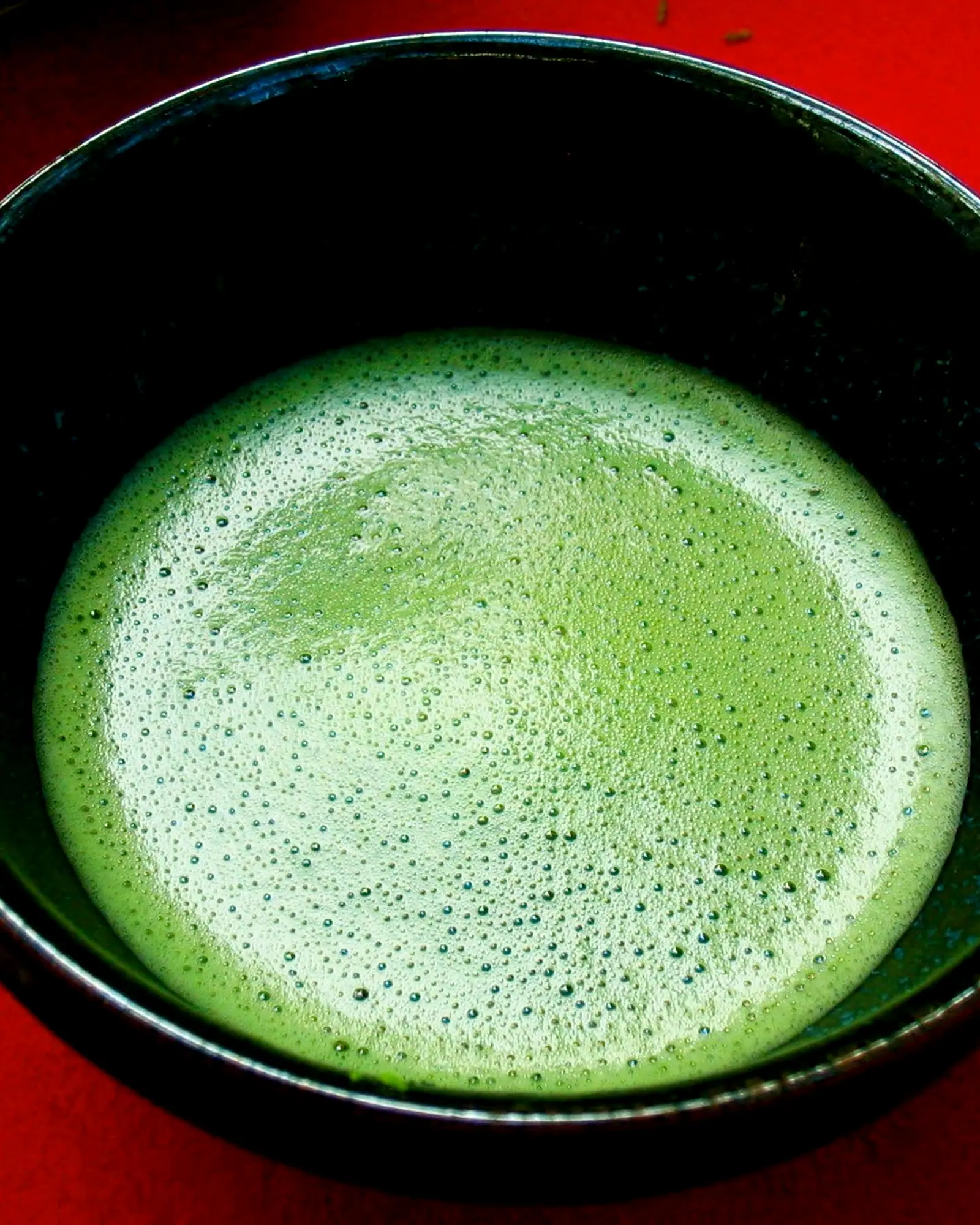

CC BY 2.0 · Cropped, white-balanced, graded and re-encoded to WebP by eXir.
Overhead view of whisked usucha matcha in a black chawan, bright green with a fine foam
Serving
Drink spec, per drink
Every figure above is per drink and does not move with the count, which is what makes the two service modes comparable. Sugar per litre, strength and standard drinks stay in the units their own authorities publish, because they are figures for comparing rather than for pouring.
Diet and allergen labels are computed from the ingredients listed on this page and nothing else. They cannot account for cross-contamination or for the particular product you buy, and they are not medical or safety guidance.
Ingredients
 2 g matcha
 70 ml water
- 2 g matcha
- 70 ml water
Glass
Vessel
70 ml of liquid, served without ice, inside the 350 ml the glass holds. The build fails if a recipe ever exceeds its stated vessel.
A batch needs a vessel that closes and fits a fridge shelf.
Drink spec, per drink
Every figure above is per drink and does not move with the count, which is what makes the two service modes comparable. Sugar per litre, strength and standard drinks stay in the units their own authorities publish, because they are figures for comparing rather than for pouring.
Diet and allergen labels are computed from the ingredients listed on this page and nothing else. They cannot account for cross-contamination or for the particular product you buy, and they are not medical or safety guidance.
Ingredients
- 4 g matcha
- 35 ml water
- 4 g matcha
- 35 ml water
Glass
Vessel
35 ml of liquid, served without ice, inside the 350 ml the glass holds. The build fails if a recipe ever exceeds its stated vessel.
A batch needs a vessel that closes and fits a fridge shelf.
Method
2 steps · 40sSift the 2 g matcha into the bowl to break up any clumps.
Add the 70 ml water just off the boil and whisk briskly in a zigzag until the surface is covered in a fine, even foam.
The chasen moves in a fast zigzag rather than a stir, which is what raises the foam; a slow circular motion just moves the powder around without breaking it into the water.
Common pitfallUnsifted matcha clumps the moment hot water hits it, and no amount of whisking afterwards fully breaks those clumps back down; the sieve is not an optional step for a smooth bowl.
Keeping and make-ahead
Whisked to order in the bowl it is drunk from; matcha whisked ahead and left standing separates and loses its foam.
Method
2 steps · 50sSift the 4 g matcha into the bowl to break up any clumps.
Add the 35 ml water just off the boil in two additions, folding and kneading with the chasen after each until the paste is smooth, glossy and free of bubbles.
The chasen folds and kneads here rather than whisking fast, working the paste smooth without raising bubbles; a foam that is the whole point of usucha is treated as a flaw in koicha, which is meant to pour as a dense, unbroken liquid.
Common pitfallWater added all at once, rather than in a couple of additions worked in gradually, tends to leave unbroken lumps of matcha suspended in the paste that the slow kneading motion cannot fully catch.
Keeping and make-ahead
Kneaded to order in the bowl it is drunk from; the paste separates if it is made ahead and left standing.
About
Powdered green tea whisked into hot water, split by Japanese tea ceremony practice into a light everyday style and a dense, formal one from the same leaf.
Powdered tea reached Japan in the late twelfth century, brought back by the Zen monk Eisai, and the earliest preparations were dense rather than light, closer to what is now called koicha than to the thin, frothed style more commonly drunk today 1. The formal split between the two only developed later, as tea practice spread out from monasteries into samurai households and beyond, and needed both a ceremonial centrepiece and a lighter, more shareable everyday form 1.
The sixteenth-century tea master Sen no Rikyū, credited with much of the Japanese tea ceremony's present form, is recorded in period texts as favouring usucha specifically, even though koicha occupies the ceremonial high point of a formal gathering 1. The likely reason given is practical rather than aesthetic: usucha uses less tea, is easier to drink and can be shared across a wider group, where koicha is reserved for smaller, more formal occasions 1.
The two are not just diluted versions of one recipe. Koicha uses roughly double the matcha in about half the water of usucha, and it is not whisked at all in the usual sense: the chasen kneads and folds it into a smooth, bubble-free paste, where usucha is whisked hard in a zigzag specifically to raise a foam 2 1. That foam softens usucha's astringency; koicha is drunk without it, closer to the tea's unmediated flavour, and is traditionally made from a single bowl shared among the guests at a formal tea gathering rather than poured individually 1.
- 1Koicha vs Usucha: The Full Breakdown of Matcha's Two Preparationsjapanesetea.sg
- 2Koicha vs. Usucha: Understanding the Differences in Traditional Matcha Preparationssugimotousa.com