
Karkade
Dried hibiscus calyces boiled and sweetened, the everyday infusion of Egypt and Sudan.
The same boiled hibiscus, brewed strong and poured hot over ice.
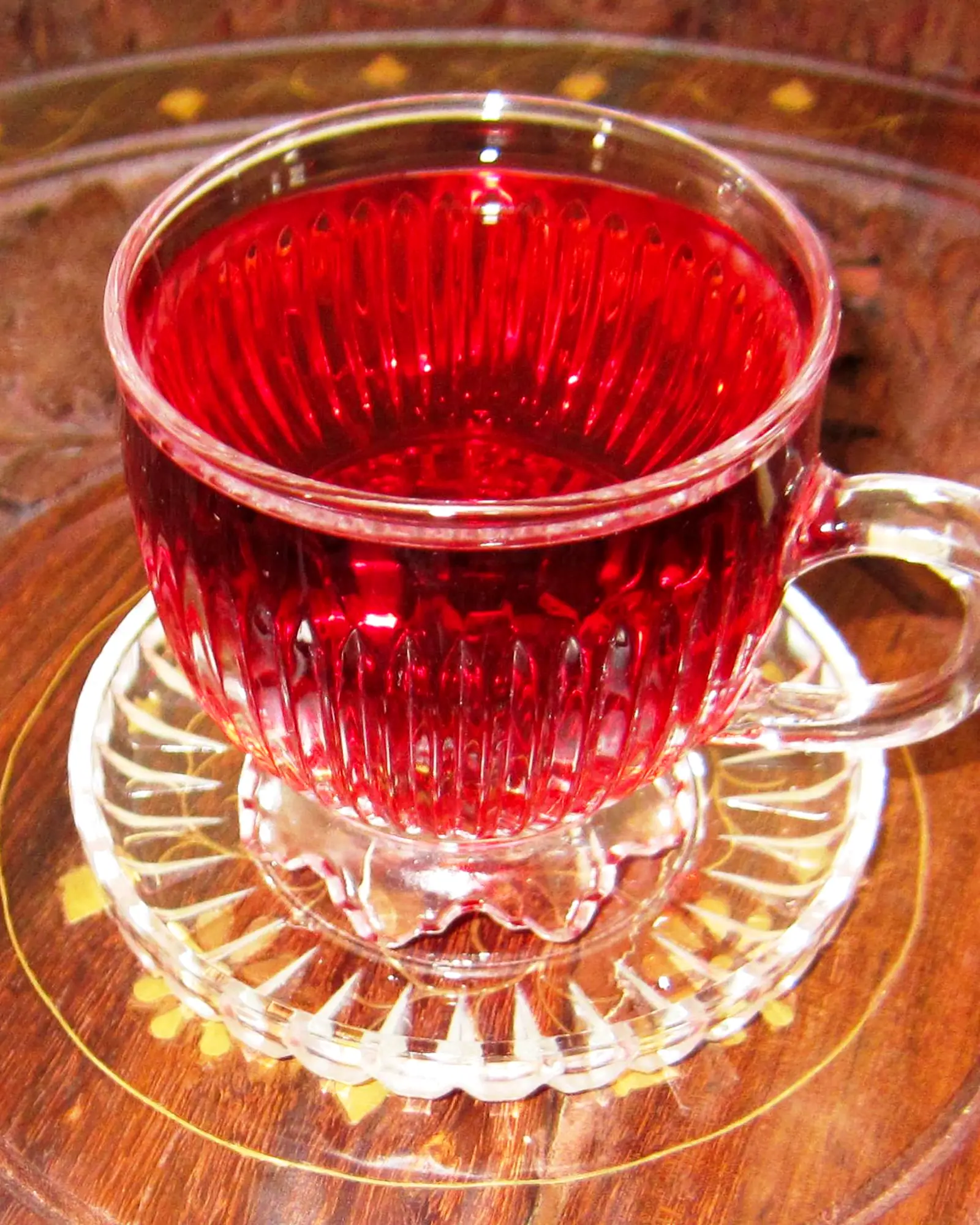

CC BY-SA 4.0 · Cropped, white-balanced, graded and re-encoded to WebP by eXir.
Deep red hibiscus infusion filling a glass teacup on a matching saucer
Serving
Drink spec, per drink
Every figure above is per drink and does not move with the count, which is what makes the two service modes comparable. Sugar per litre, strength and standard drinks stay in the units their own authorities publish, because they are figures for comparing rather than for pouring.
Diet and allergen labels are computed from the ingredients listed on this page and nothing else. They cannot account for cross-contamination or for the particular product you buy, and they are not medical or safety guidance.
Extraction
This brew works out at 50.0 g of coffee per litre of water, against the 49.5 to 60.5 g/L the standard allows, so it sits inside it. The comparison is made in grams per litre and not on the ratio, because a ratio is the reciprocal of a strength and a symmetric band on one is an asymmetric band on the other. The water temperature also sits outside the standard. Source: Golden Cup Standard, Specialty Coffee Association.
No extraction yield is shown. It needs a measured dissolved-solids figure from the finished cup, nothing on a bag of coffee supplies one, and estimating it from the method would be inventing the single number the calculation exists to establish.
Ingredients
 200 ml water
 10 g dried hibiscus calyces
 12 g granulated sugar
- 200 ml water
- 10 g dried hibiscus calyces
- 12 g granulated sugar
Glass
Vessel
183 ml of liquid, served without ice, inside the 200 ml the glass holds. The build fails if a recipe ever exceeds its stated vessel.
A batch needs a vessel that closes and fits a fridge shelf.
Drink spec, per drink
Every figure above is per drink and does not move with the count, which is what makes the two service modes comparable. Sugar per litre, strength and standard drinks stay in the units their own authorities publish, because they are figures for comparing rather than for pouring.
Diet and allergen labels are computed from the ingredients listed on this page and nothing else. They cannot account for cross-contamination or for the particular product you buy, and they are not medical or safety guidance.
Extraction
This brew works out at 71.4 g of coffee per litre of water, against the 49.5 to 60.5 g/L the standard allows, so it is stronger than it. The comparison is made in grams per litre and not on the ratio, because a ratio is the reciprocal of a strength and a symmetric band on one is an asymmetric band on the other. The water temperature also sits outside the standard. Source: Golden Cup Standard, Specialty Coffee Association.
No extraction yield is shown. It needs a measured dissolved-solids figure from the finished cup, nothing on a bag of coffee supplies one, and estimating it from the method would be inventing the single number the calculation exists to establish.
Ingredients
- 140 ml water
- 10 g dried hibiscus calyces
- 15 g granulated sugar
- 140 ml water
- 10 g dried hibiscus calyces
- 15 g granulated sugar
Glass
Vessel
129 ml of liquid plus 200 ml of cubed ice occupies about 329 ml, inside the 350 ml the glass holds. The build fails if a recipe ever exceeds its stated vessel.
A batch needs a vessel that closes and fits a fridge shelf.
Method
3 steps · 7mBring the 200 ml water to a boil, add the 10 g dried hibiscus calyces and simmer for 7m, until the liquid is a deep ruby red.
The calyces are boiled rather than steeped off the heat, which pulls out both the deep red colour and the tartness at once; a short steep gives colour without much of the sourness this drink is known for.
Strain into a cup, leaving the spent calyces behind.
Stir in the 12 g granulated sugar while the tea is still hot enough to dissolve it.
Common pitfallKarkade left on the heat with the sugar already in tends to scorch at the pan's edge before the colour has fully developed. The sugar goes in after straining, off the heat.
Keeping and make-ahead
Batched ahead, this keeps sealed and cold. The water line the engine adds is the dilution figure from the spec panel, not a rule of thumb.
Method
4 steps · 7mBring the 140 ml water to a boil, add the 10 g dried hibiscus calyces and simmer for 7m, until the liquid is a deep ruby red.
Strain out the spent calyces.
Stir in the 15 g granulated sugar while the tea is still hot enough to dissolve it.
Pour hot over a glass packed with cubed ice.
The tea is brewed to the same strength as the hot version but with less water, since it is about to be let down by melting ice; poured hot straight onto a full glass of cubes, it chills fast rather than sitting at a lukewarm stage on the counter first.
Common pitfallKarkade brewed at the same water ratio as the hot version and simply poured over ice comes out thin and pale once the ice has melted into it. The brew is concentrated first precisely because the ice is going to dilute it.
Keeping and make-ahead
Batched ahead, this keeps sealed and cold. The water line the engine adds is the dilution figure from the spec panel, not a rule of thumb.
About
Dried hibiscus calyces boiled into a ruby infusion drunk hot or cold across Egypt and Sudan, served at weddings and to break the Ramadan fast alike.
Karkade is made from the dried calyces of Hibiscus sabdariffa, a plant grown across Egypt, Sudan and Ethiopia and used here for the drink rather than for the fibre or edible seed it is also cultivated for elsewhere 1. The petals are boiled rather than simply steeped, then strained and sweetened, and the same brew is served hot in winter or poured over ice in summer 2.
The drink is often called "the tea of the pharaohs," a claim traced back to a supposed appearance in the Ebers Papyrus of around 1550 BC. Both sources treat the label as folklore rather than settled history: the papyrus reference is disputed, and the phrase itself appears to have been coined by popular writers rather than scholars of the period 2 1.
What is better documented is karkade's present-day place in Egyptian and Sudanese life. It is poured at weddings as a toast associated with joy and prosperity, and it is a fixture of Ramadan, served at iftar to break the day's fast 2 1. In Muslim communities it also does the job a toast of wine or spirits would do elsewhere, standing in as the drink of celebration at gatherings where alcohol has no place 1. Preparation has stayed a household task rather than a commercial one: the petals are still most often boiled at home, with tea bags treated as a weaker, convenience substitute for the real thing 2.
- 1Ruby Red: How Karkade Became a Signature Egyptian Teaegyptianstreets.com
- 2Karkadehen.wikipedia.org