
Karak Chai
Black tea, cardamom and evaporated milk boiled together rather than steeped apart.
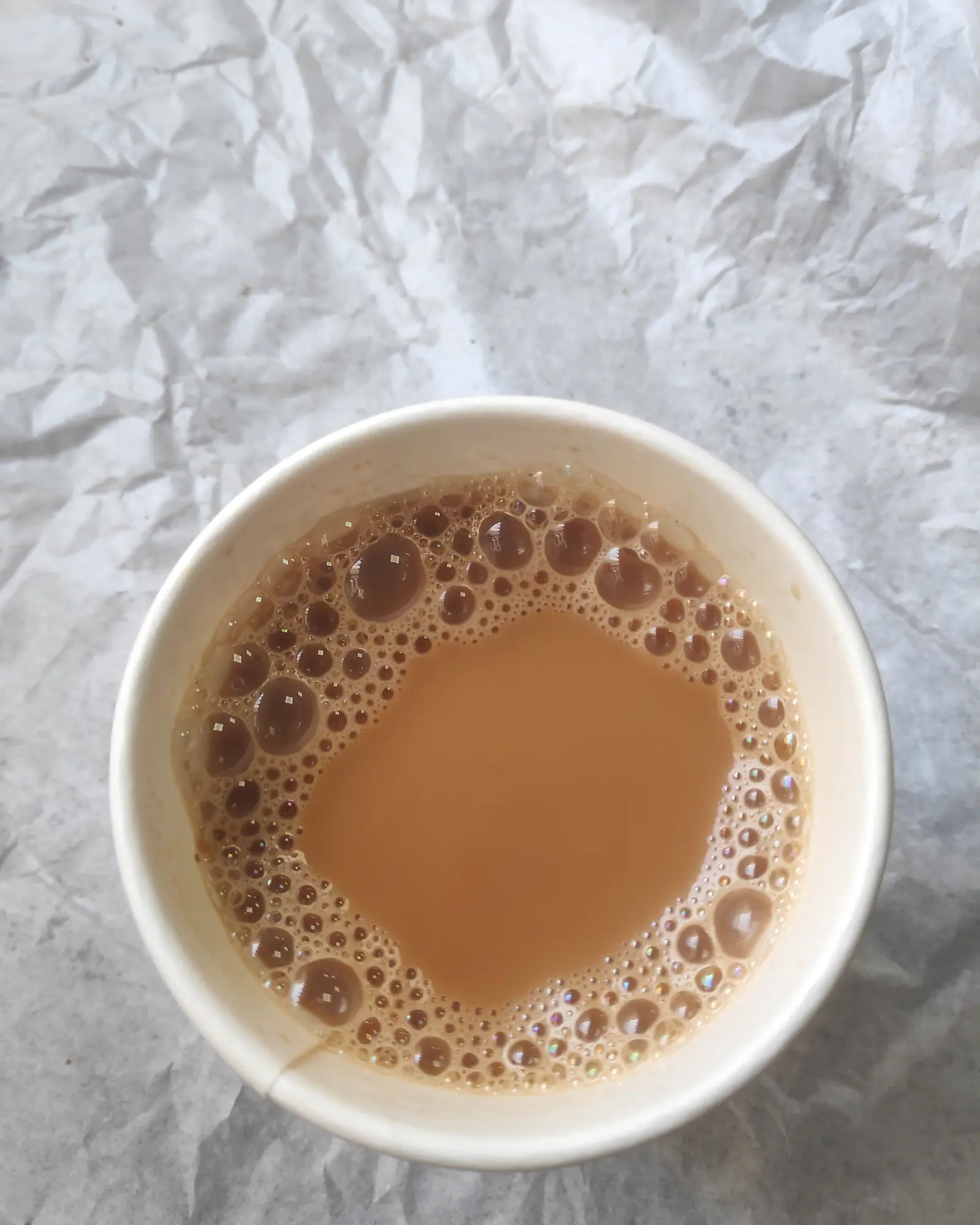
CC BY-SA 4.0 · Cropped, white-balanced, graded and re-encoded to WebP by eXir.
A cup of milky, foam-topped karak chai, viewed from above
Serving
Drink spec, per drink
Every figure above is per drink and does not move with the count, which is what makes the two service modes comparable. Sugar per litre, strength and standard drinks stay in the units their own authorities publish, because they are figures for comparing rather than for pouring.
Diet and allergen labels are computed from the ingredients listed on this page and nothing else. They cannot account for cross-contamination or for the particular product you buy, and they are not medical or safety guidance.
Extraction
This brew works out at 50.0 g of coffee per litre of water, against the 49.5 to 60.5 g/L the standard allows, so it sits inside it. The comparison is made in grams per litre and not on the ratio, because a ratio is the reciprocal of a strength and a symmetric band on one is an asymmetric band on the other. The water temperature also sits outside the standard. Source: Golden Cup Standard, Specialty Coffee Association.
No extraction yield is shown. It needs a measured dissolved-solids figure from the finished cup, nothing on a bag of coffee supplies one, and estimating it from the method would be inventing the single number the calculation exists to establish.
Ingredients


Glass
Vessel
173 ml of liquid, served without ice, inside the 200 ml the glass holds. The build fails if a recipe ever exceeds its stated vessel.
A batch needs a vessel that closes and fits a fridge shelf.
Method
4 steps · 5mCombine the 120 ml water, the 6 g black tea, the 1 g crushed cardamom pods and the 20 g granulated sugar in a small pan, bring to a boil, then lower the heat and simmer for 3m.
Stir in the 60 ml evaporated milk.
Bring back to a boil and simmer again for 2m, until the colour is an even, deep tan.
This is boiled rather than steeped, the family's other branch: the tea, cardamom and sugar go into the water from the start and are brought back to a boil a second time after the 60 ml evaporated milk goes in, which is what gives karak its body and lets a dose this heavy come out smooth rather than merely stewed.
Strain into a cup, leaving the leaf and cardamom behind.
Common pitfallAdding the milk before the tea has had its first hard boil leaves the leaf under-extracted, and the second boil then over-extracts a weaker tea trying to catch up; the strength ends up wrong in both directions at once.
Keeping and make-ahead
Boiled to order in a small pan. Reheating a made batch splits the milk proteins that the first boil bound successfully.
About
A cardamom-spiced, milk-boiled tea carried into the Gulf by South Asian migrant labour and now central to Emirati and Qatari daily life.
Karak chai descends from Indian masala chai, brought to the Arabian Peninsula by South Asian workers during the Gulf's economic boom and adapted there into a stronger, more concentrated brew than the tea it was based on 1. The name is itself a fusion of two languages: chai is the Hindi and Urdu word for tea, and karak is Arabic for strong, together naming exactly what distinguishes the drink from a plainer cup 1.
The people who carried the recipe are also the people most identified with drinking it today. Karak is sold cheaply from small stalls and cafés (a paper cup for well under a dollar) and it remains associated with the South Asian migrant workforce whose arrival brought it 2. It has become, by that account, a genuine fixture of Emirati social life (drunk at gatherings, weddings and family meetings), even though its ingredients and technique trace to a workforce that arrived from outside the region rather than to a local tea tradition 2.
What sets the Gulf version apart from the Indian chai underneath it is the same variable this family of drinks turns on everywhere: strength. The leaf is boiled harder and longer, the milk and sugar are heavier, and cardamom is boiled with the tea rather than added afterward, producing something more concentrated than a home cup of masala chai and closer to what a small roadside stall can sell quickly and cheaply, cup after cup, through a working day.
- 1Chai Karak: 10 Things You Should Knowschooloftea.com
- 2Karak Chai Is Really the Story of South Asian Migrantsthejuggernaut.com