
Jungle Bird
Dark rum against Campari, rounded out with pineapple and lime.
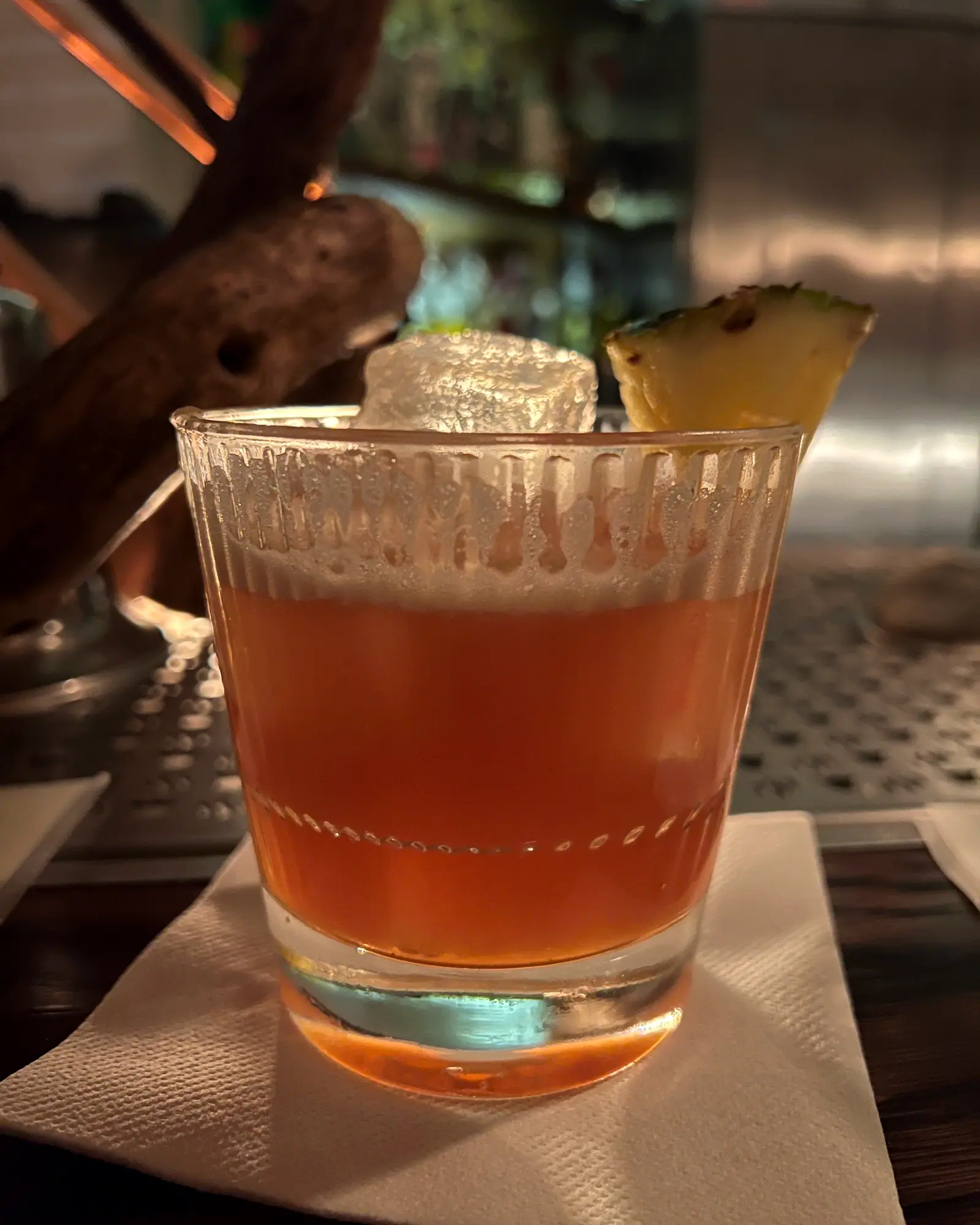

CC BY 4.0 · Cropped, white-balanced, graded and re-encoded to WebP by eXir.
A Jungle Bird cocktail in a rocks glass over ice, amber-red in colour, garnished with a pineapple leaf
Serving
Drink spec, per drink
Every figure above is per drink and does not move with the count, which is what makes the two service modes comparable. Sugar per litre, strength and standard drinks stay in the units their own authorities publish, because they are figures for comparing rather than for pouring. Dilution is modelled rather than measured, as a fraction of the poured volume before any ice; dotted figures descend from that estimate.
The red was carmine, a colourant made from insects, until the producer moved to synthetic colourants in the mid-2000s. The European label cached here lists E122, E102 and E133 and no carmine, and the United States bottling uses Red 40; reporting on the change describes it as not having reached every market at once, so which colourant is in a given bottle depends on where it was made.
Diet and allergen labels are computed from the ingredients listed on this page and nothing else. They cannot account for cross-contamination or for the particular product you buy, and they are not medical or safety guidance.
Ingredients
 15 ml fresh lime juice
 45 ml dark rumInterchangeable by volume and at the same strength, so the arithmetic barely moves. The drink loses the molasses and oak notes that stand up to the Campari and reads thinner and more purely fruity.flavour: significant change · strength: no change · sweetness: no change
 23 ml CampariProprietary
 30 ml fresh pineapple juice
 15 ml simple syrup
- 15 ml fresh lime juice
- 45 ml dark rum
- 23 ml CampariProprietary
- 30 ml fresh pineapple juice
- 15 ml simple syrup
- ~64 ml water
Glass
Vessel
191 ml of liquid plus 175 ml of cubed ice occupies about 366 ml, inside the 400 ml the glass holds. The build fails if a recipe ever exceeds its stated vessel.
A batch needs a vessel that closes and fits a fridge shelf.
Method
4 steps · 1m 37sSqueeze the 15 ml fresh lime juice and strain out the pips and pulp.
Combine the 45 ml dark rum, the 23 ml Campari, the 30 ml fresh pineapple juice, the 15 ml fresh lime juice and the 15 ml simple syrup in a shaker and fill it with cubed ice.
Campari goes in before the pineapple rather than after, so it has a moment against the rum alone before the juice's own sugar starts working on it. The order changes nothing in the glass, but it is how a bartender checks the bitter is still pulling its weight before the sweetness arrives.
Shake hard for 12s to chill and knit the juice's sugar against the Campari's bitterness.
Strain over fresh cubed ice in a double old fashioned glass. The pineapple leaves enough pulp behind in the shaker that a fine strain is not needed.
Common pitfallCanned or long-life pineapple juice reads sweeter and flatter than a fresh-pressed one, and it is the substitution most likely to be made without noticing, because the colour and cloudiness look the same on the shelf as through a juicer.
Keeping and make-ahead
Batched ahead, this keeps sealed and cold. The water line the engine adds is the dilution figure from the spec panel, not a rule of thumb.
About
A 1970s tiki drink from a Kuala Lumpur hotel bar, unusual for the time in building on a bitter aperitivo rather than another liqueur, and largely forgotten until American tiki historians revived it decades later.
The drink is credited to Jeffrey Ong, beverage manager at the Aviary Bar in the Kuala Lumpur Hilton, who created it as a welcome drink for arriving guests and named it for the caged tropical birds visible from the bar 1. Sources disagree on the year: some place it in 1973 and others in 1978 1 2.
It stayed obscure for over a decade. The first print appearance was in John J. Poister's The New American Bartender's Guide in 1989, which called for a generic dark rum 1. American tiki historian Jeff "Beachbum" Berry found it there and reprinted it in his own 2002 book Intoxica!, specifying Jamaican dark rum in place of the generic bottle and noting that what made the drink worth including was the Campari; an amaro in a tropical drink was an unusual combination for its period 1.
The recipe now treated as standard dates to 2010, when bartender Giuseppe González at the New York bar Painkiller switched the rum to a blackstrap style and cut back the pineapple juice; that version is the one most bartenders now reach for 1. The drink's wider popularity followed over the next several years as part of a broader revival of tiki drinks built on real technique rather than novelty, and it was recognised as an official cocktail by the International Bartenders Association in 2024 1.
- 1Jungle Birden.wikipedia.org
- 2The Jungle Bird Goes to Warcocktailwonk.com