
Iced Tea
Black tea steeped hot, then poured straight over ice with no sugar.
The same leaf and the same ratio, sweetened heavily while the tea is still hot.
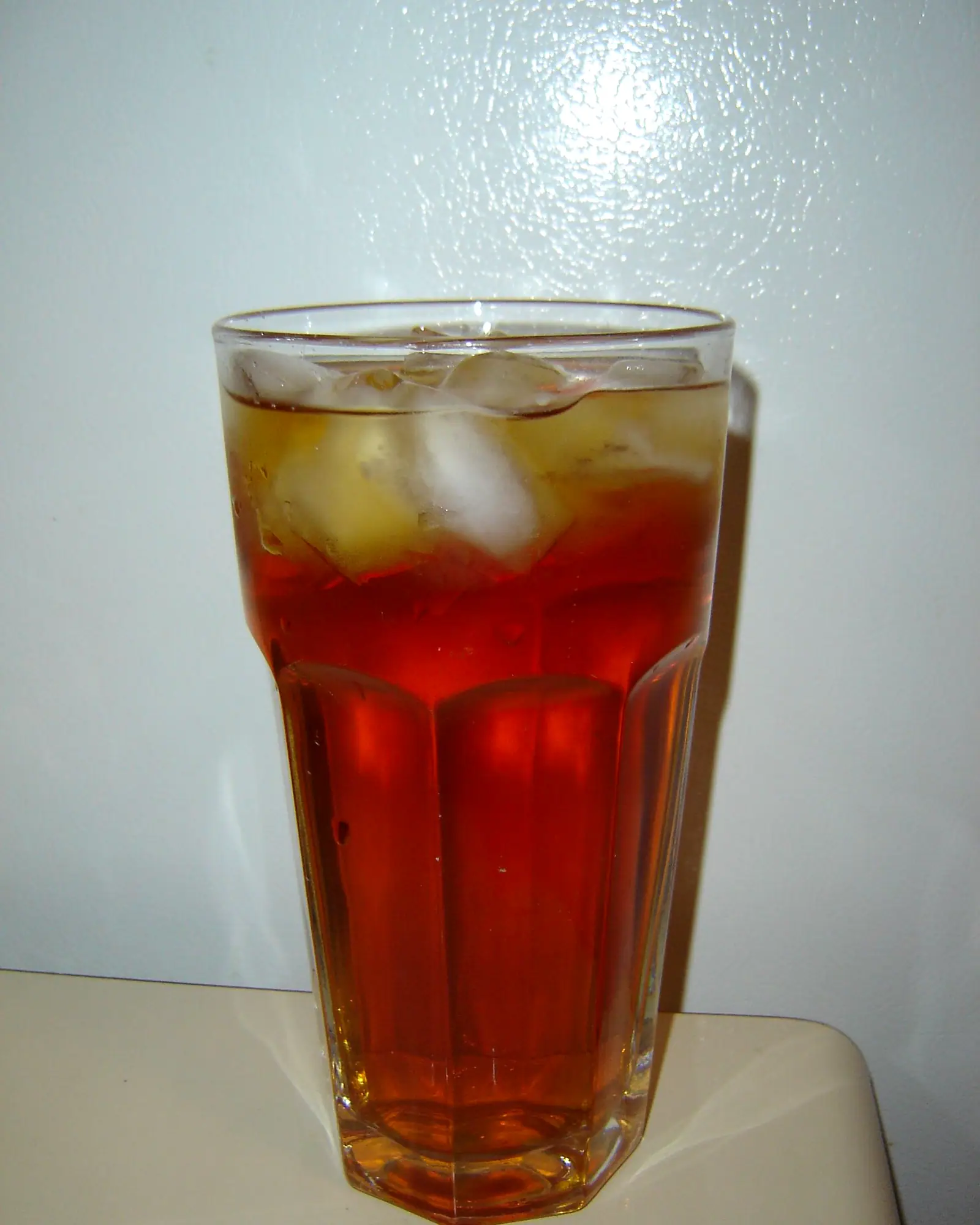

CC BY-SA 3.0 · Cropped, white-balanced, graded and re-encoded to WebP by eXir.
A tall glass of amber iced black tea over ice cubes
Serving
Drink spec, per drink
Every figure above is per drink and does not move with the count, which is what makes the two service modes comparable. Sugar per litre, strength and standard drinks stay in the units their own authorities publish, because they are figures for comparing rather than for pouring.
Diet and allergen labels are computed from the ingredients listed on this page and nothing else. They cannot account for cross-contamination or for the particular product you buy, and they are not medical or safety guidance.
Extraction
No extraction yield is shown. It needs a measured dissolved-solids figure from the finished cup, nothing on a bag of coffee supplies one, and estimating it from the method would be inventing the single number the calculation exists to establish.
Ingredients
 140 ml water
 3 g black tea
- 140 ml water
- 3 g black tea
Glass
Vessel
130 ml of liquid plus 230 ml of cubed ice occupies about 360 ml, inside the 400 ml the glass holds. The build fails if a recipe ever exceeds its stated vessel.
A batch needs a vessel that closes and fits a fridge shelf.
Drink spec, per drink
Every figure above is per drink and does not move with the count, which is what makes the two service modes comparable. Sugar per litre, strength and standard drinks stay in the units their own authorities publish, because they are figures for comparing rather than for pouring.
Diet and allergen labels are computed from the ingredients listed on this page and nothing else. They cannot account for cross-contamination or for the particular product you buy, and they are not medical or safety guidance.
Extraction
No extraction yield is shown. It needs a measured dissolved-solids figure from the finished cup, nothing on a bag of coffee supplies one, and estimating it from the method would be inventing the single number the calculation exists to establish.
Ingredients
- 140 ml water
- 3 g black tea
 30 g granulated sugar
- 140 ml water
- 3 g black tea
- 30 g granulated sugar
Glass
Vessel
149 ml of liquid plus 230 ml of cubed ice occupies about 379 ml, inside the 400 ml the glass holds. The build fails if a recipe ever exceeds its stated vessel.
A batch needs a vessel that closes and fits a fridge shelf.
Method
3 steps · 5mPour the 140 ml water at 100 °C over the 3 g black tea and leave to steep for 5m.
Strain out the leaf and discard it.
Pour over cubed ice in the glass at once, while the tea is still hot.
The tea is poured over the ice while still hot from the steep rather than cooled first, which chills it fast enough that it never sits at the lukewarm temperature where black tea turns cloudy.
Common pitfallLeaving the leaf in past the stated steep and only straining once the glass is poured makes the last of the pour noticeably more bitter than the first.
Keeping and make-ahead
Steeped a glass at a time. A jug held over ice for hours keeps drawing tannin out of the spent leaf if it is not strained promptly.
Method
4 steps · 5mPour the 140 ml water at 100 °C over the 3 g black tea and leave to steep for 5m.
Strain out the leaf and discard it.
Stir in the 30 g granulated sugar while the tea is still hot, until fully dissolved.
The 30 g granulated sugar is stirred in while the tea is still hot from the steep, which dissolves it fully; the same amount added later to a cold glass would sit grainy on the bottom rather than sweetening the drink.
Pour over cubed ice in the glass and serve at once.
Common pitfallLeaving the leaf in past the stated steep and only straining once the glass is poured makes the last of the pour noticeably more bitter than the first, and no amount of sugar hides it.
Keeping and make-ahead
Steeped a glass at a time. A jug held over ice for hours keeps drawing tannin out of the spent leaf if it is not strained promptly.
About
Black tea steeped hot and served cold, an American cookbook staple since the nineteenth century whose popular origin story is later than the drink.
The commonly told origin puts iced tea at the 1904 St. Louis World's Fair, credited to Richard Blechynden, the India Tea Commissioner running its East Indian Pavilion. The drink is considerably older than that. Marion Cabell Tyree's 1879 Virginia cookbook, Housekeeping in Old Virginia, already contains what is treated as the oldest sweet tea recipe in print: tea steeped overnight, then sweetened and poured over ice glasses at serving time 1. A Boston cookbook of 1884 gives a black tea version aimed at a wider American audience than the Virginia original 1, and the drink was already appearing on restaurant menus at the Chicago World's Fair of 1893, over a decade before St. Louis 1. The 1904 fair popularised the drink far beyond where it started rather than inventing it.
The Southern sweet version has its own separately documented history. A Missouri gathering of Confederate veterans in 1890 served, by report, several hundred gallons of iced tea at a single reunion, evidence that a sweetened, chilled tea was already an established feature of Southern hospitality before the more famous fair gave the drink a national stage 2. Its defining written recipe came later still: Henrietta Stanley Dull's 1928 Southern Cooking set out the strong-brew, hot-sweetened method that most Southern kitchens still use, dissolving the sugar into the tea while it is still hot rather than trying to stir it into a cold, already-diluted glass 1.
Prohibition, from 1920 to 1933, gave the unsweetened and sweetened versions alike a further push as a sociable alternative to a cocktail, cementing iced tea's place at the American table well before it needed a fair to explain it 1.
- 1History of Iced Tea and Sweet Teawhatscookingamerica.net
- 2Sweet Tea: A History Of The 'Nectar Of The South'gpb.org