
Hong Kong Milk Tea
A very strong black tea pulled through a cloth sock, finished with evaporated milk.
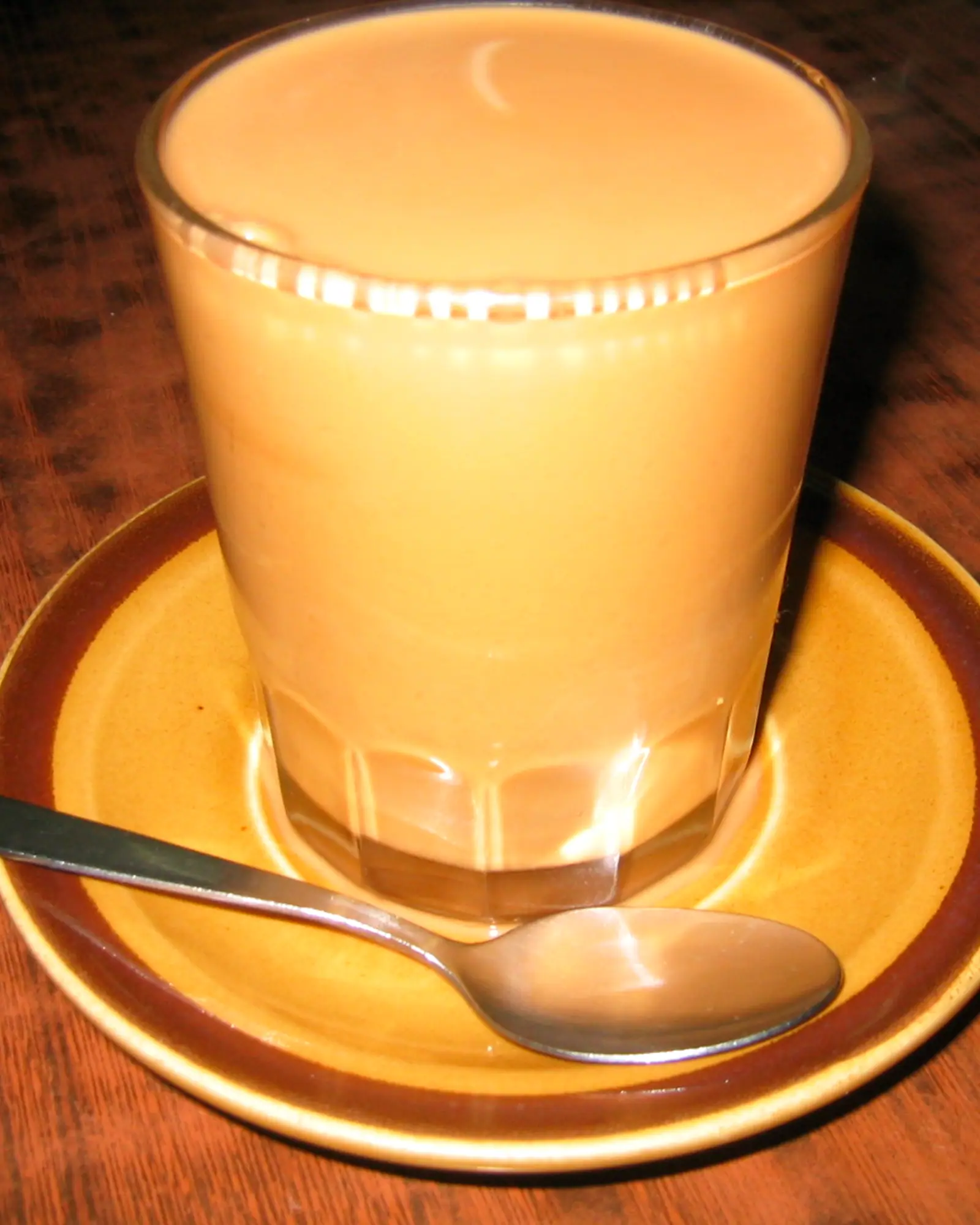
CC BY-SA 3.0 · Cropped, white-balanced, graded and re-encoded to WebP by eXir.
A glass of Hong Kong-style milk tea on a saucer with a spoon
Serving
Drink spec, per drink
Every figure above is per drink and does not move with the count, which is what makes the two service modes comparable. Sugar per litre, strength and standard drinks stay in the units their own authorities publish, because they are figures for comparing rather than for pouring.
Diet and allergen labels are computed from the ingredients listed on this page and nothing else. They cannot account for cross-contamination or for the particular product you buy, and they are not medical or safety guidance.
Extraction
No extraction yield is shown. It needs a measured dissolved-solids figure from the finished cup, nothing on a bag of coffee supplies one, and estimating it from the method would be inventing the single number the calculation exists to establish.
Ingredients


Glass
Vessel
329 ml of liquid, served without ice, inside the 350 ml the glass holds. The build fails if a recipe ever exceeds its stated vessel.
A batch needs a vessel that closes and fits a fridge shelf.
Method
3 steps · 5mPour the 300 ml water at 100 °C over the 10 g black tea and leave to steep for 5m.
Strain the tea through a fine cloth sock into a second vessel, then pour it back through the sock and into the first, back and forth several times, for 30s.
The cloth sock is a fine, deep filter rather than a strainer, and pouring the tea back through it repeatedly (the "pulling" the drink is named for in Cantonese) mixes the leaf's tannin evenly through the liquid so the cup tastes the same from the first sip to the last.
Stir in the 40 ml evaporated milk and the 15 g granulated sugar until the sugar has dissolved, and serve hot.
Common pitfallFresh milk curdles faintly against tea this strong and this hot. 40 ml evaporated milk is evaporated rather than fresh for exactly that reason, and swapping it back in is a real change, not a convenience.
Keeping and make-ahead
Steeped and pulled to order. The blend is meant to be brewed hard once, not topped up or reheated.
About
A strong Ceylon tea pulled through a cloth strainer and finished with evaporated milk, a colonial-era British tradition remade for a local budget.
British afternoon tea reached Hong Kong under colonial administration but not its ordinary population: for decades it was served almost exclusively in hotels and high-end Western restaurants, out of reach of most residents 1. It was street stalls and cheap cafés (first the bing sutt, later the cha chaan teng) that made a version of it affordable, substituting evaporated milk for fresh and brewing a stronger, cheaper leaf blend that stretched further and still stood up to milk 2. That substitution was practical rather than aesthetic: evaporated milk kept without refrigeration, cost less, and did not dilute the tea the way fresh milk would 1. In the 1940s the drink was brewed hard and sold to labourers as a caffeine source; by the 1960s, as it spread through the cha chaan teng trade, a milder version had developed for office workers 2.
The drink's Cantonese nickname, "silk-stocking milk tea," describes the strainer rather than the tea: the leaf is steeped and repeatedly poured through a fine cotton bag, which after prolonged use takes on the tea's colour and a shape said to resemble a stained silk stocking 2. The Lan Fong Yuen café's claim to have invented this specific straining style in 1952 is widely, though not universally, accepted 2.
The technique is now recognised as intangible cultural heritage in Hong Kong, and the repeated pulling through cloth remains the part hardest to reproduce outside a professional kitchen; commentators note that a convincingly smooth cup is difficult to make well at home 1, which is part of why the drink is still ordered out rather than made in.
- 1Steeped in history — how Hong Kong-style milk tea became a staplescmp.com
- 2Hong Kong–style milk teaen.wikipedia.org