
Green Smoothie
Spinach and frozen banana blended with water and honey until the leaf disappears into the colour.

CC BY-SA 4.0 · Cropped, white-balanced, graded and re-encoded to WebP by eXir.
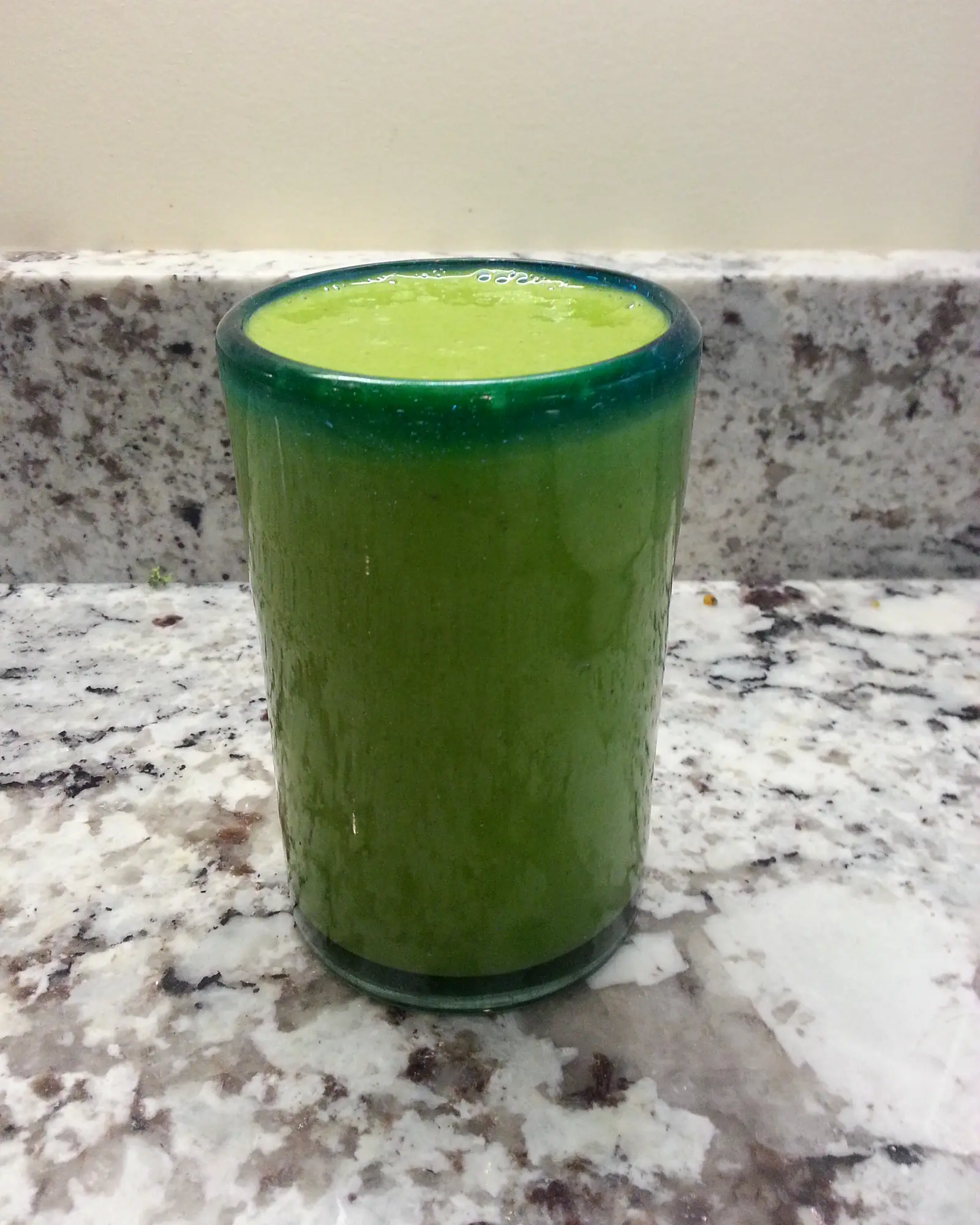
A glass of thick, dark green smoothie filling a plain tumbler, set on a granite counter
Serving
Drink spec, per drink
Every figure above is per drink and does not move with the count, which is what makes the two service modes comparable. Sugar per litre, strength and standard drinks stay in the units their own authorities publish, because they are figures for comparing rather than for pouring.
Diet and allergen labels are computed from the ingredients listed on this page and nothing else. They cannot account for cross-contamination or for the particular product you buy, and they are not medical or safety guidance.
Ingredients
 90 ml water
 40 g baby spinach
 120 g peeled banana
 15 ml honey
- 90 ml water
- 40 g baby spinach
- 120 g peeled banana
- 15 ml honey
Glass
Vessel
259 ml of liquid, served without ice, inside the 450 ml the glass holds. The build fails if a recipe ever exceeds its stated vessel.
A batch needs a vessel that closes and fits a fridge shelf.
Method
3 steps · 1m 15sAdd the 90 ml water and the 40 g baby spinach to the blender jug, then the frozen 120 g peeled banana and the 15 ml honey.
The spinach goes in with the water rather than on top of the fruit, so the blade shreds the leaf before it ever meets the frozen banana; dropped in last, it tends to catch on the ice instead of breaking down.
Blend for 40s, until no fleck of leaf remains and the colour is a single even green.
Pour into a chilled smoothie glass.
Common pitfallThe blend runs longer than a fruit-only smoothie because raw spinach leaf is fibrous rather than soft; stopping early leaves visible green flecks rather than the even colour the drink is meant to be.
Keeping and make-ahead
This drink is made to order.
About
A fruit-and-leaf smoothie popularised by raw food author Victoria Boutenko from 2004 onward, by her own account rather than an independently documented one.
The story behind blending fruit with leafy greens rather than only with each other is told by one source: Victoria Boutenko, a raw food author who says she arrived at the combination in 2004 while looking for a way to eat more dark leafy greens than she could manage by chewing them 1. By her own account, blending greens on their own produced a drink she found unpalatable, and the idea to add fruit came from reading that chimpanzees, whose diet researchers had studied for its similarity to a healthy human one, were sometimes observed wrapping fruit in a leaf before eating it 1. Blending banana with kale, in her telling, produced something that smelled and tasted like an ordinary fruit smoothie despite the greens in it.
No independent account of this moment exists outside Boutenko's own writing, which is worth stating plainly rather than repeating the story as settled history. What is independently verifiable is what came after it: Boutenko published the recipes and reasoning in Green for Life in 2005, a book that went on to a finalist nomination for an Independent Publisher's Award the following year and later editions 2. The book, not a single blended glass, is what actually carried the format from one kitchen into wider circulation, on the strength of its claimed health benefits for digestion and nutrient absorption rather than any culinary novelty.
- 1The First Green Smoothierawfamily.org
- 2Green for Lifepenguinrandomhouse.com