
Gongfu Oolong
One leaf, four short infusions, each poured off as soon as it is ready.
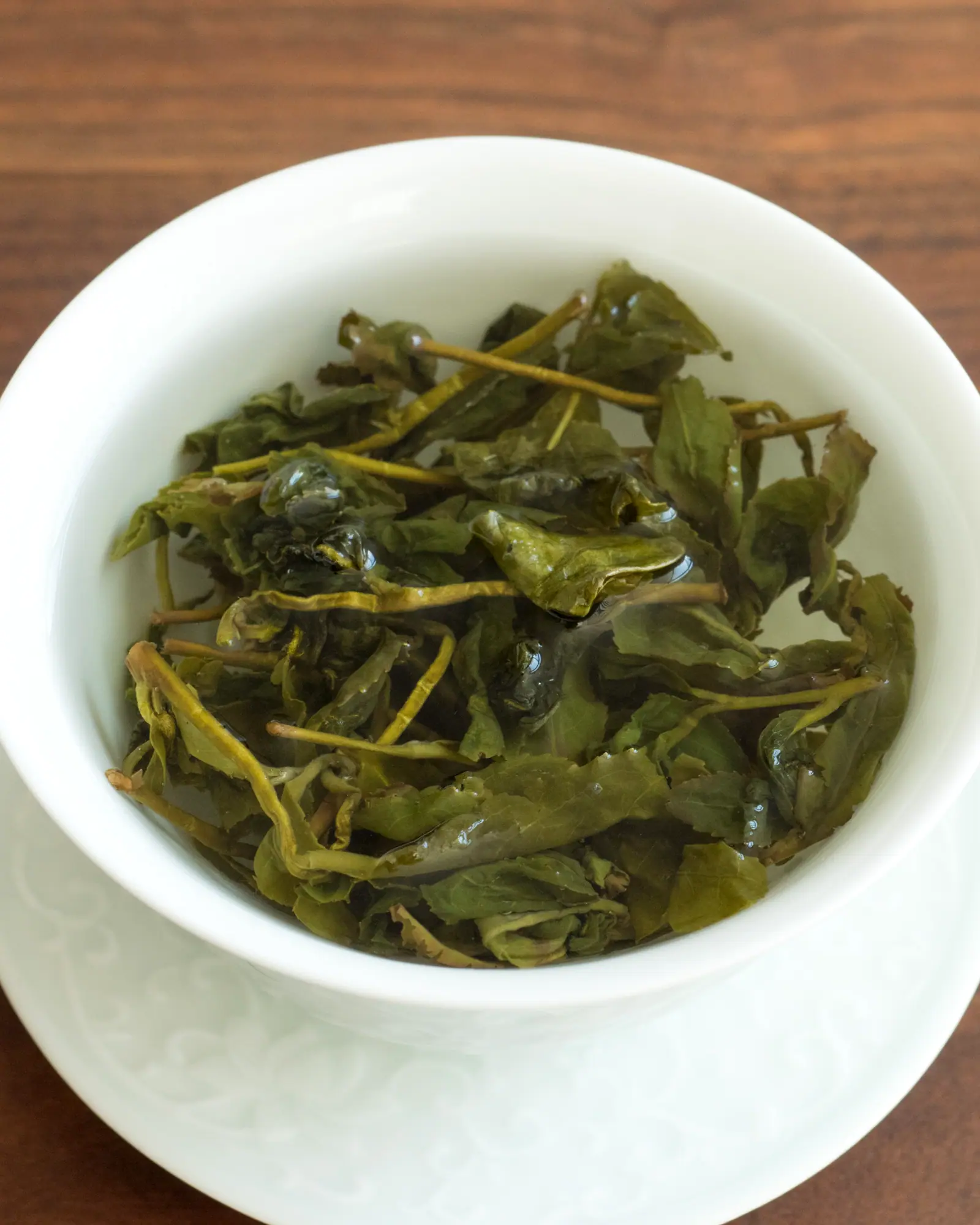

CC BY-SA 4.0 · Cropped, white-balanced, graded and re-encoded to WebP by eXir.
Unfurled green oolong leaves steeping in an open white gaiwan
Serving
Drink spec, per drink
Every figure above is per drink and does not move with the count, which is what makes the two service modes comparable. Sugar per litre, strength and standard drinks stay in the units their own authorities publish, because they are figures for comparing rather than for pouring.
Diet and allergen labels are computed from the ingredients listed on this page and nothing else. They cannot account for cross-contamination or for the particular product you buy, and they are not medical or safety guidance.
Extraction
- Infusion 110s
- Infusion 215s
- Infusion 320s
- Infusion 430s
No extraction yield is shown. It needs a measured dissolved-solids figure from the finished cup, nothing on a bag of coffee supplies one, and estimating it from the method would be inventing the single number the calculation exists to establish.
Ingredients
 100 ml water
 5 g oolong tea
- 100 ml water
- 5 g oolong tea
Glass
Vessel
90 ml of liquid, served without ice, inside the 120 ml the glass holds. The build fails if a recipe ever exceeds its stated vessel.
A batch needs a vessel that closes and fits a fridge shelf.
Method
3 steps · 1m 45sPour a little of the 100 ml water over the 5 g oolong tea in the gaiwan and pour it straight off again, to wake the leaf without tasting it.
Pour the 100 ml water at 95 °C over the same leaf four times over, refilling the gaiwan fresh each round and lengthening the contact a little each time, for 1m 15s in total across the four rounds.
This is one dose taken four separate times rather than one steep taken once: the leaf sits in each fresh pour for barely longer than it takes to pour it back out, and every round after the first runs a little longer than the one before it as the leaf gives up less on each pass.
Pour each infusion off the leaf into the cup as soon as its time is up; a gaiwan left standing keeps extracting and the next round comes out uneven.
Common pitfallJudging the dose against a teapot's ratio makes this look absurdly strong. At this contact time it is not; a gongfu session is stronger by the gram and weaker by the cup, because the leaf barely touches the water before it is poured off again.
Keeping and make-ahead
Poured one short infusion at a time from the same leaf; there is nothing to make ahead.
About
One dose of leaf infused several times over in quick succession, a Chaoshan brewing technique rather than a single recipe.
The name describes a method rather than a drink: gongfu means skill or effort applied with care, and gongfu tea is the technique of brewing one dose of leaf through several short infusions rather than one long steep 1. Its home region is contested between two areas: the Wuyi Mountains of Fujian, where the oolong trade for export first developed, and the Chaoshan area of eastern Guangdong, whose largest city, Chaozhou, is now treated as the practice's capital 1 2. Sources that favour Chaozhou point to a lineage running back to at least the eighteenth century, though the exact starting point is not agreed on, and documents from the 1940s were still describing the technique specifically as "Chaoshan gongfu tea" rather than treating it as a general Chinese practice 1.
For most of that history it stayed a regional habit rather than a national one. It was Taiwanese tea practitioners in the 1970s who reworked it into a more formal, more widely taught style, and that revised version is what carried gongfu brewing back into mainland China and out into the rest of the world, well beyond where it started 2.
The technique itself has not changed to fit that spread. A small vessel, a gaiwan or a tiny pot, takes a dose of leaf disproportionately large for its size, is rinsed with a quick discarded pour to wake the leaf, and is then refilled with fresh water for a rapid succession of infusions, the first barely longer than the rinse and each one after it a little longer than the last 1. The strength that produces is not the strength of a long steep: it is short contact repeated, which is a categorically different way of extracting the same leaf.
- 1Gongfu teaen.wikipedia.org
- 2Chaozhou Gong Fu Chapathofcha.com