
Gin and Tonic
London dry gin, tonic and ice, built tall.
A longer, gin-forward build in a wide-bowled glass, over a full load of ice.
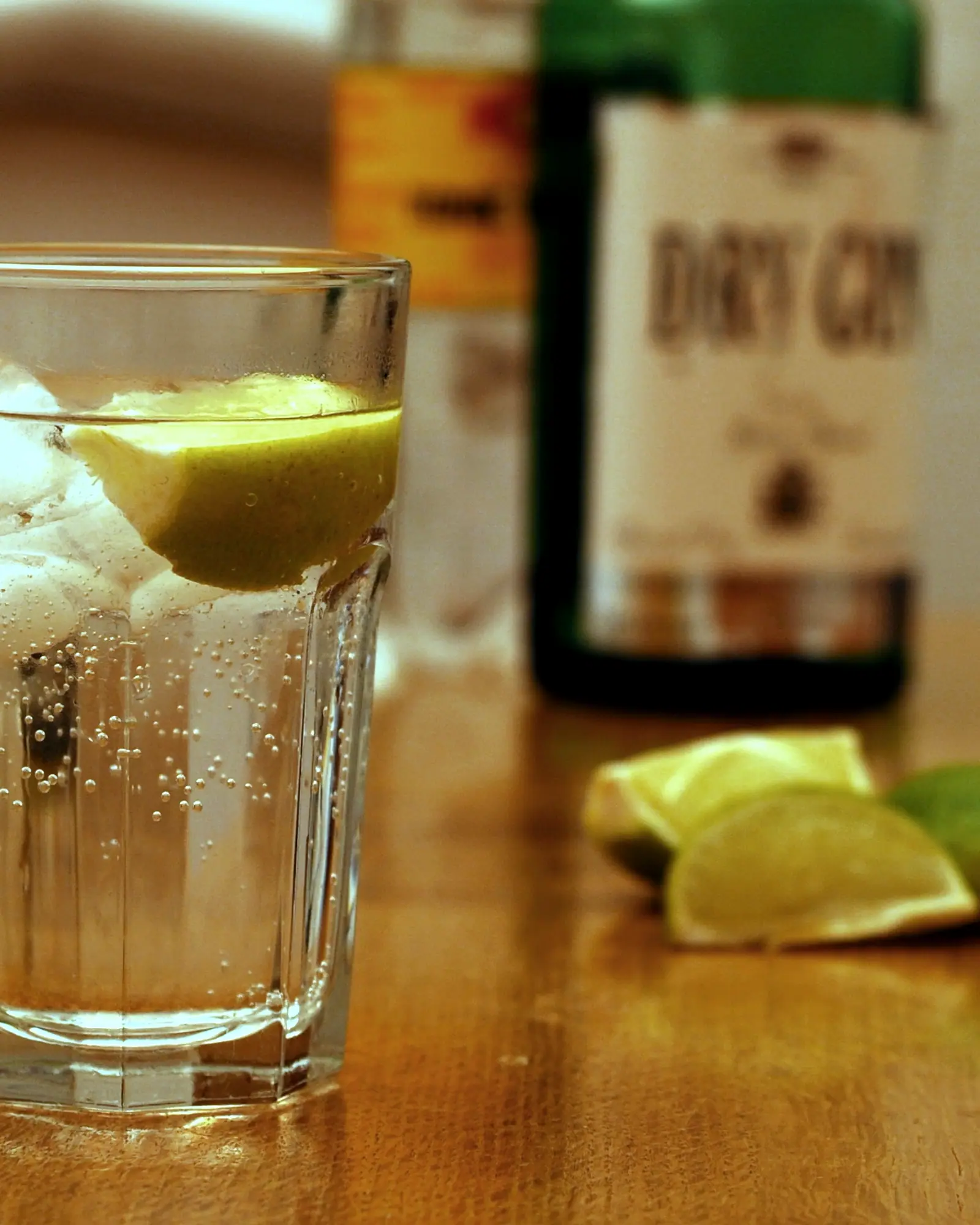

CC BY-SA 3.0 · Cropped, white-balanced, graded and re-encoded to WebP by eXir.
A gin and tonic over ice in a glass, garnished with a lime wedge, with lime wedges beside it
Serving
Drink spec, per drink
Every figure above is per drink and does not move with the count, which is what makes the two service modes comparable. Sugar per litre, strength and standard drinks stay in the units their own authorities publish, because they are figures for comparing rather than for pouring. Dilution is modelled rather than measured, as a fraction of the poured volume before any ice; dotted figures descend from that estimate.
Diet and allergen labels are computed from the ingredients listed on this page and nothing else. They cannot account for cross-contamination or for the particular product you buy, and they are not medical or safety guidance.
Ingredients
 35 ml London dry gin
 130 ml tonic water
 ½ lime (11 g)
- 35 ml London dry gin
- 130 ml tonic water
- ½ lime (11 g)
- ~41 ml water
Glass
Vessel
165 ml of liquid plus 230 ml of cubed ice occupies about 395 ml, inside the 400 ml the glass holds. The build fails if a recipe ever exceeds its stated vessel.
A batch needs a vessel that closes and fits a fridge shelf.
Drink spec, per drink
Every figure above is per drink and does not move with the count, which is what makes the two service modes comparable. Sugar per litre, strength and standard drinks stay in the units their own authorities publish, because they are figures for comparing rather than for pouring. Dilution is modelled rather than measured, as a fraction of the poured volume before any ice; dotted figures descend from that estimate.
Diet and allergen labels are computed from the ingredients listed on this page and nothing else. They cannot account for cross-contamination or for the particular product you buy, and they are not medical or safety guidance.
Ingredients
- 60 ml London dry gin
- 200 ml tonic water
 ½ lemon (5 g)
- 60 ml London dry gin
- 200 ml tonic water
- ½ lemon (5 g)
- ~65 ml water
Glass
Vessel
260 ml of liquid plus 370 ml of cubed ice occupies about 630 ml, inside the 650 ml the glass holds. The build fails if a recipe ever exceeds its stated vessel.
A batch needs a vessel that closes and fits a fridge shelf.
Method
4 steps · 1m 15sFill a tall Collins glass with ice.
Pour in the 35 ml London dry gin.
Top with the 130 ml tonic water and lift once with a bar spoon.
A narrow, tall glass holds the tonic's bead longer than a wide one, so the gin stays under a working carbonation for the length of the drink rather than for its first few minutes.
Squeeze a lime wedge over the drink and drop it in.
Common pitfallA juniper-forward London dry is chosen here because tonic's quinine and sugar are loud enough to bury a quieter, more citrus-led gin entirely rather than complementing it.
Keeping and make-ahead
Batched ahead, this keeps sealed and cold. The water line the engine adds is the dilution figure from the spec panel, not a rule of thumb.
Method
5 steps · 1m 55sChill the glass.
Fill the glass to the rim with ice.
The wide bowl is packed to the rim with ice before anything goes in it, which keeps a much larger glass from working out any warmer than the narrow British build; the point of the extra ice is to hold the same temperature over a longer drink, not to look generous.
Pour in the 60 ml London dry gin.
Cut a wide strip of lemon peel, express its oil over the drink and drop it in.
Top slowly with the 200 ml tonic water, pouring down the inside of the glass to keep the bead, and lift once with a bar spoon.
Common pitfallPoured into a bowl this wide, tonic loses its bead faster than it does in a tall narrow glass, so it goes in last, down the side or over a spoon, and the drink is finished rather than left to stand.
Keeping and make-ahead
Batched ahead, this keeps sealed and cold. The water line the engine adds is the dilution figure from the spec panel, not a rule of thumb.
About
Quinine tonic and gin met in British India as a way of making a genuine antimalarial palatable, a story since inflated well past what the modern drink can actually claim.
Quinine, extracted from cinchona bark, was established as a treatment and preventive for malaria by the Edinburgh physician George Cleghorn in the 18th century, and British personnel in colonial India took it regularly for that reason 1. Commercial quinine tonic water was patented in 1858 by Erasmus Bond, but a dose concentrated enough to matter medically was intensely bitter, and mixing it with gin and sugar was a way of getting it down rather than an accident of taste 2.
The tidy version of that story (soldiers on ration inventing a cocktail to fight off malaria) does not hold up. The historian Anistatia Miller has stated plainly that the gin and tonic was not invented in India as an antimalarial and that British troops did not drink it as part of their rations; the romantic imperial framing was largely a 20th-century retelling, even as colonial India genuinely helped popularise the drink among travellers returning home in the 1870s 1.
The gap between the historical dose and the modern one is real and measurable. A 2004 clinical study found that only very large volumes of today's tonic water (on the order of half a litre to a litre) could produce a temporarily therapeutic quinine level, and that sustaining a dose that way is not a practical defence against the disease; modern tonic is sweetened and far less bitter than its medicinal ancestor precisely because it carries a fraction of the quinine 2. Whatever the gin and tonic still owes to its origin as a way of taking medicine, it is not a protection against malaria today.
- 1The Gin and Tonic Is a Cocktail With a Storied Historysmithsonianmag.com
- 2Gin and tonicen.wikipedia.org