
French Press Coffee
Coarse coffee steeped loose in the pot, then held back by a plunged mesh.
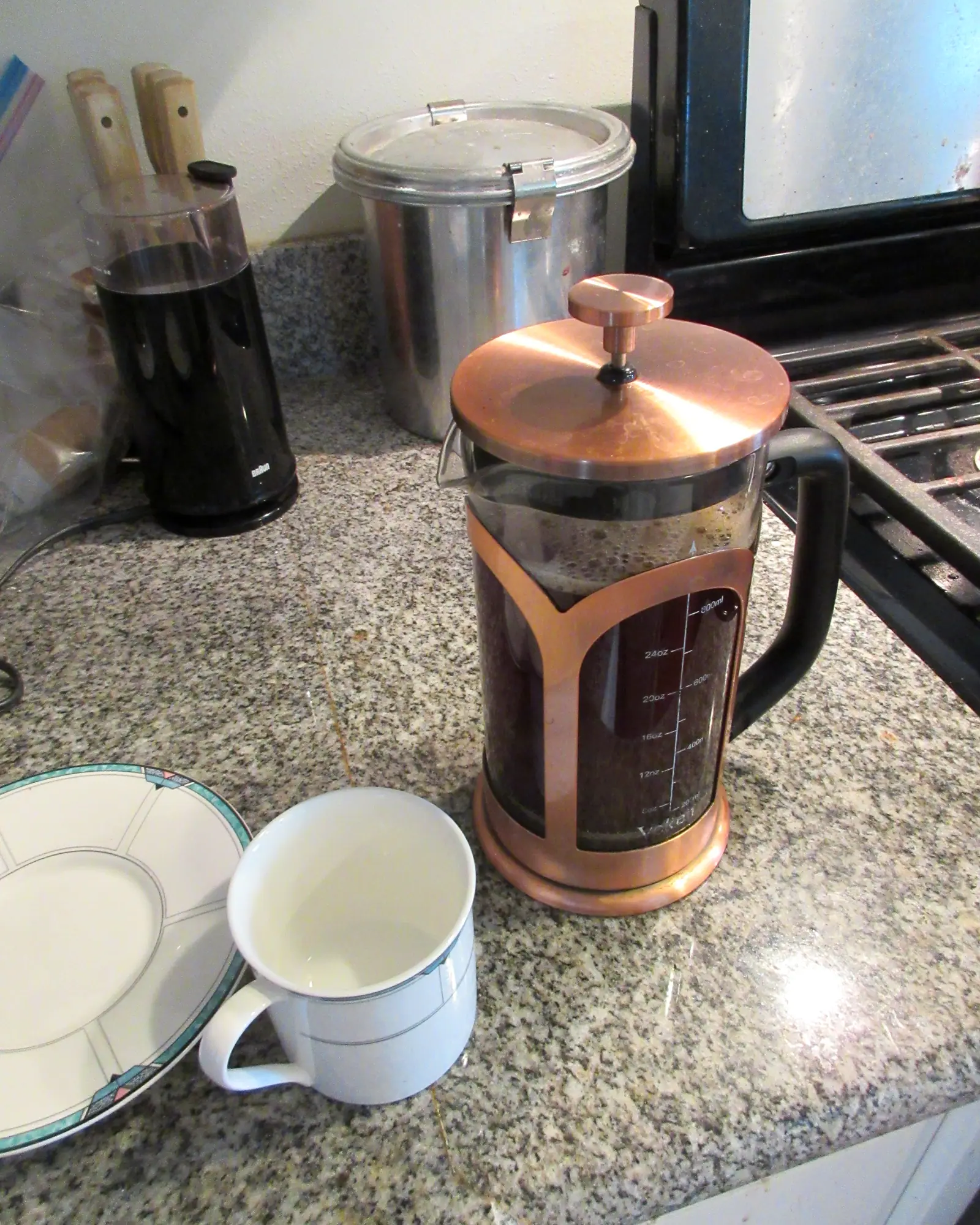

CC BY-SA 2.0 · Cropped, white-balanced, graded and re-encoded to WebP by eXir.
A copper-trimmed glass French press full of brewed coffee beside a white mug, on a kitchen counter
Serving
Drink spec, per drink
Every figure above is per drink and does not move with the count, which is what makes the two service modes comparable. Sugar per litre, strength and standard drinks stay in the units their own authorities publish, because they are figures for comparing rather than for pouring.
Diet and allergen labels are computed from the ingredients listed on this page and nothing else. They cannot account for cross-contamination or for the particular product you buy, and they are not medical or safety guidance.
Extraction
This brew works out at 68.2 g of coffee per litre of water, against the 49.5 to 60.5 g/L the standard allows, so it is stronger than it. The comparison is made in grams per litre and not on the ratio, because a ratio is the reciprocal of a strength and a symmetric band on one is an asymmetric band on the other. Source: Golden Cup Standard, Specialty Coffee Association.
No extraction yield is shown. It needs a measured dissolved-solids figure from the finished cup, nothing on a bag of coffee supplies one, and estimating it from the method would be inventing the single number the calculation exists to establish.
Ingredients
 15 g coffee
 220 ml water
- 15 g coffee
- 220 ml water
Glass
Vessel
200 ml of liquid, served without ice, inside the 350 ml the glass holds. The build fails if a recipe ever exceeds its stated vessel.
A batch needs a vessel that closes and fits a fridge shelf.
Method
4 steps · 5mGrind the 15 g coffee coarse, close to the texture of sea salt.
Add the grounds to the pot and pour the 220 ml water over them at 94 °C, wetting all of the grounds, then set the lid on without plunging.
Leave to steep for 4m, undisturbed.
Press the plunger down slowly and evenly over 20s, then pour at once.
The plunge is pressed slowly and evenly rather than forced, because driving it down fast pushes fine particles through the mesh and back into the cup, clouding a brew that is meant to stay clear below its natural sediment.
Common pitfallCoffee left in the pot after the plunge keeps extracting through the wet grounds trapped under the mesh, so a cup poured a few minutes late tastes noticeably more bitter than the same brew poured straight away.
Keeping and make-ahead
Brewed to order and plunged just before pouring. Left standing on the grounds past the plunge, the cup keeps extracting and turns bitter.
About
Coarse coffee steeped loose in hot water and held back by a plunged mesh disc, patented in stages across a century before settling into its familiar shape.
The earliest patent for a plunger pot belongs to two French inventors, Henri-Otto Mayer and Jacques-Victor Delforge, in 1852, but their design left no seal around the filter and pushed as much sediment up as it held back 1. The mechanism that fixed that problem, a spring-loaded disc sealing against the glass as it descends, was patented by the Milanese designers Giulio Moneta and Attilio Calimani in 1929, and it is their design that the modern press descends from rather than the earlier French one 2.
The most widely sold version came later still. Faliero Bondanini patented a further refinement in 1958 and had it manufactured in France, at a factory that had previously made clarinets, under the name Chambord 2. That pot, sold in Britain as La Cafetière and eventually produced by the Danish company Bodum, is the shape now most associated with the device, despite the method's Italian mechanism and the earlier French patent it is popularly named for 2.
The brewing principle has stayed constant while the hardware changed hands: coarse grounds steep loose in the full volume of water, with nothing filtering them until the plunger is pressed, so the cup carries the coffee's oils and fine sediment in a way a paper filter strains out 1. That is also the method's one real fault. Coffee left standing on its grounds after the plunge continues to extract through the wet bed trapped beneath the mesh, which is why a press left on the table rather than decanted keeps getting more bitter the longer it sits.
- 1French pressen.wikipedia.org
- 2French Press: The History & Brewing Guideperfectdailygrind.com