
Cafe Cubano
Sugar whipped into the first drops off the pot until it turns to foam.
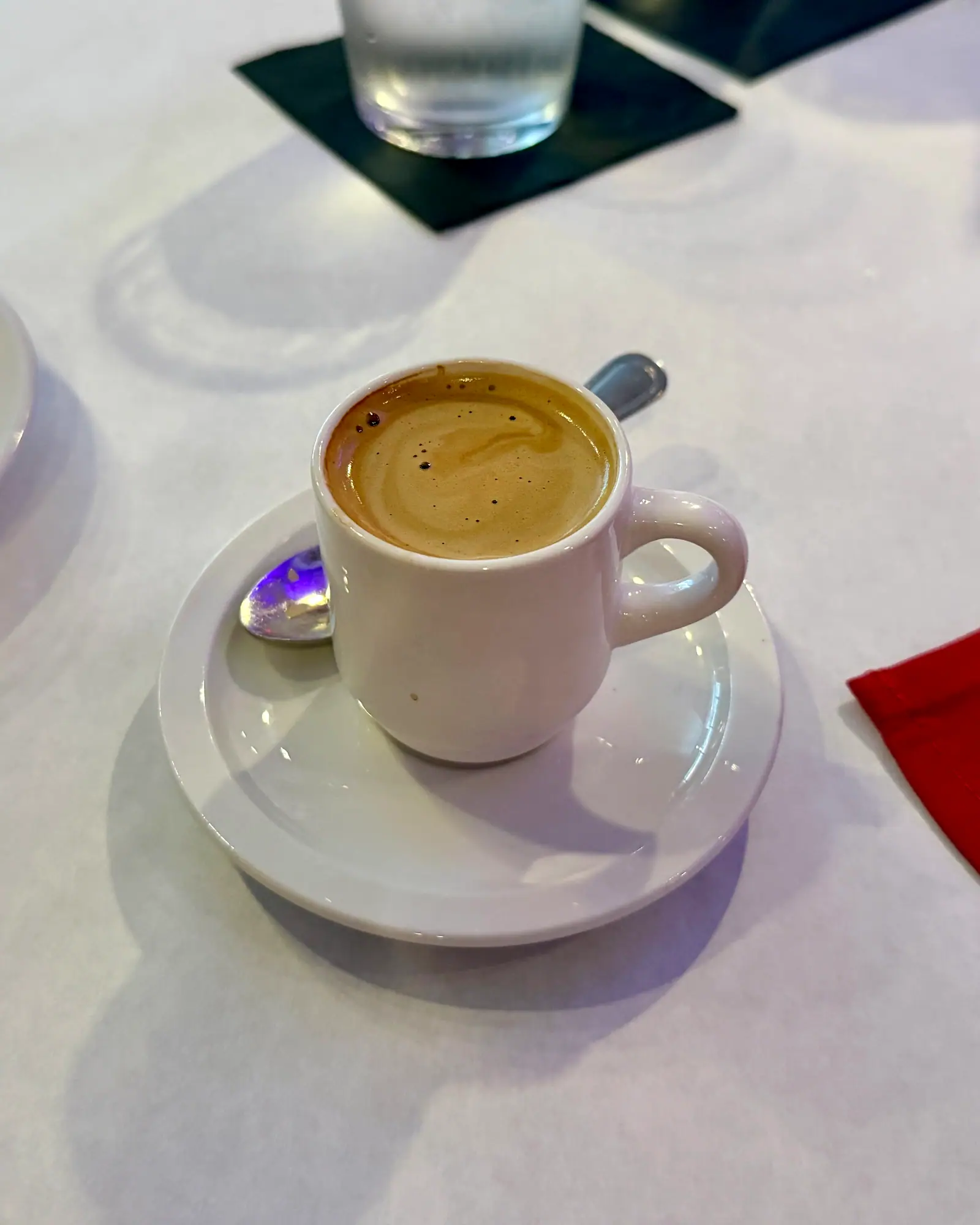

CC BY-SA 4.0 · Cropped, white-balanced, graded and re-encoded to WebP by eXir.
Cuban espresso topped with golden crema, in a small white cup on a saucer
Serving
Drink spec, per drink
Every figure above is per drink and does not move with the count, which is what makes the two service modes comparable. Sugar per litre, strength and standard drinks stay in the units their own authorities publish, because they are figures for comparing rather than for pouring.
Diet and allergen labels are computed from the ingredients listed on this page and nothing else. They cannot account for cross-contamination or for the particular product you buy, and they are not medical or safety guidance.
Extraction
This brew works out at 250.0 g of coffee per litre of water, against the 49.5 to 60.5 g/L the standard allows, so it is stronger than it. The comparison is made in grams per litre and not on the ratio, because a ratio is the reciprocal of a strength and a symmetric band on one is an asymmetric band on the other. The water temperature also sits outside the standard. Source: Golden Cup Standard, Specialty Coffee Association.
No extraction yield is shown. It needs a measured dissolved-solids figure from the finished cup, nothing on a bag of coffee supplies one, and estimating it from the method would be inventing the single number the calculation exists to establish.
Ingredients
 15 g coffee
 60 ml water
 15 g demerara sugar
- 15 g coffee
- 60 ml water
- 15 g demerara sugar
Glass
Vessel
54 ml of liquid, served without ice, inside the 80 ml the glass holds. The build fails if a recipe ever exceeds its stated vessel.
A batch needs a vessel that closes and fits a fridge shelf.
Method
4 steps · 5mGrind the 15 g coffee fine and load it into the pot's basket.
Brew the 60 ml water through the grounds at 100 °C over 4m, catching the first few drops separately as they come through.
Pour the reserved first drops over the 15 g demerara sugar and whip vigorously for 30s until it lightens to a thick, pale tan foam.
Only the first few drops off the pot go onto the sugar, because they carry the most concentrated oils of the whole brew and are what let vigorous whipping turn the sugar into a stable tan foam rather than a wet syrup.
Pour in the rest of the brewed coffee and fold it through the foam without beating it flat, then serve at once.
Common pitfallWhipping the sugar with the full pot rather than the first drops dilutes it enough that it never aerates properly, and the drink ends up sweetened but without the foam Cuban coffee is served under.
Keeping and make-ahead
The espuma is whipped from the first drops of a single brew and collapses within minutes, so nothing here is made ahead of serving.
About
Espresso whipped with sugar into a foam from its first few drops, a Cuban adaptation of an Italian machine that arrived generations after the coffee did.
Coffee reached Cuba well before the drink named for it did. French colonists fleeing the Haitian Revolution brought cultivation to the island in the eighteenth century, and by the mid-1800s Cuba had grown into a major producer, reaching over sixty thousand tons of coffee a year by the 1940s 1. The espresso machine that defines café Cubano today arrived separately and much later, carried by Italian immigration in the early twentieth century, and it was Cuban baristas who adapted the Italian machine to a preparation of their own rather than copying an existing recipe 2.
That adaptation is the espuma, and it is the drink's whole identity. The first few drops off the machine, the most concentrated part of the shot, are poured onto sugar and beaten hard enough to turn pale and foamy before the rest of the coffee is added; poured back in, the foam rises to the surface rather than dissolving into the cup 2. Demerara sugar is the traditional choice, and the whipping technique is what separates a café Cubano from an ordinary sweetened espresso: the sugar is aerated into the coffee, not merely dissolved in it.
The Cuban Revolution of the 1950s carried the drink out of Cuba rather than changing it: the wave of Cuban migration to Miami and other American cities that followed brought café Cubano culture with it, and Miami's Cuban coffee windows are now as associated with the drink as Havana is 1. The same espuma technique, scaled up, makes a colada meant for sharing; with milk added it becomes a cortadito, and with more milk still, a café con leche.
- 1What is Cuban Coffee? The Complete Guide to Café Cubanovolcanicacoffee.com
- 2The Café Cubano is a strong espresso whipped with sugarbaristamagazine.com