
Ethiopian Buna
Green beans roasted, ground and boiled in one sitting, unfiltered.
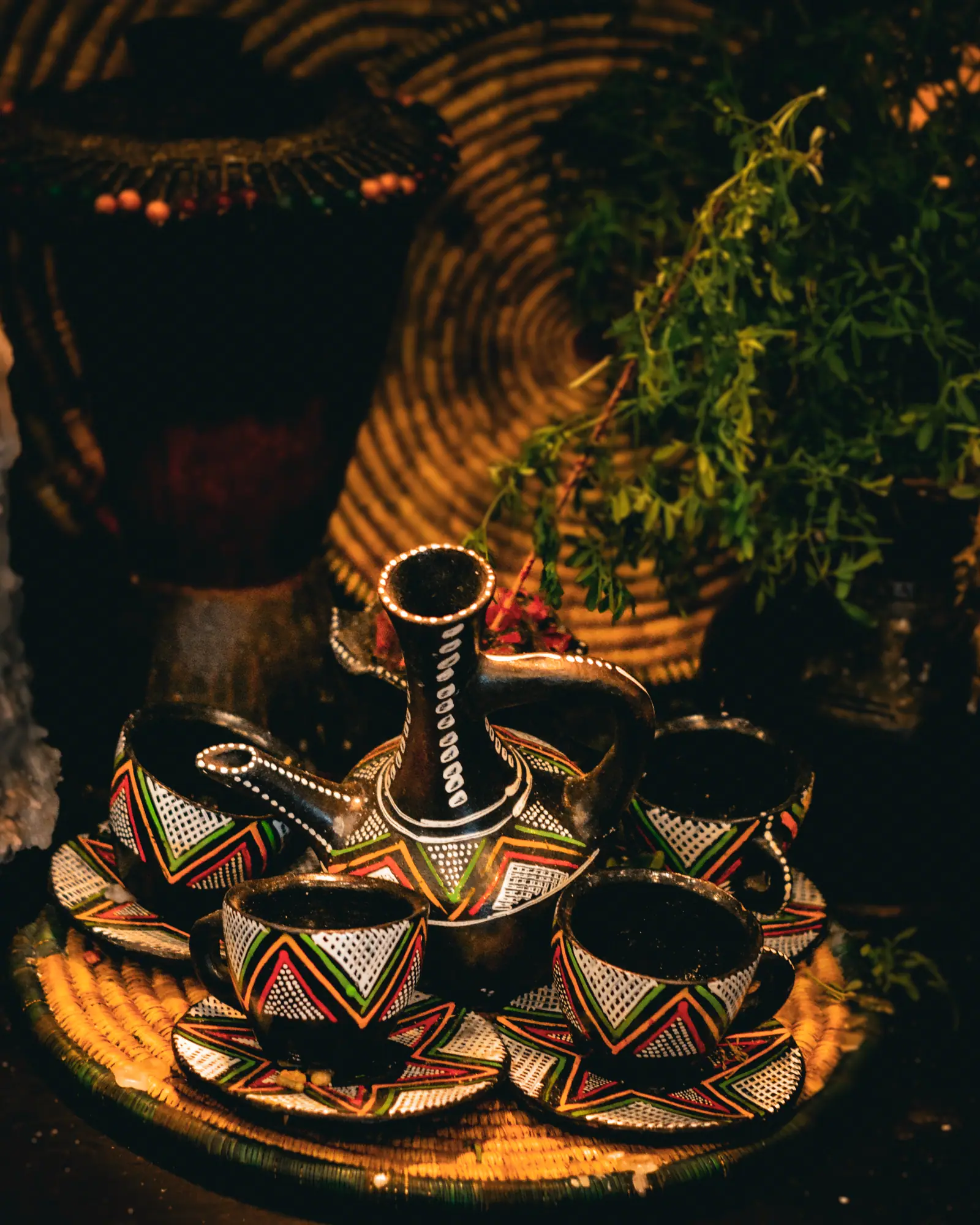

CC BY-SA 4.0 · Cropped, white-balanced, graded and re-encoded to WebP by eXir.
A clay jebena coffee pot on a woven tray, surrounded by small painted cups for an Ethiopian coffee ceremony
Serving
Drink spec, per drink
Every figure above is per drink and does not move with the count, which is what makes the two service modes comparable. Sugar per litre, strength and standard drinks stay in the units their own authorities publish, because they are figures for comparing rather than for pouring.
Diet and allergen labels are computed from the ingredients listed on this page and nothing else. They cannot account for cross-contamination or for the particular product you buy, and they are not medical or safety guidance.
Extraction
This brew works out at 111.1 g of coffee per litre of water, against the 49.5 to 60.5 g/L the standard allows, so it is stronger than it. The comparison is made in grams per litre and not on the ratio, because a ratio is the reciprocal of a strength and a symmetric band on one is an asymmetric band on the other. The water temperature also sits outside the standard. Source: Golden Cup Standard, Specialty Coffee Association.
No extraction yield is shown. It needs a measured dissolved-solids figure from the finished cup, nothing on a bag of coffee supplies one, and estimating it from the method would be inventing the single number the calculation exists to establish.
Ingredients
 10 g coffee
 90 ml water
- 10 g coffee
- 90 ml water
Glass
Vessel
75 ml of liquid, served without ice, inside the 80 ml the glass holds. The build fails if a recipe ever exceeds its stated vessel.
A batch needs a vessel that closes and fits a fridge shelf.
Method
4 steps · 17mRoast the green beans in a flat pan over low heat, shaking constantly, until they darken and turn glossy with their own oil.
Grind the roasted beans to a fine powder with a mortar and pestle to make the 10 g coffee.
Add the 90 ml water to the jebena with the grounds and bring it to a boil over the fire three times, letting it settle back each time, for a total of 5m.
The jebena is brought to a boil and pulled back from the heat three separate times rather than left to boil through, which keeps the grounds from scorching and gives the ceremony its three rounds: the same pot poured again and again, each pour weaker than the last.
Stand the jebena upright for 1m so the grounds sink to the bottom, then pour from a height into the small cups without disturbing them.
Common pitfallPouring straight off the boil sends fine grounds into the cup along with the coffee. Standing the jebena upright and letting it settle before the first pour is what keeps the sediment in the pot.
Keeping and make-ahead
The whole point of the ceremony is that roasting, grinding and brewing happen together in front of the people drinking it; nothing here is made ahead.
About
Coffee roasted, ground and boiled in a clay jebena in front of the people who will drink it, poured in three successive rounds.
Ethiopia is the plant's undisputed botanical home, but the ceremony built around it is much harder to date than the popular story about it suggests. The widely repeated tale of a goatherd named Kaldi, whose goats grew energetic after eating coffee cherries, is folklore rather than documented history: its earliest known written appearance is in a Latin text from 1671, centuries after coffee drinking is independently attested 1. The first solid written record of coffee actually being brewed and drunk comes not from Ethiopia but from fifteenth-century Yemen 1.
What the ceremony itself preserves is a method rather than an origin date: green beans washed and roasted in a long-handled pan over a small fire, shaken constantly so they colour evenly rather than scorch, then pounded to a powder with a mortar and pestle 2. The grounds go into a jebena, a round-bodied clay pot with a long neck, filled with water and brought to the boil directly over the fire 2. Regional variants of the pot's shape track how the coffee itself is served: the Mankira jebena used in Kafa carries a modified spout because Kafa coffee is traditionally finished with a floating layer of butter, which the standard design would let escape while pouring 1.
The coffee is poured in three successive rounds from the same grounds, each weaker than the last: abol, tona and a closing round usually called baraka or bereka. The structure is understood locally as mirroring conversation itself: an opening round for greeting, a middle round where the actual exchange happens, and a closing round that seals it 1. Incense is often burned alongside the roasting, and the ceremony is a social occasion built around the coffee rather than a fast way of making it. The ceremony is closer in spirit to the tea ceremonies of East Asia than to a quick cup before work.
- 1Ethiopian Coffee Ceremony Explainedjayarr.coffee
- 2What Is the Ethiopian Coffee Ceremony?compassion.com