East African · Side
Ugali
White maize meal stirred and beaten over the heat into a very stiff dough, turned out as a single mound and torn off by hand alongside a stew or greens.
Not the same asPap (South Africa's stiff maize porridge from the same maize meal and the same worked-until-smooth technique, but a separate regional dish with its own identity and a softer ratio of meal to water than ugali's.)
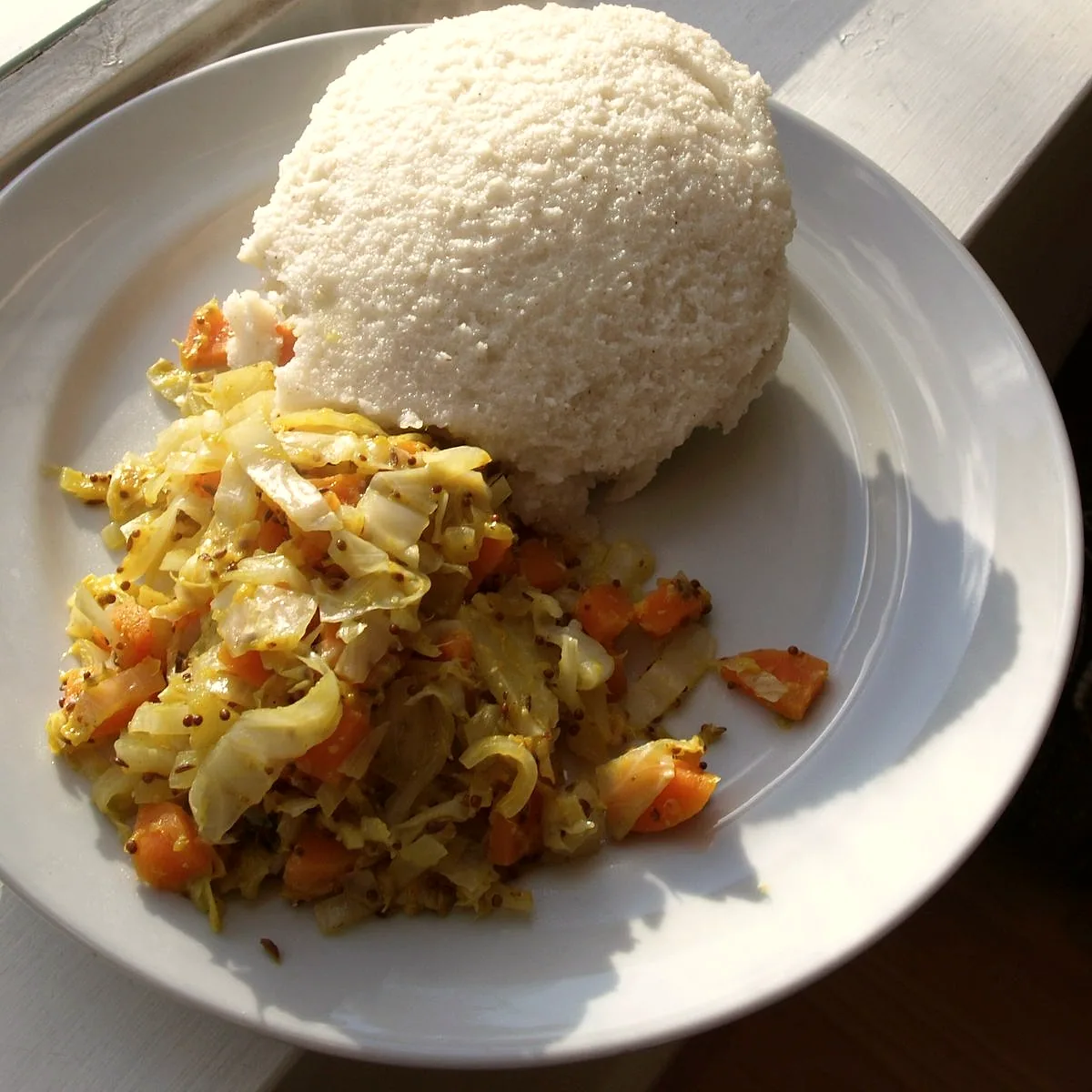

CC BY 2.0. Cropped and colour-adjusted for this site.
Method
Bring the 750 ml water and 5 g fine sea salt to a rolling boil in a heavy pot. This takes about 5m.
Reduce the heat slightly and add the 550 g white maize meal in a thin, steady stream, stirring constantly with a wooden spoon to stop lumps forming. This takes 3m.
Common pitfallTipping the maize meal in all at once seizes it into hard lumps that never fully break down. It goes in gradually, in a thin stream, with constant stirring.
Cover and simmer over a low heat for 12m, stirring every so often to stop the bottom catching, until the mixture has thickened into a dense mass.
Uncover and beat and fold the dough hard against the side of the pot for 10m, over the heat the whole time, until it is very stiff, smooth and turns over as one piece with no loose porridge left at the bottom. Turn out onto a plate as a single mound and serve hot.
Ugali is beaten far stiffer than most porridges get taken, to the point where the whole mass turns over as a single dome rather than sitting loose in the pot; that resistance under the spoon is what tells you it is ready.
Ugali is named from Swahili, but the grain it is made from is not native to East Africa. Maize arrived by way of Portuguese traders, brought initially to feed garrisons on the coast somewhere between the sixteenth and eighteenth centuries, well after sorghum and millet had already been established as the region's staple cereals for a very long time [1] [2]. For a long stretch after that, maize remained a minor crop rather than a staple one.
What changed its status was not the plant but colonial labour policy. From around the first two decades of the twentieth century, settler farms in Kenya paid their African workers partly in a daily ration of maize meal, known as posho, alongside beans and meat, and workers found the diet monotonous enough that cash wages gradually replaced it by the 1930s [2]. Maize suited the colonial economy for reasons that had nothing to do with taste: it demanded less labour to grow than sorghum or millet at a moment when men were being pulled into wage work, warfare and schooling, and once hammermills spread through the 1920s it could be milled into flour far faster than grains that first needed dehulling [2]. Production climbed accordingly, from roughly 750,000 bags in 1920 to nearly two million by the 1940s [2], and maize meal settled into the position sorghum and millet had held before it, a shift that, across the wider continent, is generally understood to have completed only in the second half of the twentieth century [1].
Ugali is also only one name among many for a dish repeated, with local variation, across most of the continent: the same stiff maize porridge is nsima in Malawi, sadza in Zimbabwe, pap in South Africa and posho in Uganda, among a great many other regional names for what is, at the level of technique, the same maize meal worked to the same dense, elastic consistency [1].
Sources
- Ugali, WikipediaCovers the Portuguese introduction of maize to Africa between the sixteenth and seventeenth centuries, its gradual adoption in place of sorghum and millet, the Swahili etymology of "ugali", and the dozens of regional names for the same dish across the continent.
- Cultivation, Commodification and Culture: Maize and Ugali in Kenya, The ElephantDetails maize's introduction to feed Portuguese coastal garrisons, colonial settler farms' use of maize-meal rations from around 1905, the spread of hammermills in the 1920s, and the production figures behind maize's rise to dominance.