Argentine · Main Course
Asado
Beef short ribs and chorizo cooked slowly over live coals, seasoned with nothing but salt, in the sequence of an Argentine parrilla.
Also known asAsado criollo · Argentina
Not the same asChurrasco (The Brazilian gaúcho method of skewering meat over an open fire or rotating it on a spit, usually with just rock salt, rather than the Argentine parrilla grate and its ordered sequence of achuras then cuts.)Picanha (A specific cut of beef rump cap, most often grilled whole and sliced against the grain to serve, not the wider live-fire cooking sequence asado describes.)
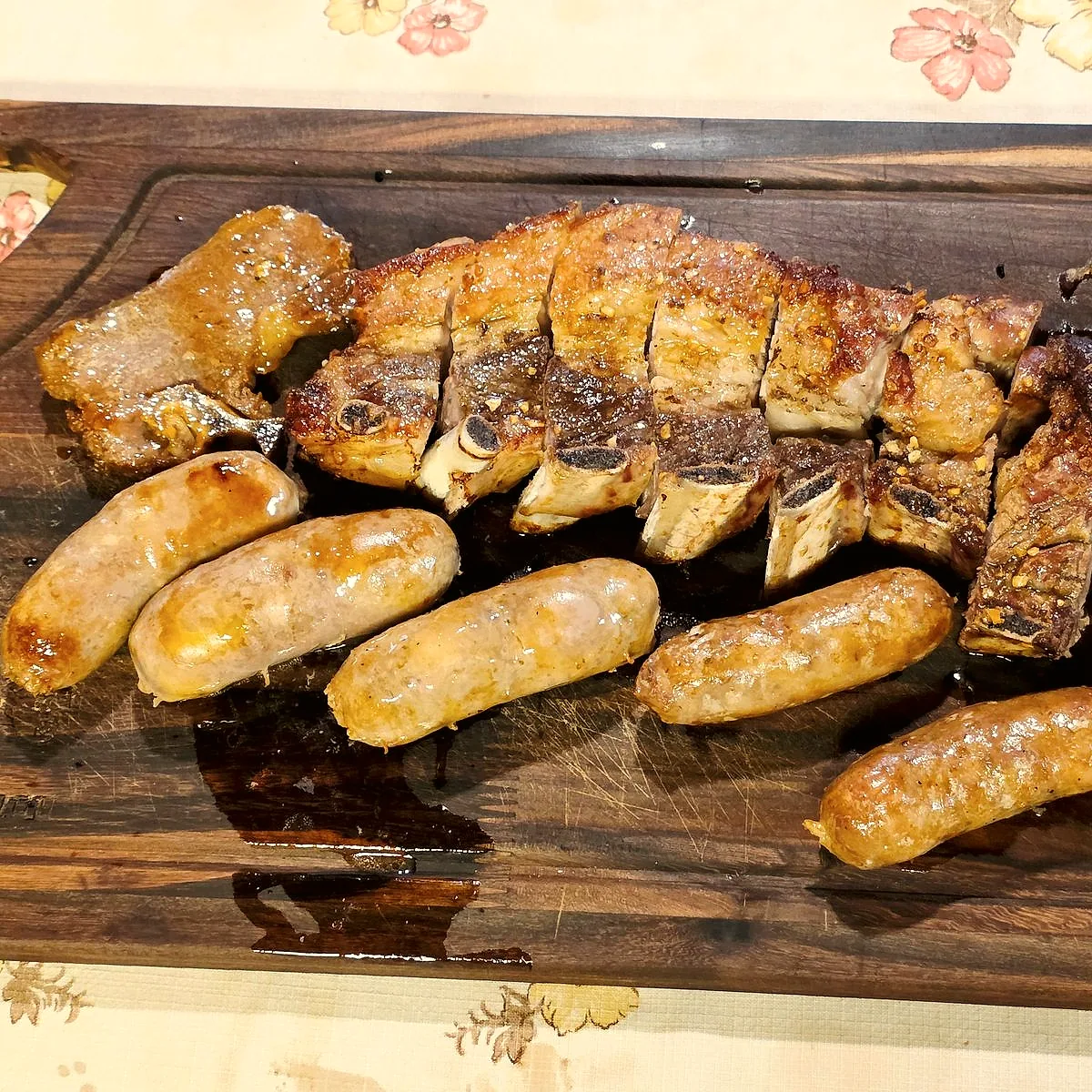
.jpg)
CC BY-SA 3.0. Cropped and colour-adjusted for this site.
Method
Light a wood or charcoal fire at one side of the grill and let it burn down for 40m, until it has stopped flaming and the coals are covered in grey ash. Rake a portion of the coals under the cooking grate to give a steady, moderate heat rather than a fierce one.
Season the 900 g raw beef short rib and 300 g raw chorizo all over with the 10 g fine sea salt.
Set the chorizo over the fire once the ribs are underway and grill for 20m, turning occasionally, until the casing is deeply coloured and the sausage is cooked through. Move it to a board and serve it first, sliced, while the ribs continue.
Set the short ribs bone side down over the fire and cook for 1h 30m, without turning more than once or twice, until the fat has rendered, the surface is deeply browned and the meat between the bones is tender enough to pull away easily.
Ribs go bone side down over a fire banked to one side rather than direct, fierce heat. The long, slow exposure renders the fat and softens the connective tissue between the bones without drying the meat, which a hot, fast grill cannot do.
Common pitfallTurning the ribs often, or moving them over the hottest part of the fire to hurry them along, sears the surface before the inside has rendered and dries the meat out. An asado is tended by adjusting the coals under the meat, not by moving the meat.
Move the ribs to a board and rest for 10m before cutting.
Cut the rack into individual ribs along the bones and serve at once.
Asado is older than the backyard grill it is now cooked on. Its roots are with the gauchos, the horsemen of the Argentine Pampas who worked and lived among the descendants of cattle brought to the region by Spanish colonisation, and whose numbers had multiplied into vast, unmanaged herds that roamed the grasslands from at least the eighteenth century until the mid-nineteenth [2][1]. Beef was abundant and land was not fenced, so a gaucho diet built almost entirely around it, cooked over an open fire, was as much a matter of what was available as of taste [1].
The technique that developed for it is largely the one still used: a side of ribs skewered on a metal frame and set beside, rather than over, a slow-burning fire, so the meat cooks through gently instead of scorching [1]. Quebracho, a dense regional hardwood, was the preferred fuel because it burns down to coals with very little smoke, leaving the meat's own flavour rather than the wood's. That fireside version (meat staked upright beside the coals rather than laid on a grate) survives today as asado a la cruz, still used for whole animals at large gatherings, while the smaller, everyday version has moved onto a raised grill, the parrilla, as Argentina urbanised.
Two things distinguish an asado from simply grilling beef. The first is sequence: chorizo and other achuras go on first and are eaten as the fire gets going, well before the main cuts are ready, so the meal unfolds in courses rather than arriving at once. The second is restraint: salt is usually the only seasoning, on the reasoning that a slow fire and a good cut need nothing else to taste of themselves. The same open-fire tradition spread under other names as it crossed borders, surfacing in Brazil as churrasco [1], though the two developed into recognisably different practices rather than remaining one dish under two words.
Sources
- Asado, Encyclopedia of Food and Culture (Encyclopedia.com)Reference-work entry on asado's technique and its place in the gaucho diet, citing the folklorist Félix Coluccio (1964) and the historian Richard W. Slatta (1983).
- Gaucho culture, WikipediaDescribes the emergence of gaucho culture from the sixteenth century and the wild cattle herds that made it possible.