Research Works
Bridging Polymer Science and Artificial Intelligence
My research explores the intersection of polymer reaction engineering and machine learning.
Rather than choosing between data-driven approaches and first-principles models, I work to combine their
strengths by bringing domain knowledge from polymer chemistry into neural networks and applying these
ML models back in the field. This tango between chemistry and AI has led to breakthroughs in predicting
polymer properties, modeling complex polymerization processes, and even real-time control of chemical reactors.
Part 1: Data-Driven Machine Learning
My journey began with pure data-driven approaches, training various ML models on experimental data to predict monomer/polymer properties that are difficult or time-consuming to measure. These foundational works demonstrated the power of ML in polymer science and highlighted both its potential and limitations.
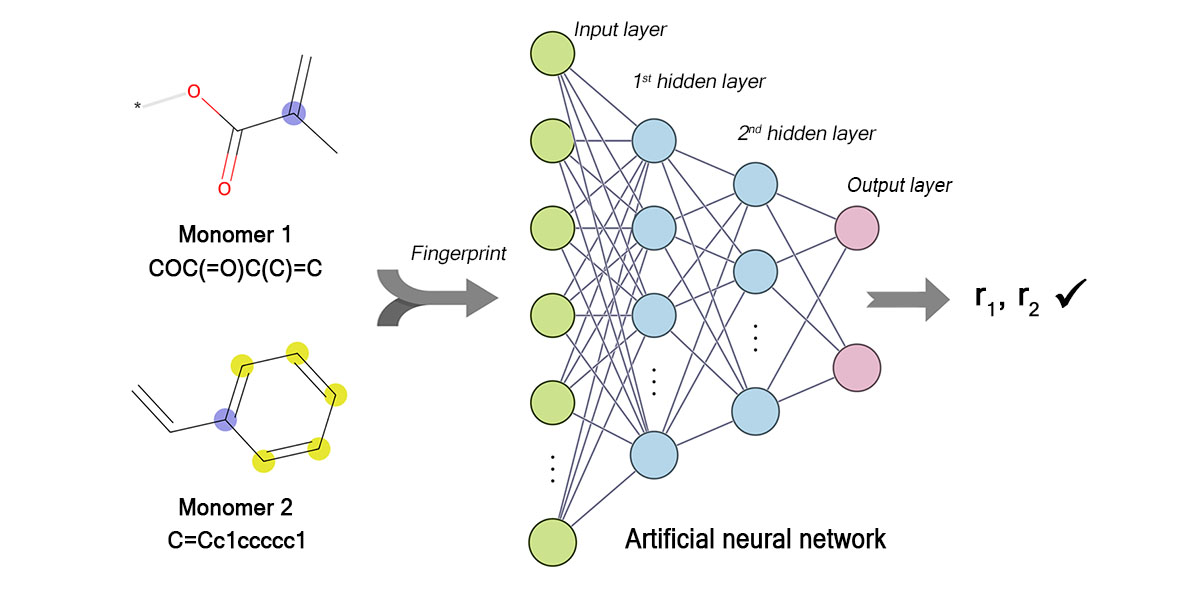
An artificial neural network to predict reactivity ratios in radical copolymerization
Reactivity ratios govern polymerization rate, copolymer composition, and sequence distribution, yet measuring them is notoriously difficult. We trained a neural network on 5,000+ monomer pairs from the Polymer Handbook that predicts these ratios purely from molecular structure, significantly outperforming the classical Q-e scheme and unlocking predictions for monomer pairs with no existing kinetic data.
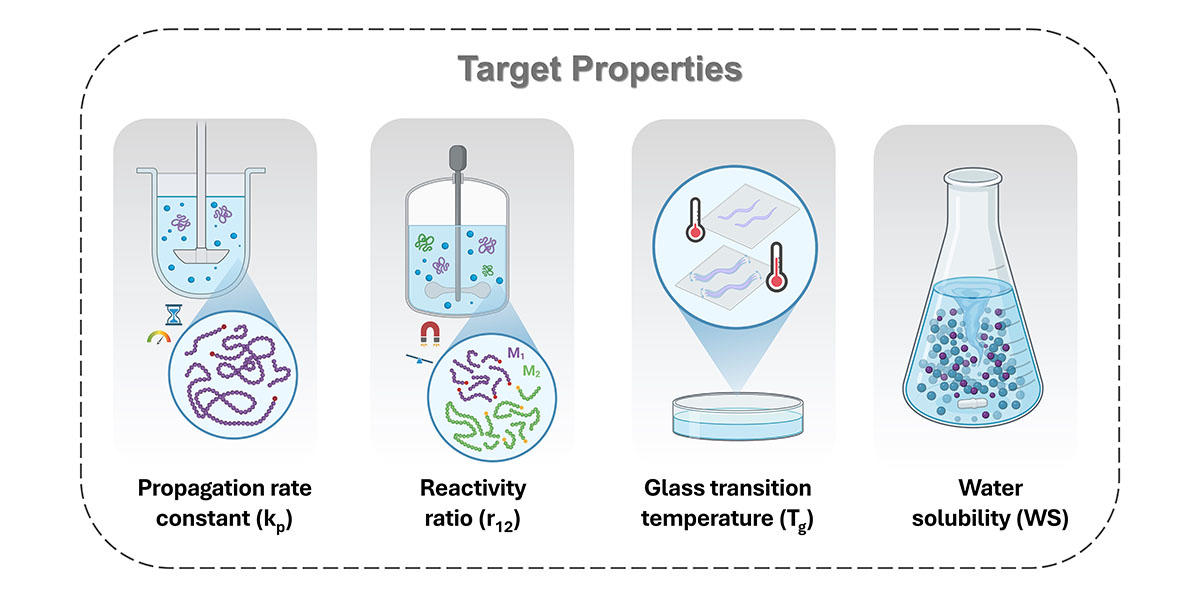
Multi-property ML Models to Accelerate the Transition Towards Bio-Based Polymers
Replacing oil-based monomers with sustainable bio-based alternatives demands simultaneous optimization of multiple properties. We built an integrated ML framework, combining neural networks and gradient boosting, that predicts propagation rate, reactivity ratios, glass transition temperature, and water solubility at once. Validated against real experimental case studies, the framework successfully identified bio-based replacements that match the performance of conventional systems.
Part 2: Informed Neural Networks
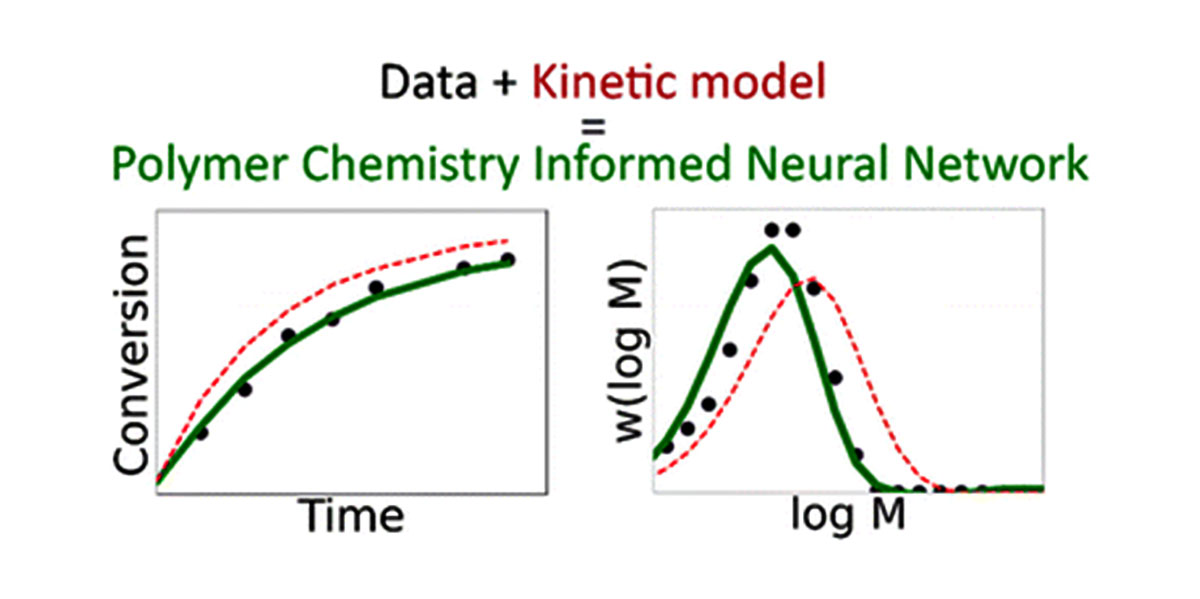
In polymer science and engineering, we don't have the luxury of abundant data. But even when we do have data, it would be a pity to use only the data while ignoring all the knowledge that the scientific community has developed over decades. This realization led us to pioneer polymer chemistry-informed neural networks (PCINNs). Inspired by physics-informed neural networks, this approach integrates domain knowledge from polymerization kinetics directly into the neural network training process. PCINNs combine the best of both worlds: the flexibility of machine learning with the reliability of first-principles chemistry, enabling us to build smarter models that respect the underlying science.
PCINNs for Predictive Models of Polymerization Processes: Solution
Neural networks typically demand large datasets and fail at extrapolation, two deal-breakers in polymer science. By weaving polymerization kinetic models directly into the training process, we showed that accurate predictive models can be built from limited data and imperfect theoretical models. Demonstrated for solution polymerization, PCINNs significantly outperform both conventional neural networks and existing first-principles kinetic models.
PCINNs for Predictive Models of Polymerization Processes: Emulsion
Emulsion polymerization is exceptionally challenging to model, as compartmentalized radical kinetics meet complex colloidal phenomena. We developed a PCINN for seeded semibatch emulsion polymerization of n-butyl acrylate that fuses first-principles knowledge with data-driven components. The result: substantially improved prediction accuracy over both mechanistic models and standard neural networks, fast enough to serve as an on-the-fly model for real-time industrial applications.
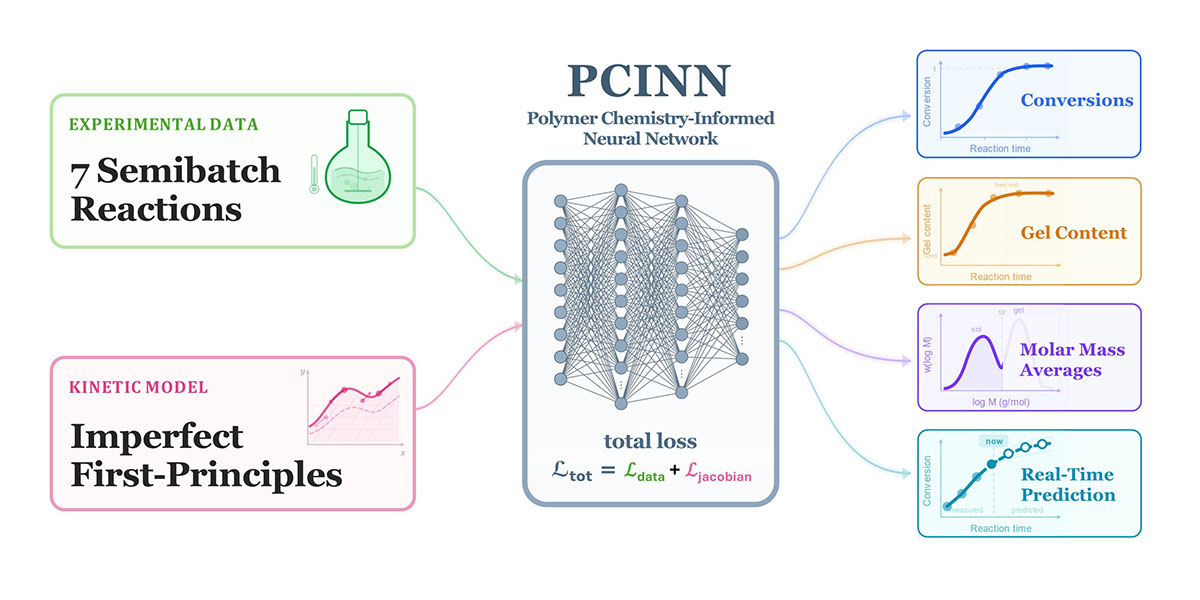
PCINNs for RAFT Polymerization with Active Learning Ongoing
Extending PCINNs into RAFT polymerization territory with three ambitious goals: optimizing kinetic rate constants using trained PINNs as fast surrogates, generating Pareto fronts via multi-objective optimization (NSGA-II) to balance competing objectives like conversion vs. residence time, and deploying active learning that uses ensemble prediction uncertainty to guide the selection of the next most informative experiment.
Part 3: Reinforcement Learning
Beyond prediction, I work to integrate machine learning directly into the chemical environment by creating AI agents that can control polymerization reactors in real-time. This interplay between the virtual and physical worlds represents the cutting edge of process control, where reinforcement learning agents learn optimal control strategies through interaction with reactor systems.
Reinforcement learning for the optimization and online control of polymerization reactors: Morphology
Online control of emulsion polymerization is hampered by process complexity and the impossibility of measuring particle morphology in real time. We showed in silico that reinforcement learning can train neural networks to select optimal control actions targeting desired morphology. A second neural network serves as a state estimator, enabling full online control of a property that cannot be directly measured, opening the door to truly autonomous reactor operation.
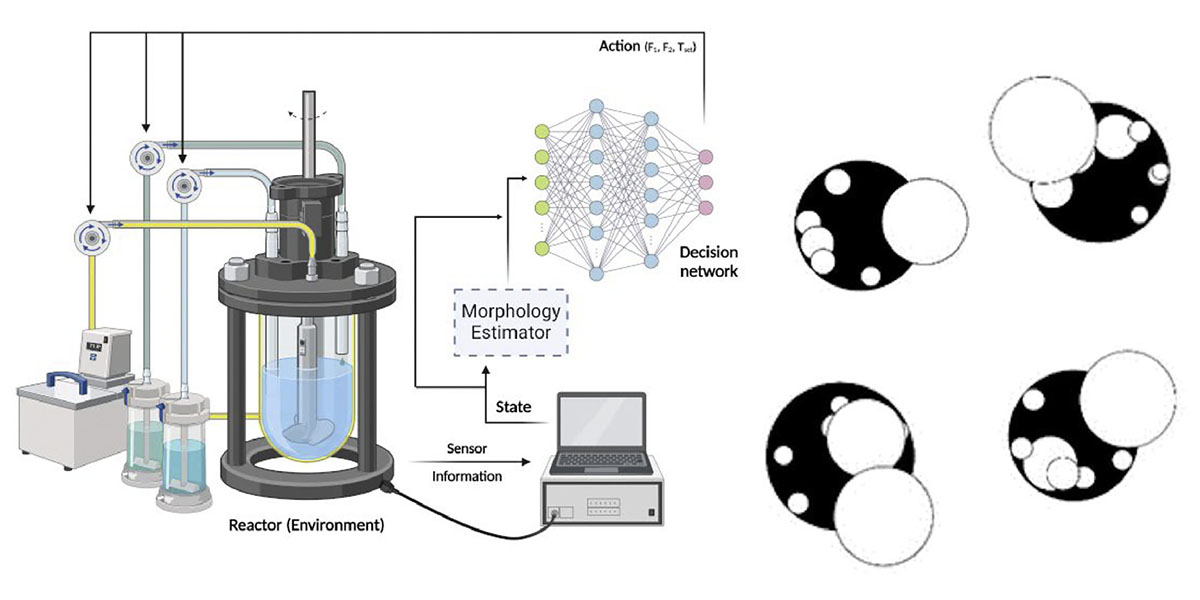
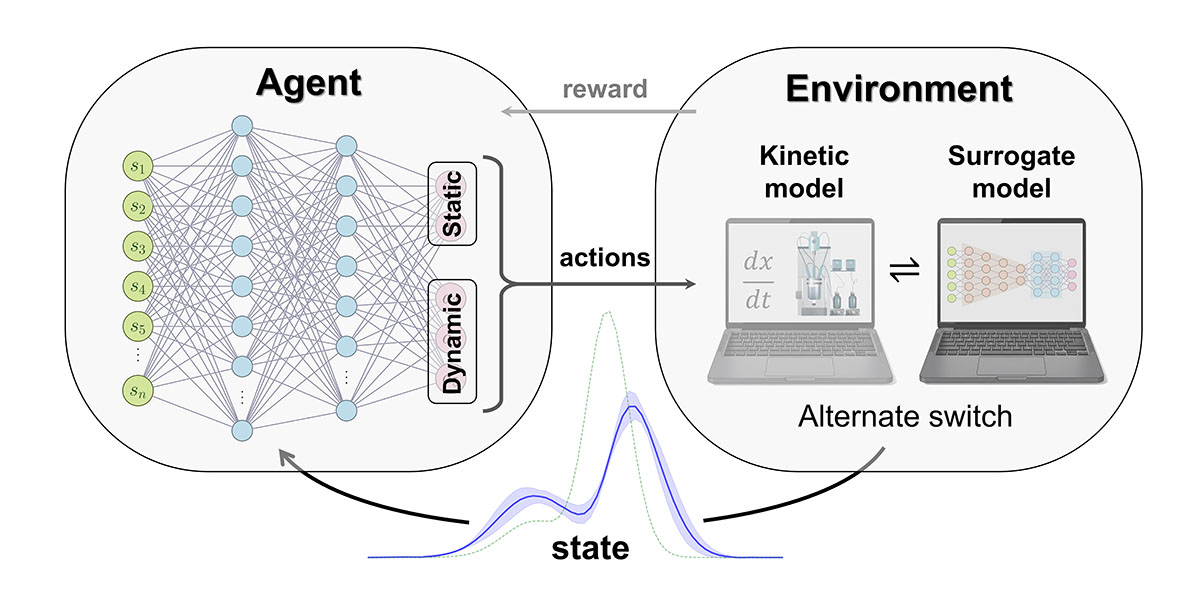
Reinforcement learning for the optimization and online control of polymerization reactors: MWD
Controlling molecular weight distribution of non-linear polymers with crosslinked and branched chains has been a notoriously intractable problem. We developed an RL-based control system for semi-batch emulsion polymerization of butyl acrylate that optimizes seed selection, feeding rates, and temperature while gracefully handling disturbances like pump errors. A surrogate neural network model slashes training time and gives operators predictive capabilities to evaluate strategies and anticipate outcomes in real time.
Real Laboratory Implementation of RL Control System in Emulsion Polymerization Processes Ongoing
From simulation to reality: the RL agent is now wired directly to our calorimetry reactor, controlling real polymerization processes in real time. This work represents the culmination of bridging AI and chemistry, demonstrating that machine learning can successfully operate physical chemical reactors autonomously.
Supporting Works
Behind every machine learning breakthrough lies robust foundational work. Developing accurate PCINNs and RL controllers for emulsion polymerization required first building reliable mechanistic models of the process itself. The work on n̄ value not only solved a long-standing measurement problem but also provided the modeling foundation that made our subsequent PCINN and RL work possible. And having built all kinds of models from the ground up, we gained a firsthand perspective on what works, what doesn't, and what's still missing. We channeled that experience, together with the literature, into a comprehensive review in Progress in Polymer Science that maps where this field has been and offers our vision for where it's headed.
The hidden secrets of the average number of radicals per particle (n̄)
Emulsion polymerization suffers from run-to-run variations because key characteristics, especially MMD of non-linear polymers, cannot be measured online. We discovered that n̄, easily obtained from calorimetric data, contains enough information to reconstruct the full radical distribution per particle. This unlocked accurate estimation of the effective termination rate and a soft sensor for online MMD estimation, offering for the first time the possibility of real-time MMD control for non-linear emulsion polymers.
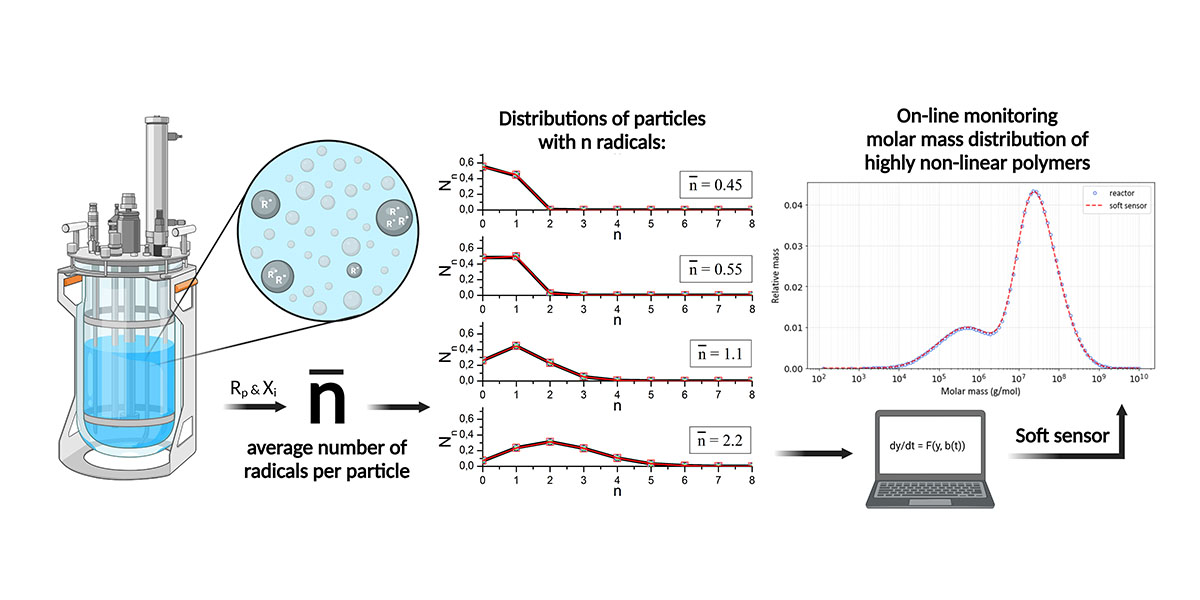
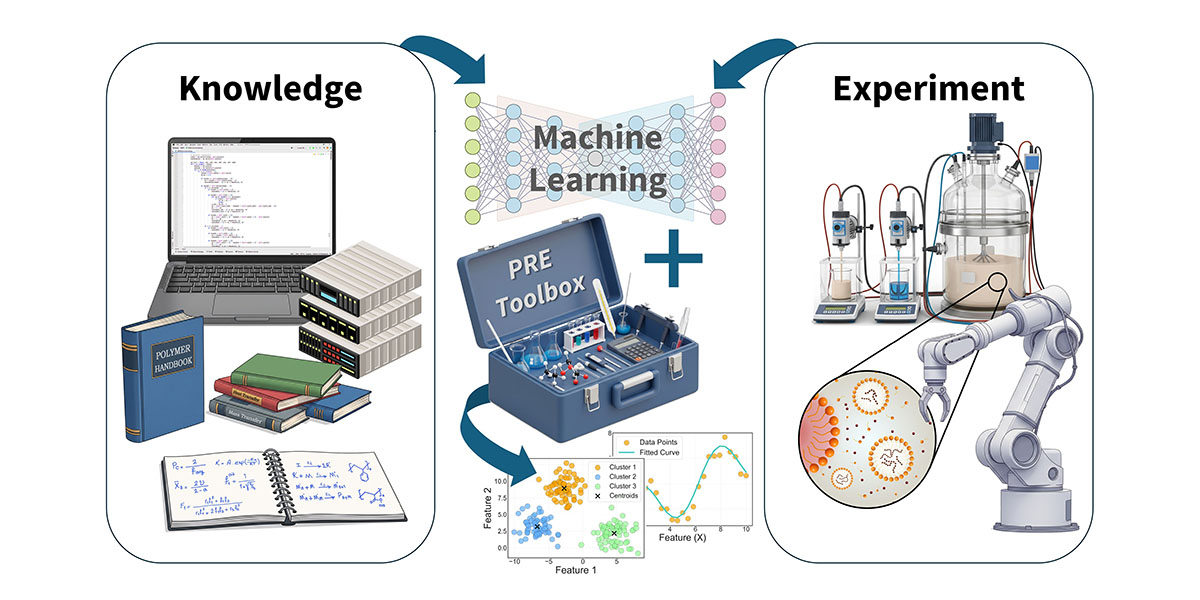
Adding Machine Learning to the Polymer Reaction Engineering Toolbox
A comprehensive review, published in the most prestigious journal in the polymer world, surveying how data-driven machine learning is reshaping polymer reaction engineering. We cover key ML techniques and their successful applications in polymeric systems, map where this nascent field has been, and show where it's headed.
Collaborations
Collaborative research expanding into related areas of polymer science and materials engineering.
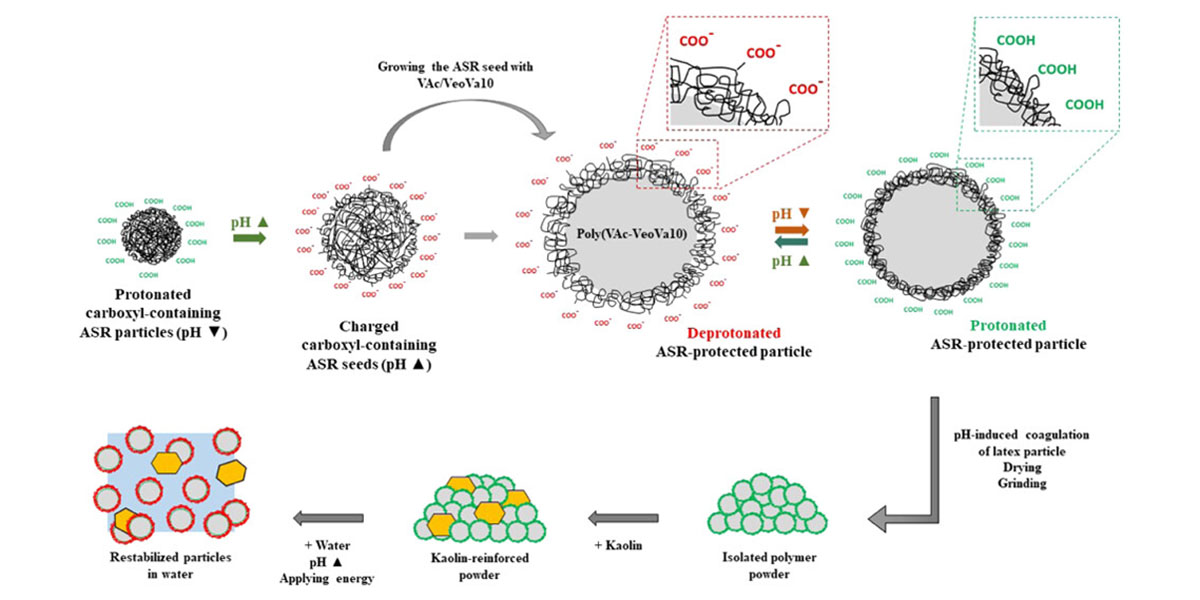
Alkali-Soluble Resins as pH-Responsive Protective Colloids
Emulsion polymers are widely used in adhesives, coatings, and construction, often preferred in dry form for storage and transportation. We investigated pH-switchable alkali-soluble resins as stabilizers that enable controlled coagulation for dry polymer isolation, followed by restabilization in water. Low Tg particles stabilized by high Tg resins were successfully isolated via pH-controlled coagulation, dried, ground, and restabilized, demonstrating a practical route for switchable emulsion polymer systems.